



 Chat with AI
Exam 27: Amino Acids and Proteins

Exam 1: Covalent Bonding and Shapes of Molecules118 Questions
Exam 2: Alkanes and Cycloalkanes101 Questions
Exam 3: Stereoisomerism and Chirality95 Questions
Exam 4: Acids and Bases94 Questions
Exam 5: Alkenes: Bonding, Nomenclature, and Properties88 Questions
Exam 6: Reactions of Alkenes97 Questions
Exam 7: Alkynes100 Questions
Exam 8: Haloalkanes, Halogenation, and Radical Reactions75 Questions
Exam 9: Nucleophilic Substitution and Beta-Elimination104 Questions
Exam 10: Alcohols102 Questions
Exam 11: Ethers, Epoxides, and Sulfides102 Questions
Exam 12: Infrared Spectroscopy74 Questions
Exam 13: Nuclear Magnetic Resonance Spectroscopy99 Questions
Exam 14: Mass Spectrometry75 Questions
Exam 15: An Introduction to Organometallic Compounds73 Questions
Exam 16: Aldehydes and Ketones122 Questions
Exam 17: Carboxylic Acids76 Questions
Exam 18: Functional Derivatives of Carboxylic Acids117 Questions
Exam 19: Enolate Anions and Enamines96 Questions
Exam 20: Dienes, Conjugated Systems, and Pericyclic Reactions75 Questions
Exam 21: Benzene and the Concept of Aromaticity77 Questions
Exam 22: Reactions of Benzene and Its Derivatives109 Questions
Exam 23: Amines92 Questions
Exam 24: Catalytic Carbon-Carbon Bond Formation84 Questions
Exam 25: Carbohydrates69 Questions
Exam 26: Lipids65 Questions
Exam 27: Amino Acids and Proteins77 Questions
Exam 28: Nucleic Acids58 Questions
Exam 29: Organic Polymer Chemistry68 Questions
Select questions type


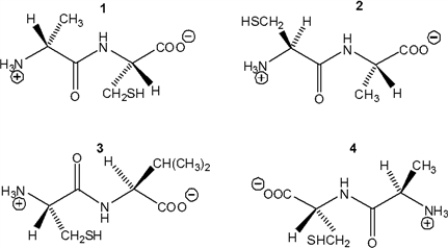
Which of the following amino acids migrates to the positive electrode on paper electrophoresis at a pH of 7.0?
(Multiple Choice)
4.9/5  (84)
(84) Identify the function of the following group in protein synthesis. 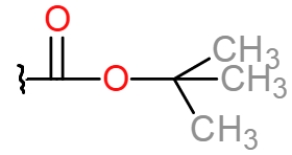
(Multiple Choice)
4.8/5 (90)
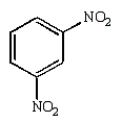
(90) 
What are the R/S designations of the two stereocenters of L-threonine? 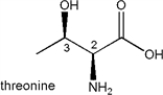
(Multiple Choice)
4.9/5 (84)
(84) Consider the following image. 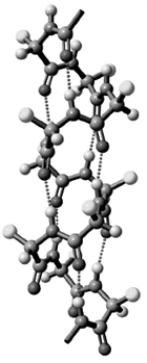 This represents the tertiary structure of a protein.
 (True/False)
4.8/5 (81)
(81) MATCH a structure from the list below to each of the following terms. Place the letter of the structure in the blank to the left of the term which it describes.
-_____ is a peptide coupling reagent.
(Multiple Choice)
4.9/5 (70)
(70) 
In terms of the number of amino acid residues Cys-Ile-Ser-Asp-Gly-His-Gly-Gly would be classified as a(n) ________________.
(Short Answer)
4.9/5 (84)
(84) To what structural feature does the term "tertiary structure" refer?
(Multiple Choice)
4.9/5 (79)
(79) Which of the following is a definition of the isoelectric point of an amino acid?
(Multiple Choice)
4.8/5 (81)
(81) Which of the following is not a strategy for the synthesis of polypeptides?
(Multiple Choice)
4.9/5 (78)
(78) What is the approximate value of the pKa of the α-NH3+ of amino acids?
(Multiple Choice)
4.8/5 (76)
(76) In the Edman degradation analysis of the N-terminus of a peptide the terminal residue reacts with phenyl isocyanate, an example is shown below. Provide the structure of both of the products of this reaction. 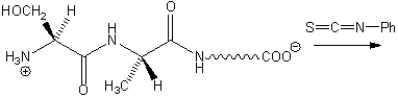
(Essay)
4.7/5 (81)
(81) The Edman degradation is used to identify the ___-terminal amino acid of a peptide.
(Short Answer)
4.9/5 (87)
(87) The structure of the phenylhydantoin derived from the _____ cycle of the Edman degradation of Phe-Ala-Ser is 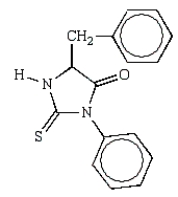
(Short Answer)
4.9/5 (67)
(67) 
Filters
- Essay(0)
- Multiple Choice(0)
- Short Answer(0)
- True False(0)
- Matching(0)