



 Chat with AI
Exam 12: Infrared Spectroscopy

Exam 1: Covalent Bonding and Shapes of Molecules118 Questions
Exam 2: Alkanes and Cycloalkanes101 Questions
Exam 3: Stereoisomerism and Chirality95 Questions
Exam 4: Acids and Bases94 Questions
Exam 5: Alkenes: Bonding, Nomenclature, and Properties88 Questions
Exam 6: Reactions of Alkenes97 Questions
Exam 7: Alkynes100 Questions
Exam 8: Haloalkanes, Halogenation, and Radical Reactions75 Questions
Exam 9: Nucleophilic Substitution and Beta-Elimination104 Questions
Exam 10: Alcohols102 Questions
Exam 11: Ethers, Epoxides, and Sulfides102 Questions
Exam 12: Infrared Spectroscopy74 Questions
Exam 13: Nuclear Magnetic Resonance Spectroscopy99 Questions
Exam 14: Mass Spectrometry75 Questions
Exam 15: An Introduction to Organometallic Compounds73 Questions
Exam 16: Aldehydes and Ketones122 Questions
Exam 17: Carboxylic Acids76 Questions
Exam 18: Functional Derivatives of Carboxylic Acids117 Questions
Exam 19: Enolate Anions and Enamines96 Questions
Exam 20: Dienes, Conjugated Systems, and Pericyclic Reactions75 Questions
Exam 21: Benzene and the Concept of Aromaticity77 Questions
Exam 22: Reactions of Benzene and Its Derivatives109 Questions
Exam 23: Amines92 Questions
Exam 24: Catalytic Carbon-Carbon Bond Formation84 Questions
Exam 25: Carbohydrates69 Questions
Exam 26: Lipids65 Questions
Exam 27: Amino Acids and Proteins77 Questions
Exam 28: Nucleic Acids58 Questions
Exam 29: Organic Polymer Chemistry68 Questions
Select questions type


MATCH each of the following molecules to the region of the infrared spectrum in which they may show a significant absorption. Place the letter of the region in the blank to the left of the bond-type.
-_______
CH3CH2OCH(CH3)

Free
(Multiple Choice)
4.9/5  (84)
(84) Correct Answer: Verified
D
Which of the following compounds gives an infrared spectrum with no significant peaks at ∼3300 cm−1 or 1600-1680 cm−1? 
Free
(Multiple Choice)
4.9/5 (86)
(86) Correct Answer:Verified
VerifiedB
Provide the structure of three compounds with the molecular formula C4H8O that give an absorption peak at 1600-1640 cm-1 in the infrared spectrum, but no significant peaks at 3000-3600 cm-1 or at 1650-1750 cm-1.
Free
(Essay)
4.9/5 (100)
(100) Correct Answer:Verified
VerifiedAny three of the following: 
Which of the following regions in the electromagnetic spectrum corresponds to the radiation with the longest wavelength?
(Multiple Choice)
4.8/5 (89)
(89) How could you distinguish between 1-hexyne and 2-hexyne by infrared spectroscopy? 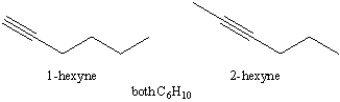
(Essay)
4.9/5 (92)
(92) MATCH each of the following groups of bond-types to the region of the infrared spectrum in which their absorptions occur. Place the letter of the region in the blank to the left of the bond-type.
-_____ C−C, C−O, C−N, and C−X single-bond vibrations.
(Multiple Choice)
4.7/5 (68)
(68) Which of the following bonds (circled) gives the weakest absorbance in the infrared spectrum? 
(Multiple Choice)
5.0/5 (80)
(80) Which of the following bonds gives rise to a strong absorbance at approximately 1630-1820 cm−1 in the infrared spectrum?
(Multiple Choice)
4.9/5 (86)
(86) How could you distinguish between methyl butanoate and pentanoic acid by infrared spectroscopy? 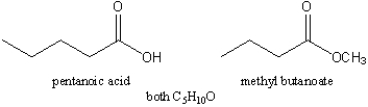
(Essay)
4.9/5 (73)
(73) Which of the following functional groups is likely to be present in a molecule that has peaks in the infrared spectrum at 1630-1820 cm−1 (strong, broad), but does not have peaks at 3200-3650 or 1000-1250 cm−1
(Multiple Choice)
4.9/5 (83)
(83) Provide a brief explanation to account for the observation that the frequency of the C=O stretching absorption in the infrared spectrum of N,N-dimethylacetamide, CH3CON(CH3)2, is higher than that of methyl acetate, CH3CO2CH3.
(Essay)
4.9/5 (69)
(69) Which of the following compounds gives a carbonyl bond absorption at the highest frequency? 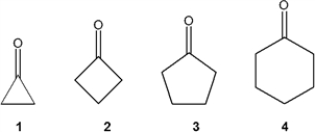
(Multiple Choice)
4.8/5 (65)
(65) How could you distinguish between 1-butanol and diethyl ether by infrared spectroscopy? 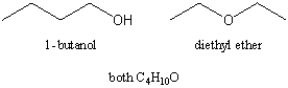
(Essay)
4.9/5 (76)
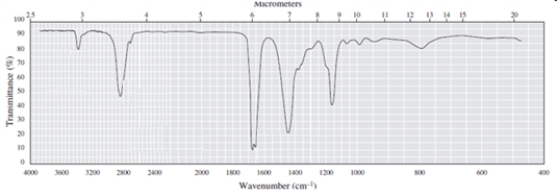
(76) Label three peaks in the following spectrum with the bond that gives rise to them, and identify the functional group that is present in the compound (the compound has a formula of C4H9NO)?
(Essay)
4.9/5 (74)
(74) In terms of the electromagnetic spectrum, 2870 cm−1 represents lower energy than 2.91 × 10¹⁶ Hz.
(True/False)
4.8/5 (72)
(72) Provide a brief explanation to account for the observation that the frequency of the C=O stretching absorption in the infrared spectrum of 2-butanone is higher than that of 3-buten-2-one.
(Essay)
4.7/5 (69)
(69) Which of the following bonds gives rise to a strong, broad, absorbance at approximately 3200-3650 cm−1 in the infrared spectrum?
(Multiple Choice)
4.8/5 (83)
(83) The region of the IR spectrum between 1500 - 400 cm-1 would be significantly different for the following two substances? 
(True/False)
4.8/5 (82)
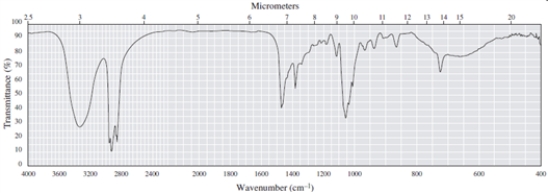
(82) Label three peaks in the following spectrum with the bond that gives rise to them, and identify the functional group that is present in the compound (the compound has a formula of C6H14O)?
(Essay)
5.0/5 (69)
(69) MATCH each of the following molecules to the region of the infrared spectrum in which they may show a significant absorption. Place the letter of the region in the blank to the left of the bond-type.
-_______
(Multiple Choice)
4.8/5 (86)
(86) 
Filters
- Essay(0)
- Multiple Choice(0)
- Short Answer(0)
- True False(0)
- Matching(0)