



 Chat with AI
Exam 12: Infrared Spectroscopy

Exam 1: Covalent Bonding and Shapes of Molecules118 Questions
Exam 2: Alkanes and Cycloalkanes101 Questions
Exam 3: Stereoisomerism and Chirality95 Questions
Exam 4: Acids and Bases94 Questions
Exam 5: Alkenes: Bonding, Nomenclature, and Properties88 Questions
Exam 6: Reactions of Alkenes97 Questions
Exam 7: Alkynes100 Questions
Exam 8: Haloalkanes, Halogenation, and Radical Reactions75 Questions
Exam 9: Nucleophilic Substitution and Beta-Elimination104 Questions
Exam 10: Alcohols102 Questions
Exam 11: Ethers, Epoxides, and Sulfides102 Questions
Exam 12: Infrared Spectroscopy74 Questions
Exam 13: Nuclear Magnetic Resonance Spectroscopy99 Questions
Exam 14: Mass Spectrometry75 Questions
Exam 15: An Introduction to Organometallic Compounds73 Questions
Exam 16: Aldehydes and Ketones122 Questions
Exam 17: Carboxylic Acids76 Questions
Exam 18: Functional Derivatives of Carboxylic Acids117 Questions
Exam 19: Enolate Anions and Enamines96 Questions
Exam 20: Dienes, Conjugated Systems, and Pericyclic Reactions75 Questions
Exam 21: Benzene and the Concept of Aromaticity77 Questions
Exam 22: Reactions of Benzene and Its Derivatives109 Questions
Exam 23: Amines92 Questions
Exam 24: Catalytic Carbon-Carbon Bond Formation84 Questions
Exam 25: Carbohydrates69 Questions
Exam 26: Lipids65 Questions
Exam 27: Amino Acids and Proteins77 Questions
Exam 28: Nucleic Acids58 Questions
Exam 29: Organic Polymer Chemistry68 Questions
Select questions type


Which of the following functional groups is likely to be present in a molecule that has peaks in the infrared spectrum at 1630-1820 cm−1 (strong, broad) and 1000-1250 cm−1; but does not have peaks at 3200-3650 cm−1?
(Multiple Choice)
4.8/5  (88)
(88) The area in the infrared spectrum between 1400 and 400 cm-1 is called the functional group region.
(True/False)
4.8/5 (92)
(92) Assume you are carrying out the conversion of 1-bromobutane to 1-butanol. How could you use IR spectroscopy to determine when the reaction is complete?  As the reaction progress the 3400−3640 cm−1 IR band should increase in intensity.
 (True/False)
4.9/5 (82)
(82) The given molecule shows two absorption peaks, each at 1760 cm−1 and 1810 cm−1. The peaks are due to the _____. 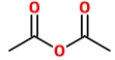
(Multiple Choice)
4.7/5 (85)
(85) Examining the infrared spectrum of a compound allows us to determine the nature of the conjugated pi electron system in the compound.
(True/False)
4.9/5 (87)
(87) What is required for a bond to give an infrared absorption?
(Multiple Choice)
4.7/5 (74)
(74) Which of the following bonds (circled) vibrates at the highest frequency? 
(Multiple Choice)
4.8/5 (78)
(78) Provide the structure of four compounds with the molecular formula C5H10O which give a strong absorption peak at 1700-1740 cm-1 in the infrared spectrum, but no significant peaks at 1600-1640 cm-1 .
(Essay)
4.8/5 (93)
(93) Which of the following processes takes place upon absorption of infrared radiation?
(Multiple Choice)
4.8/5 (82)
(82) MATCH each of the following groups of bond-types to the region of the infrared spectrum in which their absorptions occur. Place the letter of the region in the blank to the left of the bond-type.
-_____ N−H, C−H, and O−H stretching and bending motions.
(Multiple Choice)
4.9/5 (70)
(70) The vertical axis on an IR spectrum represents the percent transmission and the horizontal axis measures frequency (wavenumber).
(True/False)
4.8/5 (84)
(84) The "n" values for ethanol and carbon dioxide are given below. The total numbers of fundamental vibrations observed in ethanol and carbon dioxide are _____ and _____, respectively.
Molecule
CH3CH2OH
CO2
N
5
3
(Multiple Choice)
4.8/5 (85)
(85) Which of the following carbon-carbon bonds undergoes stretching at the highest frequency?
(Multiple Choice)
4.9/5 (75)
(75) MATCH a structure from the list below to the following IR spectra. Place the letter of the structure in the blank provided.
-_____ 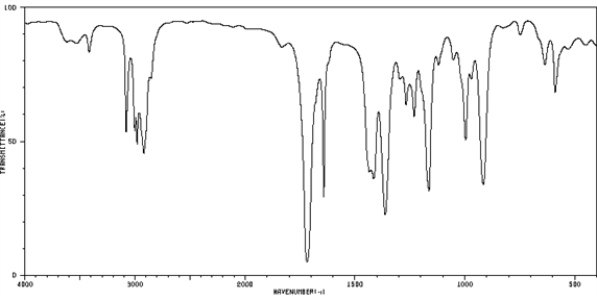 Spectrum obtained from: SDBSWeb: http://www.aist.go.jp/RIODB/SDBS/
 (Multiple Choice)
5.0/5 (81)
(81) What is the wavenumber of a radiation with a wavelength of 5.0 × 10⁻⁵ m?
(Multiple Choice)
4.9/5 (84)
(84) Which of the following functional groups is likely to be present in a molecule that has peaks in the infrared spectrum at 1000-1250 cm−1 (strong), but does not have peaks 3200-3650 at 1630-1820 or cm−1?
(Multiple Choice)
4.9/5 (69)
(69) What are the units of wavenumber, , in infrared spectroscopy?
(Multiple Choice)
4.8/5 (54)
(54) Which of the following compounds gives an infrared spectrum with peaks at 3000-3500 cm−1 and ∼1750 cm−1? 
(Multiple Choice)
4.9/5 (86)
(86) Provide a brief explanation to account for the observation that 1-butyne gives a significantly stronger peak at ∼1250 cm-1 in the infrared spectrum than 2-butyne..
(Essay)
4.7/5 (88)
(88) 
Filters
- Essay(0)
- Multiple Choice(0)
- Short Answer(0)
- True False(0)
- Matching(0)