



 Chat with AI
Exam 15: Oligopoly and Antitrust Policy

Exam 1: Economics and Economic Reasoning121 Questions
Exam 2: The Production Possibility Model, Trade, and Globalization111 Questions
Exam 3: Economic Institutions144 Questions
Exam 4: Supply and Demand151 Questions
Exam 5: Using Supply and Demand136 Questions
Exam 6: Describing Supply and Demand: Elasticities176 Questions
Exam 7: Taxation and Government Intervention169 Questions
Exam 8: Market Failure Versus Government Failure160 Questions
Exam 9: Comparative Advantage, Exchange Rates, and Globalization107 Questions
Exam 10: International Trade Policy82 Questions
Exam 11: Production and Cost Analysis I160 Questions
Exam 12: Production and Cost Analysis II129 Questions
Exam 13: Perfect Competition137 Questions
Exam 14: Monopoly and Monopolistic Competition231 Questions
Exam 15: Oligopoly and Antitrust Policy111 Questions
Exam 16: Real-World Competition and Technology86 Questions
Exam 17: Work and the Labor Market130 Questions
Exam 18: Who Gets What the Distribution of Income100 Questions
Exam 19: The Logic of Individual Choice: the Foundation of Supply and Demand134 Questions
Exam 20: Game Theory, Strategic Decision Making, and Behavioral Economics76 Questions
Exam 21: Thinking Like a Modern Economist67 Questions
Exam 22: Behavioral Economics and Modern Economic Policy87 Questions
Exam 23: Microeconomic Policy, Economic Reasoning, and Beyond111 Questions
Select questions type


Which is the most likely solution to addressing the market power of new firms such as Google and Facebook?
(Multiple Choice)
4.8/5  (79)
(79) The central element of the oligopoly model is that each firm produces a differentiated product.
(True/False)
4.8/5 (79)
(79) Refer to the table above. Using the four-firm concentration ratio, the upholstered furniture industry is best categorized as: Industry Number of sellers \% of shipments accuunted far by the 4 larget comnanies Tires 15 95 Upholstered furniture 2,000 15
(Multiple Choice)
4.8/5 (83)
(83) In the ALCOA antitrust case in 1945, the Court ruled that the:
(Multiple Choice)
4.9/5 (80)
(80) When government uses the judgment by performance criterion, a firm is considered a monopoly if it controls a significant segment of the market.
(True/False)
4.9/5 (78)
(78) According to the contestable market model, the higher an industry's concentration ratio, the more profitable the industry.
(True/False)
4.7/5 (71)
(71) From society's perspective, a possible benefit of a cartel is that it could:
(Multiple Choice)
4.7/5 (81)
(81) Refer to the graph shown. If a firm operating as if it were faced with a kinked demand curve believes that if it lowers price from P2 to P4, its rival will match the price cut, then: 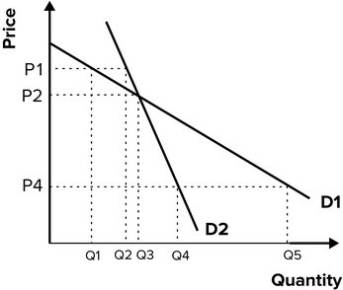
(Multiple Choice)
4.9/5 (87)
(87) According to the kinked demand curve theory of sticky prices, in an oligopolistic market:
(Multiple Choice)
4.9/5 (70)
(70) The higher an industry's concentration ratio is, the more competitive the industry is.
(True/False)
4.7/5 (66)
(66) An important antitrust concern about new companies such as Google and Facebook is that they:
(Multiple Choice)
4.8/5 (67)
(67) One advantage of the Herfindahl index over the concentration ratio is that it:
(Multiple Choice)
4.8/5 (76)
(76) In the cartel model of oligopoly, the firms would decide how much to produce where:
(Multiple Choice)
4.8/5 (74)
(74) According to the contestable market model, if there are no barriers to entry or exit, the price an oligopolist sets will be equivalent to average total cost.
(True/False)
4.8/5 (74)
(74) The primary criterion governing U.S. antitrust policy until 1945 was:
(Multiple Choice)
4.8/5 (83)
(83) When government uses the judgment by structure criterion, a firm is considered a monopoly only if, for example, it charges excessive prices.
(True/False)
4.9/5 (83)
(83) An attorney for a firm that is arguing that its market is competitive rather than monopolistic would be most likely to argue that the relevant market is shown by a:
(Multiple Choice)
4.9/5 (82)
(82) An important way in which globalization changed U.S. antitrust policy is:
(Multiple Choice)
4.9/5 (80)
(80) For a cartel to be successful in increasing economic profits for its members:
(Multiple Choice)
4.7/5 (79)
(79) 
Filters
- Essay(0)
- Multiple Choice(0)
- Short Answer(0)
- True False(0)
- Matching(0)