



 Chat with AI
Exam 15: Oligopoly and Antitrust Policy

Exam 1: Economics and Economic Reasoning121 Questions
Exam 2: The Production Possibility Model, Trade, and Globalization111 Questions
Exam 3: Economic Institutions144 Questions
Exam 4: Supply and Demand151 Questions
Exam 5: Using Supply and Demand136 Questions
Exam 6: Describing Supply and Demand: Elasticities176 Questions
Exam 7: Taxation and Government Intervention169 Questions
Exam 8: Market Failure Versus Government Failure160 Questions
Exam 9: Comparative Advantage, Exchange Rates, and Globalization107 Questions
Exam 10: International Trade Policy82 Questions
Exam 11: Production and Cost Analysis I160 Questions
Exam 12: Production and Cost Analysis II129 Questions
Exam 13: Perfect Competition137 Questions
Exam 14: Monopoly and Monopolistic Competition231 Questions
Exam 15: Oligopoly and Antitrust Policy111 Questions
Exam 16: Real-World Competition and Technology86 Questions
Exam 17: Work and the Labor Market130 Questions
Exam 18: Who Gets What the Distribution of Income100 Questions
Exam 19: The Logic of Individual Choice: the Foundation of Supply and Demand134 Questions
Exam 20: Game Theory, Strategic Decision Making, and Behavioral Economics76 Questions
Exam 21: Thinking Like a Modern Economist67 Questions
Exam 22: Behavioral Economics and Modern Economic Policy87 Questions
Exam 23: Microeconomic Policy, Economic Reasoning, and Beyond111 Questions
Select questions type


In the contestable market model, an oligopoly with no barriers to entry sets a:
(Multiple Choice)
4.8/5  (79)
(79) If individuals were fully rational, financing services such as social networks and search engines by selling data collected on consumers would be:
(Multiple Choice)
4.9/5 (91)
(91) When the FTC investigated whether firms conspired to fix prices of computer memory called dynamic random-access memory (DRAM) chips, Samsung, Micron Technology, Hynix Semiconductor, and Infineon controlled more than 75 percent of the market for DRAM chips. The market for these chips is most likely:
(Multiple Choice)
5.0/5 (76)
(76) Refer to the graph shown. If a firm operating as if it were faced with a kinked demand curve believes that if it raises price from P2 to P1, its rival will not go along, then: 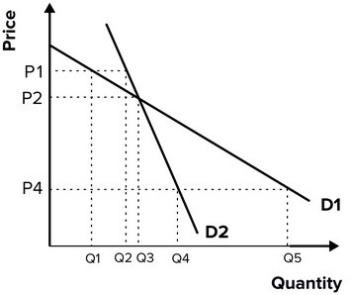
(Multiple Choice)
4.7/5 (85)
(85) The Herfindahl index and the concentration ratio fail to give a complete picture of an economy's competitiveness because:
(Multiple Choice)
4.7/5 (83)
(83) Which of the following market structures does not have predictable price and output decisions at which the firms will arrive rationally?
(Multiple Choice)
4.9/5 (83)
(83) Firms base decisions on the decisions of other firms in the market in:
(Multiple Choice)
4.8/5 (74)
(74) The basis of judgment for the Standard Oil case was ________, whereas the basis of judgment for the ALCOA case was ________:
(Multiple Choice)
4.9/5 (64)
(64) One reason fewer antitrust cases have been brought before the courts is:
(Multiple Choice)
5.0/5 (86)
(86) Analyzing each action of a firm on a case-by-case basis to determine if it is in violation of the antitrust laws is generally called judgment by:
(Multiple Choice)
4.9/5 (64)
(64) Competition in markets defined as platform monopolies is most likely to come from:
(Multiple Choice)
4.8/5 (86)
(86) The contestable market model of oligopoly bases pricing and output decisions on:
(Multiple Choice)
4.9/5 (87)
(87) When judging the competitiveness of markets by the size and number of firms in that market, one is using the:
(Multiple Choice)
4.8/5 (99)
(99) In the North American Industry Classification System (NAICS) classification system, the broadest classification would be:
(Multiple Choice)
4.7/5 (80)
(80) The Sherman Antitrust Act of 1890 was passed primarily because of:
(Multiple Choice)
4.7/5 (81)
(81) If a profit-maximizing oligopolist has a kinked demand curve, a downward shift in its marginal cost curve:
(Multiple Choice)
4.9/5 (71)
(71) 
Filters
- Essay(0)
- Multiple Choice(0)
- Short Answer(0)
- True False(0)
- Matching(0)