



 Chat with AI
Exam 15: Oligopoly and Antitrust Policy

Exam 1: Economics and Economic Reasoning121 Questions
Exam 2: The Production Possibility Model, Trade, and Globalization111 Questions
Exam 3: Economic Institutions144 Questions
Exam 4: Supply and Demand151 Questions
Exam 5: Using Supply and Demand136 Questions
Exam 6: Describing Supply and Demand: Elasticities176 Questions
Exam 7: Taxation and Government Intervention169 Questions
Exam 8: Market Failure Versus Government Failure160 Questions
Exam 9: Comparative Advantage, Exchange Rates, and Globalization107 Questions
Exam 10: International Trade Policy82 Questions
Exam 11: Production and Cost Analysis I160 Questions
Exam 12: Production and Cost Analysis II129 Questions
Exam 13: Perfect Competition137 Questions
Exam 14: Monopoly and Monopolistic Competition231 Questions
Exam 15: Oligopoly and Antitrust Policy111 Questions
Exam 16: Real-World Competition and Technology86 Questions
Exam 17: Work and the Labor Market130 Questions
Exam 18: Who Gets What the Distribution of Income100 Questions
Exam 19: The Logic of Individual Choice: the Foundation of Supply and Demand134 Questions
Exam 20: Game Theory, Strategic Decision Making, and Behavioral Economics76 Questions
Exam 21: Thinking Like a Modern Economist67 Questions
Exam 22: Behavioral Economics and Modern Economic Policy87 Questions
Exam 23: Microeconomic Policy, Economic Reasoning, and Beyond111 Questions
Select questions type


The top four firms in the industry have 10 percent, 8 percent, 8 percent, and 6 percent of the market. The four-firm concentration ratio of this market is:
(Multiple Choice)
4.9/5  (82)
(82) One of the reasons fewer antitrust cases have been brought before the courts is:
(Multiple Choice)
4.9/5 (81)
(81) Taking explicit account of a rival's expected response to a decision you are making is called:
(Multiple Choice)
4.7/5 (86)
(86) Refer to the graph shown. The oligopolist shown currently charges a price P1. It believes that rival firms will: 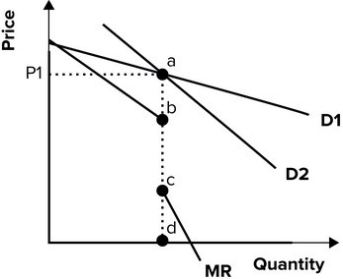
(Multiple Choice)
4.9/5 (72)
(72) The higher the concentration ratio in a given industry, the:
(Multiple Choice)
4.8/5 (82)
(82) Judgment by performance means that the competitiveness of a market is determined by:
(Multiple Choice)
4.9/5 (93)
(93) In the market for bank credit, a large bank sometimes announces a change in interest rates. After the changes in interest rates are announced, other banks in the industry usually react by changing their rates in the same way. This is an example of:
(Multiple Choice)
4.8/5 (79)
(79) A four-firm concentration ratio of 75 tells you that the top:
(Multiple Choice)
5.0/5 (85)
(85) Which of the following is a problem associated with judging competitiveness by structure?
(Multiple Choice)
4.8/5 (82)
(82) The oligopoly model is the only model that explicitly considers how the pricing and output decisions of one firm affect other firms.
(True/False)
4.7/5 (77)
(77) The only way to judge monopoly is to use both structure and performance criterion simultaneously.
(True/False)
4.8/5 (67)
(67) Refer to the graph shown, which shows an oligopolist facing a kinked demand curve. The firm will not increase price when marginal costs fluctuate between which two points? 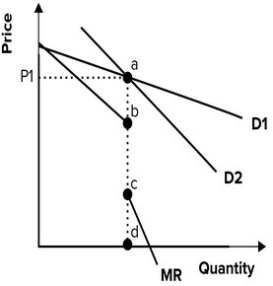
(Multiple Choice)
5.0/5 (84)
(84) When OPEC reduces output to keep prices high, OPEC is acting as a:
(Multiple Choice)
4.7/5 (94)
(94) If an industry has a Herfindahl index of 3,000, the contestable market model probably would predict that the industry would be more likely to have a:
(Multiple Choice)
4.8/5 (77)
(77) One of the reasons fewer antitrust cases have been brought before the courts is:
(Multiple Choice)
4.8/5 (81)
(81) Suppose there are only four airlines that service the air route between two cities. If there is a barrier to entering the market (such as a limited number of gates), the market is best characterized as:
(Multiple Choice)
4.8/5 (77)
(77) Which of the following is an argument in favor of judging competitiveness by performance rather than structure?
(Multiple Choice)
4.9/5 (77)
(77) A market has the following characteristics: There is strategic pricing, output is somewhat restricted, there is interdependent decision making, and some long-run economic profits are possible. This market is:
(Multiple Choice)
4.7/5 (78)
(78) 
Filters
- Essay(0)
- Multiple Choice(0)
- Short Answer(0)
- True False(0)
- Matching(0)