



 Chat with AI
Exam 7: The Economy at Full Employment

Exam 1: Introduction: What Is Economics144 Questions
Exam 2: The Key Principles of Economics195 Questions
Exam 3: Exchange and Markets135 Questions
Exam 4: Demand, Supply, and Market Equilibrium279 Questions
Exam 5: Measuring a Nations Production and Income161 Questions
Exam 6: Unemployment and Inflation206 Questions
Exam 7: The Economy at Full Employment165 Questions
Exam 8: Why Do Economies Grow203 Questions
Exam 9: Aggregate Demand and Aggregate Supply189 Questions
Exam 10: Fiscal Policy166 Questions
Exam 11: The Income-Expenditure Model265 Questions
Exam 12: Investment and Financial Markets179 Questions
Exam 13: Money and the Banking System184 Questions
Exam 14: The Federal Reserve and Monetary Policy203 Questions
Exam 15: Modern Macroeconomics: From the Short Run to the Long Run176 Questions
Exam 16: The Dynamics of Inflation and Unemployment186 Questions
Exam 17: Macroeconomic Policy Debates143 Questions
Exam 18: International Trade and Public Policy226 Questions
Exam 19: The World of International Finance189 Questions
Select questions type


The production function is Y = 2K0.5L0.5. If there are 121 units of capital and 225 units of labor, aggregate output is:
(Multiple Choice)
4.8/5  (83)
(83) In a production function that is graphed with output on the y- axis and labor on the x- axis, a decrease in the labor stock is illustrated as:
(Multiple Choice)
4.8/5 (72)
(72) What happens to the number of workers a firm wants to hire if the wage falls? Explain.
(Essay)
4.8/5 (85)
(85) An increase in the size of the capital stock will shift the production function up.
(True/False)
4.8/5 (67)
(67) According to the real business cycle theory, an adverse change in technology:
(Multiple Choice)
4.9/5 (76)
(76) 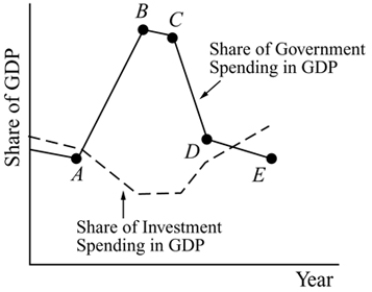 Figure 7.4
-From Figure 7.4, crowding out occurs between:
If the capital stock remains fixed while the supply of labor increases, it is likely that:
(Multiple Choice)
4.8/5 (75)
(75) The tendency for increases in government spending to cause reductions in private saving is known as the crowding out effect.
(True/False)
4.7/5 (86)
(86) 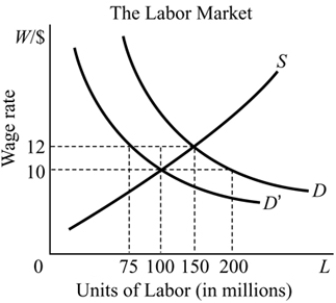 Figure 7.3
-Refer to Figure 7.3. The classical economists argued the wage rate will _______ from _______ if the demand for labor changes from D' to D.
Figure 7.3
-Refer to Figure 7.3. The classical economists argued the wage rate will _______ from _______ if the demand for labor changes from D' to D. (Multiple Choice)
4.8/5 (76)
(76) Recall Application 1, "The Black Death and the Living Standards in Old England," to answer the following questions:
-From the application, the decline in the real wages of laborers in England from the time after the plague until the 1800s implies that during this period:
(Multiple Choice)
4.7/5 (94)
(94) According to the real business cycle theory, technological progress is responsible for fluctuations in output.
(True/False)
4.9/5 (66)
(66) If the production function is Y = 3K, then an increase in capital (K) by 1 unit would
(Multiple Choice)
4.8/5 (78)
(78) If Y is total output, K is the capital stock and L is the total labor input stock, which of the following represents a production function?
(Multiple Choice)
4.8/5 (79)
(79) Recall Application 1, "The Black Death and the Living Standards in Old England," to answer the following questions:
-According to the application, which economist made the observation all the way back in the 19th century that maladies such as plagues would cause a temporary increase in living standard?
(Multiple Choice)
4.9/5 (85)
(85) Recall Application 2, "A Nobel Laureate Explains Why Europeans Work Less than U.S. workers or the Japanese," to answer the following questions:
-Taking into account all taxes, the tax burden in the Europe is higher than in Japan.
(True/False)
4.9/5 (81)
(81) Because GDP must be divided among competing demands in the economy, we should expect:
(Multiple Choice)
4.9/5 (69)
(69) Recall Application 3, "Can Labor Market Policies Account for the Great Depression," to answer the following questions:
-According to the application, what was observed during the Great Depression that contradicts the basic real business cycles?
(Multiple Choice)
4.9/5 (73)
(73) If the classical models provided an accurate description of the workings of the economy during the Great Depression, then:
(Multiple Choice)
4.8/5 (78)
(78) 
Filters
- Essay(0)
- Multiple Choice(0)
- Short Answer(0)
- True False(0)
- Matching(0)