



 Chat with AI
Exam 7: The Economy at Full Employment

Exam 1: Introduction: What Is Economics144 Questions
Exam 2: The Key Principles of Economics195 Questions
Exam 3: Exchange and Markets135 Questions
Exam 4: Demand, Supply, and Market Equilibrium279 Questions
Exam 5: Measuring a Nations Production and Income161 Questions
Exam 6: Unemployment and Inflation206 Questions
Exam 7: The Economy at Full Employment165 Questions
Exam 8: Why Do Economies Grow203 Questions
Exam 9: Aggregate Demand and Aggregate Supply189 Questions
Exam 10: Fiscal Policy166 Questions
Exam 11: The Income-Expenditure Model265 Questions
Exam 12: Investment and Financial Markets179 Questions
Exam 13: Money and the Banking System184 Questions
Exam 14: The Federal Reserve and Monetary Policy203 Questions
Exam 15: Modern Macroeconomics: From the Short Run to the Long Run176 Questions
Exam 16: The Dynamics of Inflation and Unemployment186 Questions
Exam 17: Macroeconomic Policy Debates143 Questions
Exam 18: International Trade and Public Policy226 Questions
Exam 19: The World of International Finance189 Questions
Select questions type


What was observed about labor markets during the Great Depression that was not explained by classical models? This was also what most models developed after the Great Depression tried to explain.
(Multiple Choice)
4.9/5  (89)
(89) A tax on labor causes a smaller drop in equilibrium wages when:
(Multiple Choice)
4.8/5 (70)
(70) "Diminishing returns to labor occurs additional units of labor decreases total production." Do you agree or disagree? Explain.
(Essay)
4.8/5 (75)
(75) 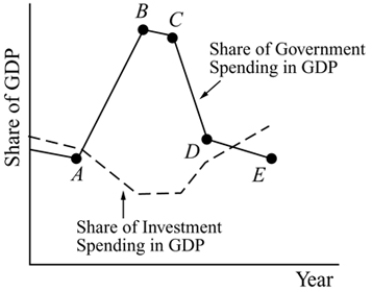 Figure 7.4
-From Figure 7.4, crowding in did not occur between:
Figure 7.4
-From Figure 7.4, crowding in did not occur between: (Multiple Choice)
5.0/5 (80)
(80) What happens to the equilibrium wage rate in the US and Canada when more Canadian workers migrate to the United States?
(Multiple Choice)
4.9/5 (85)
(85) 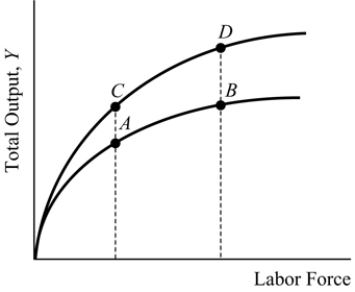 Figure 7.1
-Please refer to Figure 7.1. Suppose the economy is at point D. A health pandemic that results in the loss of the lives to countless workers will:
Figure 7.1
-Please refer to Figure 7.1. Suppose the economy is at point D. A health pandemic that results in the loss of the lives to countless workers will: (Multiple Choice)
4.9/5 (75)
(75) Which of the following must be true when it is observed that government spending is causing crowding out?
(Multiple Choice)
4.7/5 (76)
(76) 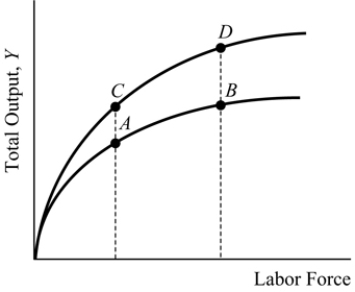 Figure 7.1
-Please refer to Figure 7.1. Suppose the economy is at point D. A war that destroys factories will:
Figure 7.1
-Please refer to Figure 7.1. Suppose the economy is at point D. A war that destroys factories will: (Multiple Choice)
4.7/5 (83)
(83) According to the real business cycle theory, shocks to aggregate demand and shocks to aggregate supply both cause fluctuations in output.
(True/False)
4.9/5 (79)
(79) The level of full- employment output in an economy increases as:
(Multiple Choice)
4.9/5 (75)
(75) Which of the following would not be considered part of the stock of capital?
(Multiple Choice)
4.9/5 (80)
(80) Which of the following would not cause an increase in output?
(Multiple Choice)
4.9/5 (71)
(71) An increase in the productivity of workers shifts the labor _______ curve to the _______.
(Multiple Choice)
4.8/5 (85)
(85) If the real business cycle theory were correct, then the recession that the U.S. experienced in 2008 was caused by:
(Multiple Choice)
4.8/5 (96)
(96) 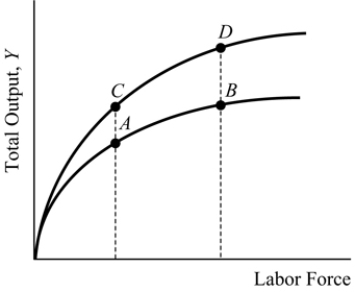 Figure 7.1
-Please refer to Figure 7.1. The production function that passes through points A and B exhibits
Figure 7.1
-Please refer to Figure 7.1. The production function that passes through points A and B exhibits (Multiple Choice)
4.9/5 (76)
(76) In macroeconomics, the term "classical" refers to a school of economics that believed that
(Multiple Choice)
5.0/5 (77)
(77) When constructing a production function between labor and output, which is drawn on the x- axis?
(Multiple Choice)
4.9/5 (78)
(78) The horizontal axis of the production function typically measures:
(Multiple Choice)
4.8/5 (83)
(83) Recall Application 1, "The Black Death and the Living Standards in Old England," to answer the following questions:
-From the application, if the industrial revolution occurred right around the time of the bubonic plague, then we would expect to see the real wage rate of laborers in England to be:
(Multiple Choice)
4.9/5 (73)
(73) 
Filters
- Essay(0)
- Multiple Choice(0)
- Short Answer(0)
- True False(0)
- Matching(0)