



 Chat with AI
Exam 7: The Economy at Full Employment

Exam 1: Introduction: What Is Economics144 Questions
Exam 2: The Key Principles of Economics195 Questions
Exam 3: Exchange and Markets135 Questions
Exam 4: Demand, Supply, and Market Equilibrium279 Questions
Exam 5: Measuring a Nations Production and Income161 Questions
Exam 6: Unemployment and Inflation206 Questions
Exam 7: The Economy at Full Employment165 Questions
Exam 8: Why Do Economies Grow203 Questions
Exam 9: Aggregate Demand and Aggregate Supply189 Questions
Exam 10: Fiscal Policy166 Questions
Exam 11: The Income-Expenditure Model265 Questions
Exam 12: Investment and Financial Markets179 Questions
Exam 13: Money and the Banking System184 Questions
Exam 14: The Federal Reserve and Monetary Policy203 Questions
Exam 15: Modern Macroeconomics: From the Short Run to the Long Run176 Questions
Exam 16: The Dynamics of Inflation and Unemployment186 Questions
Exam 17: Macroeconomic Policy Debates143 Questions
Exam 18: International Trade and Public Policy226 Questions
Exam 19: The World of International Finance189 Questions
Select questions type


Which of the following would be counted as part of the stock of capital?
(Multiple Choice)
4.7/5  (81)
(81) The mathematical representation of the technological relationship between inputs and national output is known as the:
(Multiple Choice)
4.9/5 (81)
(81) Recall Application 2, "A Nobel Laureate Explains Why Europeans Work Less than U.S. workers or the Japanese," to
answer the following questions:
-According to the application, Europeans work less hours than Americans because
(Multiple Choice)
4.8/5 (78)
(78) Can the basic real business cycle model explain unemployment? Explain.
(Essay)
4.7/5 (84)
(84) Graphically illustrate an increase in labor demand and explain its impact on the equilibrium wage rate and quantities.
(Essay)
4.8/5 (71)
(71) Classical economists believed that recessions were self correcting. In their view, how did the economy self correct?
(Essay)
4.8/5 (81)
(81) The production function described in the chapter assumes that:
(Multiple Choice)
4.9/5 (85)
(85) According to the Classical model, an excess supply of labor would drive up wages to a new equilibrium level and therefore unemployment would not persist.
(True/False)
4.9/5 (74)
(74) A tax on labor causes a larger drop in equilibrium wages when:
(Multiple Choice)
5.0/5 (79)
(79) According to the book, the estimate of the natural rate of unemployment in the U.S. in recent years is between:
(Multiple Choice)
4.8/5 (78)
(78) When the U.S. economy experienced a recession and the unemployment rate increased to over 10 percent, does this imply that the potential output of the economy decreased?
(Essay)
5.0/5 (86)
(86) 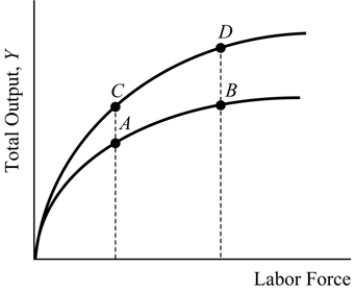 Figure 7.1
-Please refer to Figure 7.1. Suppose the economy is at point A. An increase in the capital stock will:
Figure 7.1
-Please refer to Figure 7.1. Suppose the economy is at point A. An increase in the capital stock will: (Multiple Choice)
4.9/5 (60)
(60) In a closed economy, crowding out occurs when an increase in government spending results in:
(Multiple Choice)
4.7/5 (69)
(69) The full- employment level of output changes with the supply of labor.
(True/False)
4.8/5 (75)
(75) Ignoring income effects, an increase in the wage rate will cause an increase in the quantity of labor supplied.
(True/False)
4.7/5 (81)
(81) 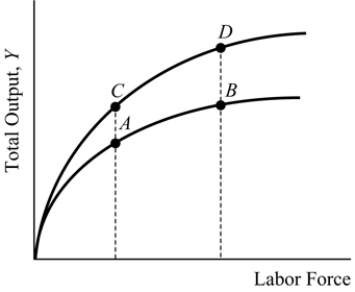 Figure 7.1
-Please refer to Figure 7.1. Suppose the economy is at point A. An increase in the labor force will:
Figure 7.1
-Please refer to Figure 7.1. Suppose the economy is at point A. An increase in the labor force will: (Multiple Choice)
4.8/5 (69)
(69) 
Filters
- Essay(0)
- Multiple Choice(0)
- Short Answer(0)
- True False(0)
- Matching(0)