



 Chat with AI
Exam 7: The Economy at Full Employment

Exam 1: Introduction: What Is Economics144 Questions
Exam 2: The Key Principles of Economics195 Questions
Exam 3: Exchange and Markets135 Questions
Exam 4: Demand, Supply, and Market Equilibrium279 Questions
Exam 5: Measuring a Nations Production and Income161 Questions
Exam 6: Unemployment and Inflation206 Questions
Exam 7: The Economy at Full Employment165 Questions
Exam 8: Why Do Economies Grow203 Questions
Exam 9: Aggregate Demand and Aggregate Supply189 Questions
Exam 10: Fiscal Policy166 Questions
Exam 11: The Income-Expenditure Model265 Questions
Exam 12: Investment and Financial Markets179 Questions
Exam 13: Money and the Banking System184 Questions
Exam 14: The Federal Reserve and Monetary Policy203 Questions
Exam 15: Modern Macroeconomics: From the Short Run to the Long Run176 Questions
Exam 16: The Dynamics of Inflation and Unemployment186 Questions
Exam 17: Macroeconomic Policy Debates143 Questions
Exam 18: International Trade and Public Policy226 Questions
Exam 19: The World of International Finance189 Questions
Select questions type


The number of hours worked per worker in the U.S. is higher than in Japan.
(True/False)
4.9/5  (77)
(77) Because a tax on labor makes labor more expensive and raises the marginal cost of hiring workers, it follows that:
(Multiple Choice)
5.0/5 (84)
(84) Recall Application 1, "The Black Death and the Living Standards in Old England," to answer the following questions:
-According to the application, the higher real wages in England during the 1350s through the 1550s was caused by:
(Multiple Choice)
4.9/5 (80)
(80) Using the real business cycle theory, explain how a significant technological improvement can alter the equilibrium employment level and the output level.
(Essay)
4.8/5 (65)
(65) Explain what happens to the equilibrium real wage when the firms makes investments to increase the capital stock.
(Essay)
4.9/5 (78)
(78) What happens to the labor supply curves in the U.S. and Canada when Canadian workers migrate to the United States?
(Multiple Choice)
4.8/5 (79)
(79) In a production function that is graphed with output on the y- axis and labor on the x- axis, an increase in the labor stock is illustrated as:
(Multiple Choice)
4.9/5 (86)
(86) If the production function is Y = 3K, then an increase in labor (L) by one unit would
(Multiple Choice)
4.7/5 (79)
(79) 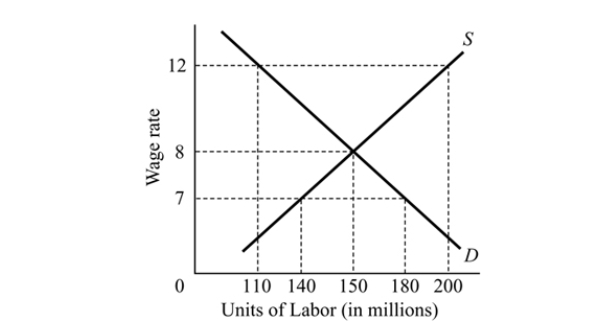 Figure 7.2
-Refer to Figure 7.2. At wage rate $7, there is a _______ of labor equal to _______ million people.
Figure 7.2
-Refer to Figure 7.2. At wage rate $7, there is a _______ of labor equal to _______ million people. (Multiple Choice)
4.7/5 (92)
(92) Recall Application 1, "The Black Death and the Living Standards in Old England," to answer the following questions:
-From the application, the lack of growth in the real wages of laborers in England from the 1200s to the 180s implies that during this period:
(Multiple Choice)
4.8/5 (88)
(88) The idea that wages and prices adjust freely and quickly to changes in the demand and supply is adopted and defended by:
(Multiple Choice)
5.0/5 (76)
(76) The production function is the mathematical representation of the technological relationship between:
(Multiple Choice)
4.8/5 (68)
(68) A tax on labor causes a smaller drop in equilibrium employment when:
(Multiple Choice)
4.9/5 (86)
(86) A tax on labor causes a larger drop in equilibrium employment when:
(Multiple Choice)
4.9/5 (67)
(67) The production function described in the chapter assumes that with a fixed capital stock, increases in the labor input results in increases in output at a decreasing rate. This relationship between labor and output is known as:
(Multiple Choice)
4.8/5 (67)
(67) Suppose that the U.S. has an open economy and is currently at full employment. When the country ends its war in Afghanistan and cuts military spending, crowding in will take the form of:
(Multiple Choice)
4.9/5 (83)
(83) 
Filters
- Essay(0)
- Multiple Choice(0)
- Short Answer(0)
- True False(0)
- Matching(0)