



 Chat with AI
Exam 2: Physical Biochemistry: Energy Conversion, Water, and Membranes

Exam 1: Principles of Biochemistry100 Questions
Exam 2: Physical Biochemistry: Energy Conversion, Water, and Membranes100 Questions
Exam 3: Nucleic Acid Structure and Function100 Questions
Exam 4: Protein Structure100 Questions
Exam 5: Methods in Protein Biochemistry100 Questions
Exam 6: Protein Function114 Questions
Exam 7: Enzyme Mechanisms106 Questions
Exam 8: Cell Signaling Systems102 Questions
Exam 9: Glycolysis: a Paradigm of Metabolic Regulation100 Questions
Exam 10: The Citrate Cycle100 Questions
Exam 11: Oxidative Phosphorylation99 Questions
Exam 12: Photosynthesis100 Questions
Exam 13: Carbohydrate Structure and Function100 Questions
Exam 14: Carbohydrate Metabolism100 Questions
Exam 15: Lipid Structure and Function100 Questions
Exam 16: Lipid Metabolism100 Questions
Exam 17: Amino Acid Metabolism100 Questions
Exam 18: Nucleotide Metabolism99 Questions
Exam 19: Metabolic Integration101 Questions
Exam 20: DNA Replication, Repair, and Recombination99 Questions
Exam 21: RNA Synthesis, Processing, and Gene Silencing100 Questions
Exam 22: Protein Synthesis, Posttranslational Modification, and Transport100 Questions
Exam 23: Gene Regulation100 Questions
Select questions type


Calculate G for a reaction given H = 15.4 kJ/mole and S = 2.0 J/K at 298 K. Is this reaction spontaneous in the forward direction?
(Essay)
4.9/5  (73)
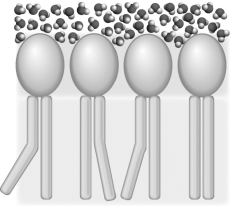
(73) Using the figure below, explain how having unsaturated fatty acid tails on phospholipids affects the fluidity of the membrane.
(Essay)
4.8/5 (76)
(76) Calculate the pH of a solution that contains 3.9 *10- 4M H+.
(Multiple Choice)
4.9/5 (78)
(78) Energy conversion in a biological system operates under constant and constant _.
(Multiple Choice)
4.7/5 (76)
(76) List the three chemical properties of ATP that account for the large standard free energy change that occurs when a phosphoanhydride bond is cleaved.
(Essay)
4.8/5 (74)
(74) Red blood cells are placed into a solution of unknown solute concentration. After an hour they have all burst open. The best explanation is that the solution
(Multiple Choice)
4.8/5 (69)
(69) The inclusion of cholesterol in a membrane can change the behavior of the membrane. Compare how the membrane behaves at low cholesterol concentration compared with high cholesterol concentration.
(Essay)
4.8/5 (72)
(72) Under steady-state conditions in a mammalian cell, the adenine nucleotide concentrations are [ATP] = 3.3 mM, [ADP] = 1.2 mM, and [AMP] = 0.2 mM. What is the energy charge of this cell?
(Multiple Choice)
4.8/5 (80)
(80) Energy conversion in living systems is required for what three types of work?
(Multiple Choice)
4.9/5 (69)
(69) Compare the reaction conditions under which you measure Keq versus Q.
(Essay)
4.9/5 (64)
(64) Calculate the G for the net reaction given the following two reactions: 
(Essay)
4.9/5 (82)
(82) If the Gibbs free energy change value for a reaction is less than zero, this reaction is
(Multiple Choice)
4.8/5 (82)
(82) Which of the following correctly describes the relationship between an ice cube melting on the table and the air surrounding it?
(Multiple Choice)
4.9/5 (75)
(75) The endomembrane system encompasses which part of the cell?
(Multiple Choice)
4.8/5 (91)
(91) 
Filters
- Essay(0)
- Multiple Choice(0)
- Short Answer(0)
- True False(0)
- Matching(0)