



 Chat with AI
Exam 13: Carbohydrate Structure and Function

Exam 1: Principles of Biochemistry100 Questions
Exam 2: Physical Biochemistry: Energy Conversion, Water, and Membranes100 Questions
Exam 3: Nucleic Acid Structure and Function100 Questions
Exam 4: Protein Structure100 Questions
Exam 5: Methods in Protein Biochemistry100 Questions
Exam 6: Protein Function114 Questions
Exam 7: Enzyme Mechanisms106 Questions
Exam 8: Cell Signaling Systems102 Questions
Exam 9: Glycolysis: a Paradigm of Metabolic Regulation100 Questions
Exam 10: The Citrate Cycle100 Questions
Exam 11: Oxidative Phosphorylation99 Questions
Exam 12: Photosynthesis100 Questions
Exam 13: Carbohydrate Structure and Function100 Questions
Exam 14: Carbohydrate Metabolism100 Questions
Exam 15: Lipid Structure and Function100 Questions
Exam 16: Lipid Metabolism100 Questions
Exam 17: Amino Acid Metabolism100 Questions
Exam 18: Nucleotide Metabolism99 Questions
Exam 19: Metabolic Integration101 Questions
Exam 20: DNA Replication, Repair, and Recombination99 Questions
Exam 21: RNA Synthesis, Processing, and Gene Silencing100 Questions
Exam 22: Protein Synthesis, Posttranslational Modification, and Transport100 Questions
Exam 23: Gene Regulation100 Questions
Select questions type


Compared with Gram-negative bacteria, Gram-positive bacteria have a
(Multiple Choice)
4.9/5  (73)
(73) In a lectin array, how are lectin proteins attached to the solid support?
(Multiple Choice)
4.8/5 (78)
(78) What type of antibody or antibodies is/are found in the plasma of a person with type O blood?
(Multiple Choice)
4.8/5 (85)
(85) The glycosaminoglycan sulfate is responsible for providing structural support in the cornea of the eye.
(Multiple Choice)
5.0/5 (101)
(101) Outline the methods used to stain both Enterococcus faecalis and Escherichia coli.
(Essay)
4.8/5 (88)
(88) Compare the mechanisms of resistance that bacteria have developed with penicillin and methicillin.
(Essay)
4.9/5 (76)
(76) What method is used to release the O-linked glycan groups from the membrane-associated glycoconjugates shown in 2 in the figure below? 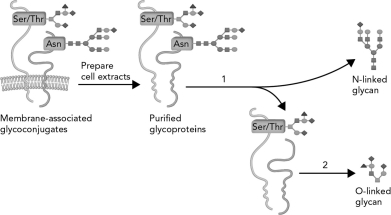
(Multiple Choice)
4.9/5 (69)
(69) Explain the connection the disaccharide lactose has to lacto-N-tetraose and lacto-N-fucopentaose I that is found in human breast milk.
(Essay)
4.9/5 (80)
(80) The growth rate of nonruminating animals often decreases when they eat feed containing __________ because of the inability to digest it.
(Multiple Choice)
4.9/5 (69)
(69) Compare and contrast the structure of glycogen, amylose, and amylopectin.
(Essay)
4.8/5 (61)
(61) What method is used to release the N-linked glycan groups from the membrane-associated glycoconjugates shown in 1 in the figure below? 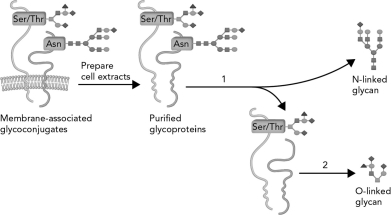
(Multiple Choice)
4.9/5 (83)
(83) Compare the information about glycan structure that is determined from liquid chromatography with the information obtained from mass spectrometry.
(Essay)
4.9/5 (73)
(73) How do the antibacterial properties of penicillin compare with methicillin?
(Essay)
4.9/5 (68)
(68) The glycan group on glycoproteins and glycolipids on the red blood cells all contain the glycan subgroup(s)
(Multiple Choice)
4.8/5 (73)
(73) The figure below is a fluorescence readout from a lectin array. What can be deduced from A? 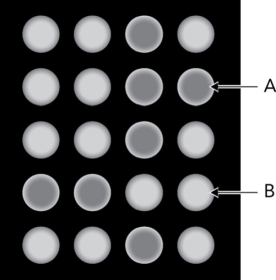
(Multiple Choice)
4.8/5 (67)
(67) Gram-negative bacteria contain which potent inflammatory agent in animals?
(Multiple Choice)
5.0/5 (82)
(82) Which glucose homopolymer would be used if a person had to sprint quickly?
(Multiple Choice)
4.9/5 (96)
(96) What is the blood type of a person who fails to express either the GTA or GTB glycosyltransferases?
(Multiple Choice)
5.0/5 (87)
(87) 
Filters
- Essay(0)
- Multiple Choice(0)
- Short Answer(0)
- True False(0)
- Matching(0)