



 Chat with AI
Exam 10: Classification of Microorganisms


One of the advantages of some newly developed rapid identification tools is that pure cultures are not needed. Why is a pure culture necessary for biochemical tests such as the Enterotube, but not for DNA probes?

 (88)
 Answered by Examlex AI Copilot
A pure culture is necessary for biochemical tests such as the Enterotube because these tests rely on the metabolic activities of a single species of bacteria to determine its identity. The Enterotube is a multi-test system that contains a series of compartments with different biochemical substrates and indicators. When a bacterium metabolizes a substrate, it produces a change in the indicator, such as a color change, which can be interpreted to identify the bacterium.
The requirement for a pure culture in this context is crucial because the presence of multiple bacterial species can confound the results. Different bacteria may consume the substrates and produce byproducts at different rates, or they may produce similar byproducts that make interpretation difficult or impossible. The metabolic activities of one species could mask or alter the expected reactions of another, leading to incorrect identification.
In contrast, DNA probes do not require a pure culture because they are designed to hybridize, or bind, specifically to the DNA sequences that are unique to a particular bacterial species or group of species. DNA probes can be used directly on mixed cultures because they will only bind to their target sequences, regardless of the presence of other bacterial DNA. This specificity is due to the complementary nature of DNA strands, where the probe will only bind to a sequence that matches it perfectly or with a high degree of similarity.
The use of DNA probes in rapid identification tools allows for the direct detection of pathogens in a sample without the need for isolation and cultivation of a pure culture. This can significantly reduce the time required for diagnosis and is particularly beneficial in clinical settings where timely identification of the causative agent of an infection can guide appropriate treatment decisions. Additionally, DNA-based methods can be highly sensitive and capable of detecting low levels of bacteria that might be missed by traditional culturing techniques.
You discovered a unicellular organism that lacks a nucleus and peptidoglycan. You suspect the organism is in the group
(89)  Verified
D
Western blotting is an immunological test used to identify the antigens in an individual suspected of having Lyme disease.
(84) VerifiedFalse
A bacterial species differs from a species of eukaryotic organisms in that a bacterial species
(78) Which of the following is NOT based on nucleic- acid hybridization?
(84) Into which group would you place a multicellular organism that has a mouth and lives inside the human liver?
(76) Figure 10.1
 -In Figure 10.1, species "c." is most closely related to which of the following?
 (80) Into which group would you place a multicellular heterotroph with chitin cell walls?
(72) What is the outstanding characteristic of the Kingdom Fungi?
(82) Figure 10.1
 -In Figure 10.1, the closest ancestor for both species "a." and species "b." would be which of the following?
 (84) The cell membranes of all three domains are composed of straight carbon chains attached to glycerol by ester linkage.
(83) Once a culture is purified, the next step in the process of identifying bacteria is biochemical testing.
(72) Which of the following is the best evidence for a three- domain system?
(70) Fossil evidence indicates that prokaryotic cells first existed on the Earth
(84) Table 10.2 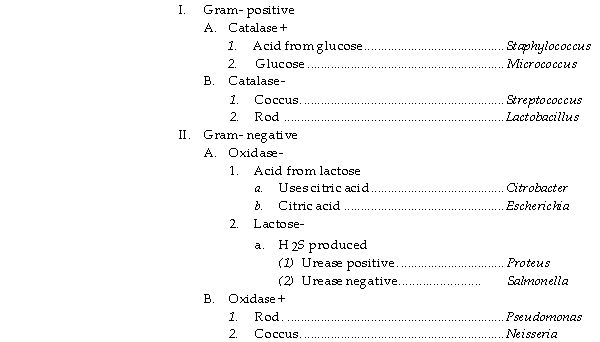 -Use the dichotomous key in Table 10.2 to identify a gram- negative coccus.
 (67) Chloroplasts possess circular DNA and reproduce by binary fission.
(79) 
Filters
- Essay(0)
- Multiple Choice(0)
- Short Answer(0)
- True False(0)
- Matching(0)