



 Chat with AI
Exam 14: Principles of Disease and Epidemiology

Exam 1: The Microbial World and You56 Questions
Exam 2: Chemical Principles58 Questions
Exam 3: Observing Microorganisms Through a Microscope57 Questions
Exam 4: Functional Anatomy of Prokaryotic and Eukaryotic Cells56 Questions
Exam 5: Microbial Metabolism57 Questions
Exam 6: Microbial Growth57 Questions
Exam 7: The Control of Microbial Growth55 Questions
Exam 8: Microbial Genetics56 Questions
Exam 9: Biotechnology and Recombinant Dna57 Questions
Exam 10: Classification of Microorganisms56 Questions
Exam 11: The Prokaryotes: Domains Bacteria and Archaea57 Questions
Exam 12: The Eukaryotes: Fungi, Algae, Protozoa, and Helminths56 Questions
Exam 13: Viruses, Viroids, and Prions55 Questions
Exam 14: Principles of Disease and Epidemiology58 Questions
Exam 15: Microbial Mechanisms of Pathogenicity56 Questions
Exam 16: Innate Immunity: Nonspecific Defenses of the Host57 Questions
Exam 17: Adaptive Immunity: Specific Defenses of the Host57 Questions
Exam 18: Practical Applications of Immunology55 Questions
Exam 19: Disorders Associated With the Immune System58 Questions
Exam 20: Antimicrobial Drugs55 Questions
Exam 21: Microbial Diseases of the Skin and Eyes57 Questions
Exam 22: Microbial Diseases of the Nervous System55 Questions
Exam 23: Microbial Diseases of the Cardiovascular and Lymphatic Systems57 Questions
Exam 24: Microbial Diseases of the Respiratory System57 Questions
Exam 25: Microbial Diseases of the Digestive System56 Questions
Exam 26: Microbial Diseases of the Urinary and Reproductive Systems56 Questions
Exam 27: Environmental Microbiology57 Questions
Exam 28: Applied and Industrial Microbiology58 Questions
Select questions type


A cold transmitted by a facial tissue is an example of

Free
(Multiple Choice)
4.7/5  (93)
(93) Correct Answer: Verified
B
A researcher only needs to select a cohort group when implementing an analytical epidemiological study.
Free
(True/False)
4.8/5 (89)
(89) Correct Answer:Verified
VerifiedFalse
Diseases that are referred to as EIDs have only been discovered in the past fifty years.
Free
(True/False)
4.8/5 (80)
(80) Correct Answer:Verified
VerifiedFalse
In which of the following patterns of disease does the patient experience no signs or symptoms?
(Multiple Choice)
4.8/5 (84)
(84) When studying the epidemiology of a particular disease, why are retrospective studies commonly undertaken before prospective studies?
(Short Answer)
4.9/5 (73)
(73) The yeast Candida albicans does not normally cause disease because of
(Multiple Choice)
4.9/5 (82)
(82) Figure 14.2
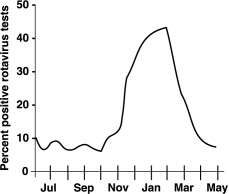 -In Figure 14.2, when is the prevalence the highest?
 (Multiple Choice)
4.7/5 (66)
(66) In which of the following diseases can gender be considered a viable predisposing factor?
(Multiple Choice)
4.7/5 (77)
(77) Figure 14.3
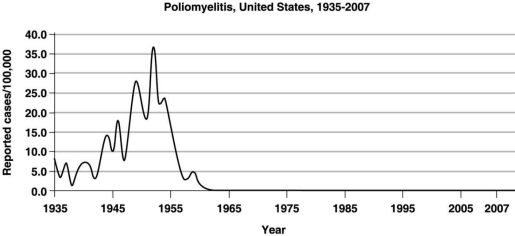 -The graph in Figure 14.3 shows the incidence of polio in the United States. The period between 1945 and 1955 indicates a(n)
 (Multiple Choice)
4.9/5 (87)
(87) Symptoms of disease differ from signs of disease in that symptoms
(Multiple Choice)
4.7/5 (90)
(90) The science that deals with when diseases occur and how they are transmitted is called
(Multiple Choice)
4.9/5 (83)
(83) Figure 14.4
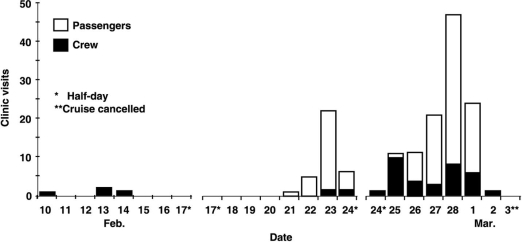 -Salmonella Heidelberg gastroenteritis occurred on three cruises aboard the T.S.S. Festivale. Figure 14.4 shows on- board clinic visits for diarrheal illness between February 10 and March 3. Explain the incidence pattern shown on the graph. What are probable modes of transmission? What changes would you recommend before the ship books more cruises after March 3?
 (Essay)
4.8/5 (66)
(66) 
Filters
- Essay(0)
- Multiple Choice(0)
- Short Answer(0)
- True False(0)
- Matching(0)