



 Chat with AI
Exam 14: Principles of Disease and Epidemiology

Exam 1: The Microbial World and You56 Questions
Exam 2: Chemical Principles58 Questions
Exam 3: Observing Microorganisms Through a Microscope57 Questions
Exam 4: Functional Anatomy of Prokaryotic and Eukaryotic Cells56 Questions
Exam 5: Microbial Metabolism57 Questions
Exam 6: Microbial Growth57 Questions
Exam 7: The Control of Microbial Growth55 Questions
Exam 8: Microbial Genetics56 Questions
Exam 9: Biotechnology and Recombinant Dna57 Questions
Exam 10: Classification of Microorganisms56 Questions
Exam 11: The Prokaryotes: Domains Bacteria and Archaea57 Questions
Exam 12: The Eukaryotes: Fungi, Algae, Protozoa, and Helminths56 Questions
Exam 13: Viruses, Viroids, and Prions55 Questions
Exam 14: Principles of Disease and Epidemiology58 Questions
Exam 15: Microbial Mechanisms of Pathogenicity56 Questions
Exam 16: Innate Immunity: Nonspecific Defenses of the Host57 Questions
Exam 17: Adaptive Immunity: Specific Defenses of the Host57 Questions
Exam 18: Practical Applications of Immunology55 Questions
Exam 19: Disorders Associated With the Immune System58 Questions
Exam 20: Antimicrobial Drugs55 Questions
Exam 21: Microbial Diseases of the Skin and Eyes57 Questions
Exam 22: Microbial Diseases of the Nervous System55 Questions
Exam 23: Microbial Diseases of the Cardiovascular and Lymphatic Systems57 Questions
Exam 24: Microbial Diseases of the Respiratory System57 Questions
Exam 25: Microbial Diseases of the Digestive System56 Questions
Exam 26: Microbial Diseases of the Urinary and Reproductive Systems56 Questions
Exam 27: Environmental Microbiology57 Questions
Exam 28: Applied and Industrial Microbiology58 Questions
Select questions type


The rise in herd immunity amongst a population can directly attributed to
(Multiple Choice)
4.8/5  (74)
(74) A disease in which the causative agent remains inactive for a time before producing symptoms is referred to as
(Multiple Choice)
4.8/5 (93)
(93) Urinary tract infections are the most common forms of nosocomial infections.
(True/False)
4.9/5 (75)
(75) Compromised hosts are always suffering from suppressed immune systems.
(True/False)
4.7/5 (91)
(91) Dengue fever, a zoonotic disease, is endemic in northern Mexico, but not in the U.S. Provide two plausible explanations for this dichotomy, and explain.
(Essay)
4.9/5 (82)
(82) Which one of the following does NOT contribute to the incidence of nosocomial infections?
(Multiple Choice)
4.8/5 (82)
(82) Emergence of infectious diseases can be attributed to all of the following EXCEPT
(Multiple Choice)
5.0/5 (75)
(75) Pseudomonas bacteria colonized the bile duct of a patient following his liver transplant surgery. This is an example of a
(Multiple Choice)
5.0/5 (74)
(74) Which of the following is NOT an example of microbial antagonism?
(Multiple Choice)
4.8/5 (67)
(67) Which of the following can contribute to postoperative infections?
(Multiple Choice)
4.8/5 (71)
(71) Which of the following is NOT a predisposing factor of disease?
(Multiple Choice)
4.8/5 (75)
(75) Which of the following diseases is NOT spread by droplet infection?
(Multiple Choice)
4.9/5 (92)
(92) A host is not considered diseased until an infection changes one's state of health.
(True/False)
4.8/5 (80)
(80) Figure 14.1
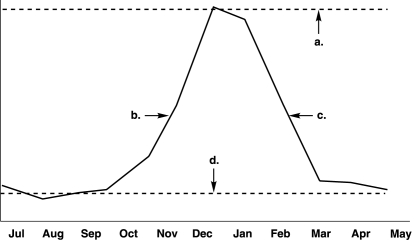 -Figure 14.1 shows the incidence of influenza during a typical year. Which letter on the graph indicates the endemic level?
 (Multiple Choice)
4.8/5 (77)
(77) Which of the following statements about biological transmission is FALSE?
(Multiple Choice)
4.8/5 (65)
(65) 
Filters
- Essay(0)
- Multiple Choice(0)
- Short Answer(0)
- True False(0)
- Matching(0)