



 Chat with AI
Exam 28: Applied and Industrial Microbiology


Vessels used for industrial fermentation reactions are known as bioreactors. Explain the difference between batch production and continuous flow production using a bioreactor.

 (73)
 Answered by Examlex AI Copilot
Batch production in a bioreactor involves adding all the necessary ingredients for the fermentation process at once and allowing the reaction to run its course until the desired product is obtained. Once the fermentation is complete, the bioreactor is emptied, and the product is harvested. This method is suitable for small-scale production and for producing high-value or specialized products.
On the other hand, continuous flow production in a bioreactor involves a continuous supply of nutrients and the removal of the product as it is being formed. This allows for a constant production of the desired product without the need to stop and start the fermentation process. Continuous flow production is more suitable for large-scale production and for producing commodities or products with a high demand.
In summary, the main difference between batch production and continuous flow production in a bioreactor is the way in which the fermentation process is operated. Batch production is a one-time addition of ingredients and harvest, while continuous flow production involves a continuous supply of nutrients and the removal of the product as it is being formed. Each method has its own advantages and is chosen based on the specific requirements of the fermentation process and the desired end product.
You are growing Bacillus subtilis in a bioreactor and notice that the growth rate has slowed and the pH has decreased. What could you add?
(78)  Verified
C
Thiobacillus ferrooxidans is used for the recovery of from ore.
(82) VerifiedD
Microbial products can be improved by all of the following EXCEPT
(86) All of the following are advantages of a bioreactor instead of a flask culture EXCEPT
(95) All of the following are industrial products produced using microbial fermentations EXCEPT
(88) Figure 28.1 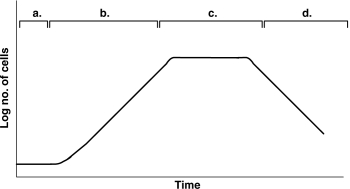 -In Figure 28.1, assume that a secondary metabolite is your desired product. When would you be able to obtain it?
 (74) The blue- green clumps observed in Roquefort cheese are a result of mold growth.
(76) Which of the following is an undesirable contaminant in wine- making?
(75) All of the following are industrial enzymes made by microbial fermentations EXCEPT
(87) Bioreactors are widely used for industrial fermentation. Which of the following conditions must be closely monitored for optimal fermentation?
(69) Explain how ionizing radiation can be used to preserve foods. Discuss its advantage over canning as a method of preservation.
(70) Figure 28.3
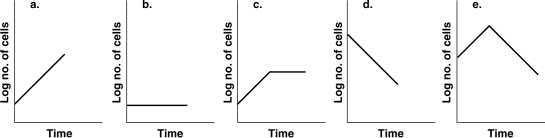 -Figure 28.3 shows the growth curves of Acetobacter under different conditions. Which culture would produce the highest amount of the primary metabolite acetic acid?
 (83) What role do lactic acid bacteria play in cheese production?
(73) Microorganisms themselves are commercial products. Which of the following microbes is available as a product sold in retail stores?
(85) 
Filters
- Essay(0)
- Multiple Choice(0)
- Short Answer(0)
- True False(0)
- Matching(0)