



 Chat with AI
Exam 2: Chemical Principles

Exam 1: The Microbial World and You56 Questions
Exam 2: Chemical Principles58 Questions
Exam 3: Observing Microorganisms Through a Microscope57 Questions
Exam 4: Functional Anatomy of Prokaryotic and Eukaryotic Cells56 Questions
Exam 5: Microbial Metabolism57 Questions
Exam 6: Microbial Growth57 Questions
Exam 7: The Control of Microbial Growth55 Questions
Exam 8: Microbial Genetics56 Questions
Exam 9: Biotechnology and Recombinant Dna57 Questions
Exam 10: Classification of Microorganisms56 Questions
Exam 11: The Prokaryotes: Domains Bacteria and Archaea57 Questions
Exam 12: The Eukaryotes: Fungi, Algae, Protozoa, and Helminths56 Questions
Exam 13: Viruses, Viroids, and Prions55 Questions
Exam 14: Principles of Disease and Epidemiology58 Questions
Exam 15: Microbial Mechanisms of Pathogenicity56 Questions
Exam 16: Innate Immunity: Nonspecific Defenses of the Host57 Questions
Exam 17: Adaptive Immunity: Specific Defenses of the Host57 Questions
Exam 18: Practical Applications of Immunology55 Questions
Exam 19: Disorders Associated With the Immune System58 Questions
Exam 20: Antimicrobial Drugs55 Questions
Exam 21: Microbial Diseases of the Skin and Eyes57 Questions
Exam 22: Microbial Diseases of the Nervous System55 Questions
Exam 23: Microbial Diseases of the Cardiovascular and Lymphatic Systems57 Questions
Exam 24: Microbial Diseases of the Respiratory System57 Questions
Exam 25: Microbial Diseases of the Digestive System56 Questions
Exam 26: Microbial Diseases of the Urinary and Reproductive Systems56 Questions
Exam 27: Environmental Microbiology57 Questions
Exam 28: Applied and Industrial Microbiology58 Questions
Select questions type


Based upon the valence numbers of the elements magnesium (2) and hydrogen (1), predict how many covalent bonds would form between these atoms to achieve the full complement of electrons in their outermost energy shells.

Free
(Multiple Choice)
4.8/5  (69)
(69) Correct Answer: Verified
B
Identify the following reaction: Glucose + Fructose -Sucrose + Water
Free
(Multiple Choice)
4.8/5 (91)
(91) Correct Answer:Verified
VerifiedD
Which of the following is the type of bond between molecules of water in a beaker of water?
(Multiple Choice)
4.8/5 (89)
(89) Elements only achieve the full complement of electrons in outermost energy cells by donating or sharing electrons.
(True/False)
4.7/5 (79)
(79) The antimicrobial drug imidazole inhibits sterol synthesis. This would most likely interfere with
(Multiple Choice)
4.8/5 (83)
(83) Which of the following statements regarding protein structure is FALSE?
(Multiple Choice)
4.9/5 (84)
(84) Most amino acids found in cells demonstrate what type of chirality?
(Multiple Choice)
4.8/5 (89)
(89) What is the type of bond between carbon, hydrogen, and oxygen atoms in organic molecules?
(Multiple Choice)
5.0/5 (67)
(67) Which of the following statements about the atom 12 C is FALSE? 6
(Multiple Choice)
4.8/5 (78)
(78) Identify the following reaction: Lactose + H2O -Glucose + Galactose
(Multiple Choice)
4.9/5 (74)
(74) There are some forms of life on Earth that can survive without water.
(True/False)
4.9/5 (86)
(86) Figure 2.5
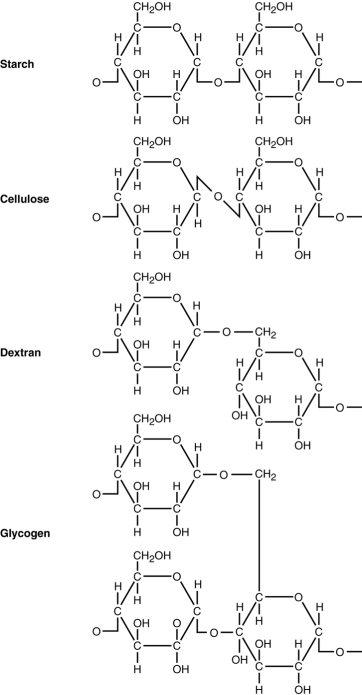 -Use Figure 2.5 to answer the following. Starch, cellulose, dextran, and glycogen are polysaccharides. How are they similar? To what are their different properties due? Why can't an enzyme that hydrolyzes starch degrade cellulose?
 (Short Answer)
4.9/5 (83)
(83) Antacids neutralize acid by the following reaction. Identify the salt in the following equation: Mg(OH)2 + 2HCl -MgCl2 + H2O
(Multiple Choice)
4.8/5 (77)
(77) Desulfovibrio bacteria can perform the following reaction: S6- -S2- . These bacteria are
(Multiple Choice)
4.8/5 (66)
(66) 
Filters
- Essay(0)
- Multiple Choice(0)
- Short Answer(0)
- True False(0)
- Matching(0)