



 Chat with AI
Exam 2: Chemical Principles

Exam 1: The Microbial World and You56 Questions
Exam 2: Chemical Principles58 Questions
Exam 3: Observing Microorganisms Through a Microscope57 Questions
Exam 4: Functional Anatomy of Prokaryotic and Eukaryotic Cells56 Questions
Exam 5: Microbial Metabolism57 Questions
Exam 6: Microbial Growth57 Questions
Exam 7: The Control of Microbial Growth55 Questions
Exam 8: Microbial Genetics56 Questions
Exam 9: Biotechnology and Recombinant Dna57 Questions
Exam 10: Classification of Microorganisms56 Questions
Exam 11: The Prokaryotes: Domains Bacteria and Archaea57 Questions
Exam 12: The Eukaryotes: Fungi, Algae, Protozoa, and Helminths56 Questions
Exam 13: Viruses, Viroids, and Prions55 Questions
Exam 14: Principles of Disease and Epidemiology58 Questions
Exam 15: Microbial Mechanisms of Pathogenicity56 Questions
Exam 16: Innate Immunity: Nonspecific Defenses of the Host57 Questions
Exam 17: Adaptive Immunity: Specific Defenses of the Host57 Questions
Exam 18: Practical Applications of Immunology55 Questions
Exam 19: Disorders Associated With the Immune System58 Questions
Exam 20: Antimicrobial Drugs55 Questions
Exam 21: Microbial Diseases of the Skin and Eyes57 Questions
Exam 22: Microbial Diseases of the Nervous System55 Questions
Exam 23: Microbial Diseases of the Cardiovascular and Lymphatic Systems57 Questions
Exam 24: Microbial Diseases of the Respiratory System57 Questions
Exam 25: Microbial Diseases of the Digestive System56 Questions
Exam 26: Microbial Diseases of the Urinary and Reproductive Systems56 Questions
Exam 27: Environmental Microbiology57 Questions
Exam 28: Applied and Industrial Microbiology58 Questions
Select questions type


Table 2.1  -Using the information in Table 2.1, calculate the number of moles in 92 grams of ethanol, C2H5OH.
 (Multiple Choice)
4.9/5  (89)
(89) Which of the following is the type of bond holding K+and I-ions in KI?
(Multiple Choice)
4.8/5 (71)
(71) Two antiparallel strands of DNA combine to form a double helix. The specific interactions that permit this phenomenon occur by way of bonds between .
(Multiple Choice)
4.8/5 (80)
(80) 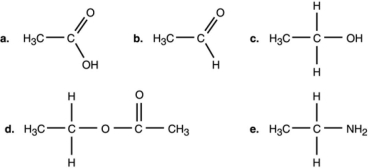 -Which compound in Figure 2.1 is an ester?
Radioisotopes are frequently used to label molecules in a cell. The fate of atoms and molecules in a cell can then be followed. Assume Saccharomyces cerevisiae is grown in a nutrient medium containing the radioisotope 32P. After a 48- hour incubation, the majority of the 32P would be found in the S. cerevisiae's
(Multiple Choice)
4.9/5 (88)
(88) What is the type of bond holding hydrogen and oxygen atoms in the H2O molecule?
(Multiple Choice)
4.8/5 (81)
(81) An E. coli culture that has been growing at 37°C is moved to 25°C. Which of the following changes must be made in its plasma membrane?
(Multiple Choice)
4.8/5 (68)
(68) Table 2.2  -Which of the following statements about the reactions in Table 2.2 is FALSE?
 (Multiple Choice)
4.9/5 (73)
(73) A scientist wants to perform a test that will indicate whether a nucleic acid sample is composed of RNA or DNA. Testing for the presence of which of the following is most appropriate in this situation?
(Multiple Choice)
4.7/5 (81)
(81) Figure 2.2
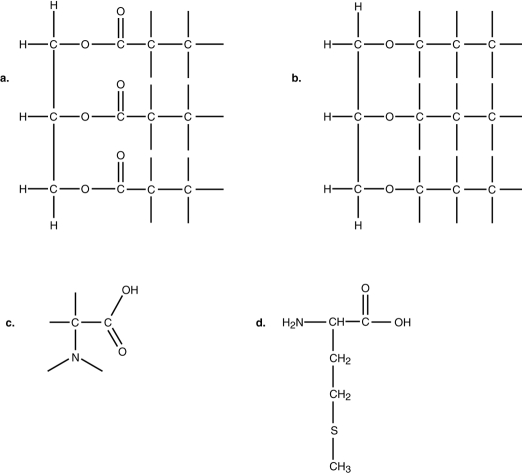 -Archaea differ from bacteria in the composition of the cell membrane lipids. Archaea have
Ether- bonded lipids, shown in part _ of Figure 2.2, and bacteria have ester- bonded lipids, shown in part of Figure 2.2.
-Archaea differ from bacteria in the composition of the cell membrane lipids. Archaea have
Ether- bonded lipids, shown in part _ of Figure 2.2, and bacteria have ester- bonded lipids, shown in part of Figure 2.2. (Multiple Choice)
4.7/5 (82)
(82) 
Filters
- Essay(0)
- Multiple Choice(0)
- Short Answer(0)
- True False(0)
- Matching(0)