



 Chat with AI
Exam 27: Environmental Microbiology

Exam 1: The Microbial World and You56 Questions
Exam 2: Chemical Principles58 Questions
Exam 3: Observing Microorganisms Through a Microscope57 Questions
Exam 4: Functional Anatomy of Prokaryotic and Eukaryotic Cells56 Questions
Exam 5: Microbial Metabolism57 Questions
Exam 6: Microbial Growth57 Questions
Exam 7: The Control of Microbial Growth55 Questions
Exam 8: Microbial Genetics56 Questions
Exam 9: Biotechnology and Recombinant Dna57 Questions
Exam 10: Classification of Microorganisms56 Questions
Exam 11: The Prokaryotes: Domains Bacteria and Archaea57 Questions
Exam 12: The Eukaryotes: Fungi, Algae, Protozoa, and Helminths56 Questions
Exam 13: Viruses, Viroids, and Prions55 Questions
Exam 14: Principles of Disease and Epidemiology58 Questions
Exam 15: Microbial Mechanisms of Pathogenicity56 Questions
Exam 16: Innate Immunity: Nonspecific Defenses of the Host57 Questions
Exam 17: Adaptive Immunity: Specific Defenses of the Host57 Questions
Exam 18: Practical Applications of Immunology55 Questions
Exam 19: Disorders Associated With the Immune System58 Questions
Exam 20: Antimicrobial Drugs55 Questions
Exam 21: Microbial Diseases of the Skin and Eyes57 Questions
Exam 22: Microbial Diseases of the Nervous System55 Questions
Exam 23: Microbial Diseases of the Cardiovascular and Lymphatic Systems57 Questions
Exam 24: Microbial Diseases of the Respiratory System57 Questions
Exam 25: Microbial Diseases of the Digestive System56 Questions
Exam 26: Microbial Diseases of the Urinary and Reproductive Systems56 Questions
Exam 27: Environmental Microbiology57 Questions
Exam 28: Applied and Industrial Microbiology58 Questions
Select questions type


The BOD is a measurement of the amount of bacteria present before and after the sewage treatment process.
(True/False)
4.9/5  (76)
(76) The bacteriological safety of drinking water is determined by testing water samples for the presence of human pathogens.
(True/False)
4.8/5 (72)
(72) The dense growth of algae in an algal bloom leads to increased oxygen levels in lakes that enhance the habitat for fish.
(True/False)
4.8/5 (83)
(83) In freshwater lakes and ponds, the majority of photosynthetic microbes are located in the zone(s).
(Multiple Choice)
4.7/5 (76)
(76) Which of the following is NOT characteristic of fecal coliforms?
(Multiple Choice)
4.7/5 (86)
(86) Bioremediation involves the use of microbes to degrade or detoxify pollutants.
(True/False)
4.8/5 (87)
(87) In the early 1900s, cities such as Philadelphia reduced the incidence of typhoid fever by
(Multiple Choice)
5.0/5 (75)
(75) Based on your knowledge of extremophiles and endoliths, describe the characteristics you would expect of microorganisms capable of living on Mars or other non- Earth environments.
(Essay)
4.9/5 (82)
(82) Which of the following is NOT a symbiotic pair of organisms?
(Multiple Choice)
4.9/5 (76)
(76) Nitrogen fixation by bacteria occurs only in the root nodules of leguminous plants.
(True/False)
4.8/5 (83)
(83) Figure 27.2
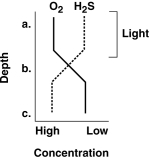 -Where are the benthic microbes such as Desulfovibrio and Clostridium most likely to be found in Figure 27.2?
 (Multiple Choice)
4.8/5 (66)
(66) All of the following are used in secondary sewage treatment EXCEPT
(Multiple Choice)
4.9/5 (73)
(73) The purpose of tertiary sewage treatment is to remove all of the phosphorus, nitrogen, and BOD left from secondary treatment.
(True/False)
4.8/5 (85)
(85) Which of the following organisms is using sulfur as a source of energy?
(Multiple Choice)
4.9/5 (81)
(81) Which wastewater treatment process produces BOD- containing effluent used for irrigation?
(Multiple Choice)
4.8/5 (78)
(78) For the biogeochemical cycles of the following elements, which does NOT have an atmospheric cycle?
(Multiple Choice)
4.8/5 (77)
(77) 
Filters
- Essay(0)
- Multiple Choice(0)
- Short Answer(0)
- True False(0)
- Matching(0)