



 Chat with AI
Exam 3: Observing Microorganisms Through a Microscope

Exam 1: The Microbial World and You56 Questions
Exam 2: Chemical Principles58 Questions
Exam 3: Observing Microorganisms Through a Microscope57 Questions
Exam 4: Functional Anatomy of Prokaryotic and Eukaryotic Cells56 Questions
Exam 5: Microbial Metabolism57 Questions
Exam 6: Microbial Growth57 Questions
Exam 7: The Control of Microbial Growth55 Questions
Exam 8: Microbial Genetics56 Questions
Exam 9: Biotechnology and Recombinant Dna57 Questions
Exam 10: Classification of Microorganisms56 Questions
Exam 11: The Prokaryotes: Domains Bacteria and Archaea57 Questions
Exam 12: The Eukaryotes: Fungi, Algae, Protozoa, and Helminths56 Questions
Exam 13: Viruses, Viroids, and Prions55 Questions
Exam 14: Principles of Disease and Epidemiology58 Questions
Exam 15: Microbial Mechanisms of Pathogenicity56 Questions
Exam 16: Innate Immunity: Nonspecific Defenses of the Host57 Questions
Exam 17: Adaptive Immunity: Specific Defenses of the Host57 Questions
Exam 18: Practical Applications of Immunology55 Questions
Exam 19: Disorders Associated With the Immune System58 Questions
Exam 20: Antimicrobial Drugs55 Questions
Exam 21: Microbial Diseases of the Skin and Eyes57 Questions
Exam 22: Microbial Diseases of the Nervous System55 Questions
Exam 23: Microbial Diseases of the Cardiovascular and Lymphatic Systems57 Questions
Exam 24: Microbial Diseases of the Respiratory System57 Questions
Exam 25: Microbial Diseases of the Digestive System56 Questions
Exam 26: Microbial Diseases of the Urinary and Reproductive Systems56 Questions
Exam 27: Environmental Microbiology57 Questions
Exam 28: Applied and Industrial Microbiology58 Questions
Select questions type


In 1877, Robert Koch thought preparing permanently stained slides would be valuable. Why was his assessment correct?
(Short Answer)
5.0/5  (71)
(71) A microorganism measures 5 µm in length. Its length in mm would be
(Multiple Choice)
4.8/5 (68)
(68) In 1884, Hans Christian Gram described a method of staining bacterial cells while not staining surrounding animal tissues. However, he thought that the staining method he developed was faulty because not all bacteria stained. In a letter to the editor of the journal in which Gram published his findings, write your response to Gram's concern.
(Essay)
4.9/5 (78)
(78) The capsules and flagella of bacteria can be observed in gram- stained smears.
(True/False)
4.9/5 (66)
(66) A student is looking at a bacterial specimen using the oil immersion lens, but has forgotten to put immersion oil on the slide. The specimen will appear
(Multiple Choice)
4.9/5 (80)
(80) You find colorless areas in cells in a gram- stained smear. What should you apply next?
(Multiple Choice)
4.9/5 (84)
(84) Scanned probe microscopy is used to examine fine detail of molecular complexes, such as blood clots, or molecules, such as DNA.
(True/False)
4.9/5 (82)
(82) The greater resolution of the electron microscope compared to the compound microscope is due to the longer wavelengths of the electrons used to examine specimens.
(True/False)
4.8/5 (82)
(82) Which microscope achieves the highest magnification and greatest resolution?
(Multiple Choice)
4.7/5 (62)
(62) You are performing a Gram stain on gram- positive bacteria and you stop after the addition of the first dye. What is the appearance of the bacteria at this point?
(Multiple Choice)
4.9/5 (82)
(82) What is the total magnification of a specimen viewed with a 10x ocular lens and a 45x objective lens?
(Multiple Choice)
4.9/5 (83)
(83) Figure 3.1
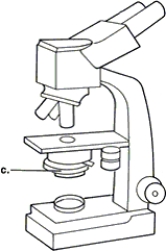 -In Figure 3.1, line "c" points to the microscope's
 (Multiple Choice)
4.8/5 (69)
(69) What structure does light pass through after leaving the condenser in a compound light microscope?
(Multiple Choice)
4.8/5 (87)
(87) Which microscope is used to see intracellular detail in a living cell?
(Multiple Choice)
4.8/5 (71)
(71) Which microscope is used to observe viruses and the internal structure of thinly sectioned cells?
(Multiple Choice)
4.9/5 (76)
(76) Which microscope uses two beams of light to produce a three- dimensional color image?
(Multiple Choice)
4.9/5 (78)
(78) You are performing a Gram stain on gram- negative bacteria and you stop after the addition of the mordant. What is the appearance of the bacteria at this point?
(Multiple Choice)
4.9/5 (74)
(74) Which of the following correctly traces the path of light through the compound microscope?
(Multiple Choice)
4.9/5 (79)
(79) 
Filters
- Essay(0)
- Multiple Choice(0)
- Short Answer(0)
- True False(0)
- Matching(0)