



 Chat with AI
Exam 6: Microbial Growth

Exam 1: The Microbial World and You56 Questions
Exam 2: Chemical Principles58 Questions
Exam 3: Observing Microorganisms Through a Microscope57 Questions
Exam 4: Functional Anatomy of Prokaryotic and Eukaryotic Cells56 Questions
Exam 5: Microbial Metabolism57 Questions
Exam 6: Microbial Growth57 Questions
Exam 7: The Control of Microbial Growth55 Questions
Exam 8: Microbial Genetics56 Questions
Exam 9: Biotechnology and Recombinant Dna57 Questions
Exam 10: Classification of Microorganisms56 Questions
Exam 11: The Prokaryotes: Domains Bacteria and Archaea57 Questions
Exam 12: The Eukaryotes: Fungi, Algae, Protozoa, and Helminths56 Questions
Exam 13: Viruses, Viroids, and Prions55 Questions
Exam 14: Principles of Disease and Epidemiology58 Questions
Exam 15: Microbial Mechanisms of Pathogenicity56 Questions
Exam 16: Innate Immunity: Nonspecific Defenses of the Host57 Questions
Exam 17: Adaptive Immunity: Specific Defenses of the Host57 Questions
Exam 18: Practical Applications of Immunology55 Questions
Exam 19: Disorders Associated With the Immune System58 Questions
Exam 20: Antimicrobial Drugs55 Questions
Exam 21: Microbial Diseases of the Skin and Eyes57 Questions
Exam 22: Microbial Diseases of the Nervous System55 Questions
Exam 23: Microbial Diseases of the Cardiovascular and Lymphatic Systems57 Questions
Exam 24: Microbial Diseases of the Respiratory System57 Questions
Exam 25: Microbial Diseases of the Digestive System56 Questions
Exam 26: Microbial Diseases of the Urinary and Reproductive Systems56 Questions
Exam 27: Environmental Microbiology57 Questions
Exam 28: Applied and Industrial Microbiology58 Questions
Select questions type


Figure 6.4


 -In each graph in Figure 6.4, the culture was incubated at 30°C in glucose- minimal salts broth, aerobically. The bacterium is a facultative anaerobe with an optimum temperature of 37°C and can metabolize glucose and lactose. Indicate how each growth curve would change under the conditions indicated in each graph. Draw the new graphs, or write "no change."
 (Essay)
4.7/5  (73)
(73) During which growth phase will gram- positive bacteria be most susceptible to penicillin?
(Multiple Choice)
4.9/5 (97)
(97) Patients with indwelling catheters are susceptible to infections because
(Multiple Choice)
4.8/5 (82)
(82) Figure 6.2
 -Figure 6.2 shows a typical bacterial growth curve with the x- axis indicating the log of the number of bacteria and the y- axis indicating time in culture. In the figure, which sections of the graph illustrate a logarithmic change in cell numbers?
 (Multiple Choice)
5.0/5 (79)
(79) A culture medium on which only gram- positive organisms grow and a yellow halo surrounds Staphylococcus aureus colonies is called a(n)
(Multiple Choice)
4.9/5 (70)
(70) Which of the following is an advantage of the direct microscopic count?
(Multiple Choice)
4.8/5 (77)
(77) Table 6.1
Three different culture media are shown below. Medium A Medium B Medium C Tide detergent Glucose Peptone
-For the three types of media in Table 6.1, which medium (or media) is/are chemically defined?
(Multiple Choice)
4.9/5 (93)
(93) Figure 6.3
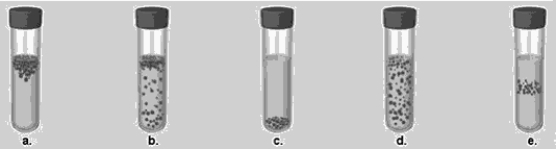 -In Figure 6.3, which tube shows the expected growth pattern for a facultative anaerobe?
 (Multiple Choice)
4.9/5 (96)
(96) Which of the following is an example of a metabolic activity that could be used to measure microbial growth?
(Multiple Choice)
5.0/5 (72)
(72) Laboratory cultivation of obligate anaerobes requires reducing media or special growth chambers filled with inert gases.
(True/False)
4.8/5 (77)
(77) The biosafety level (BSL) for a clinical microbiology laboratory working with potentially airborne pathogens, such as tuberculosis bacteria, is
(Multiple Choice)
4.9/5 (77)
(77) In one hospital, Pseudomonas aeruginosa serotype 10 infected the biliary tract of 10 percent of 1300 patients who underwent gastrointestinal endoscopic procedures. After each use, endoscopes were washed with an automatic reprocessor that flushed detergent and glutaraldehyde through the endoscopes, followed by a tap water rinse. P. aeruginosa 10 was not isolated from the detergent, glutaraldehyde, or tap water. What was the source of the infections?
(Multiple Choice)
4.9/5 (81)
(81) Pathogenic bacteria isolated from the respiratory or intestinal tracts of humans are
(Multiple Choice)
4.7/5 (79)
(79) 
Filters
- Essay(0)
- Multiple Choice(0)
- Short Answer(0)
- True False(0)
- Matching(0)