



 Chat with AI
Exam 7: The Control of Microbial Growth

Exam 1: The Microbial World and You56 Questions
Exam 2: Chemical Principles58 Questions
Exam 3: Observing Microorganisms Through a Microscope57 Questions
Exam 4: Functional Anatomy of Prokaryotic and Eukaryotic Cells56 Questions
Exam 5: Microbial Metabolism57 Questions
Exam 6: Microbial Growth57 Questions
Exam 7: The Control of Microbial Growth55 Questions
Exam 8: Microbial Genetics56 Questions
Exam 9: Biotechnology and Recombinant Dna57 Questions
Exam 10: Classification of Microorganisms56 Questions
Exam 11: The Prokaryotes: Domains Bacteria and Archaea57 Questions
Exam 12: The Eukaryotes: Fungi, Algae, Protozoa, and Helminths56 Questions
Exam 13: Viruses, Viroids, and Prions55 Questions
Exam 14: Principles of Disease and Epidemiology58 Questions
Exam 15: Microbial Mechanisms of Pathogenicity56 Questions
Exam 16: Innate Immunity: Nonspecific Defenses of the Host57 Questions
Exam 17: Adaptive Immunity: Specific Defenses of the Host57 Questions
Exam 18: Practical Applications of Immunology55 Questions
Exam 19: Disorders Associated With the Immune System58 Questions
Exam 20: Antimicrobial Drugs55 Questions
Exam 21: Microbial Diseases of the Skin and Eyes57 Questions
Exam 22: Microbial Diseases of the Nervous System55 Questions
Exam 23: Microbial Diseases of the Cardiovascular and Lymphatic Systems57 Questions
Exam 24: Microbial Diseases of the Respiratory System57 Questions
Exam 25: Microbial Diseases of the Digestive System56 Questions
Exam 26: Microbial Diseases of the Urinary and Reproductive Systems56 Questions
Exam 27: Environmental Microbiology57 Questions
Exam 28: Applied and Industrial Microbiology58 Questions
Select questions type


Autoclaving is the most effective method of moist heat sterilization.
(True/False)
4.8/5  (70)
(70) Disinfection of water is achieved by all of the following EXCEPT
(Multiple Choice)
5.0/5 (88)
(88) Table 7.3
The following data were obtained by incubating gram- positive bacteria in nutrient medium + disinfectant for 24 hr, then transferring one loopful to nutrient medium (subculturing). (+ = growth; - = no growth)
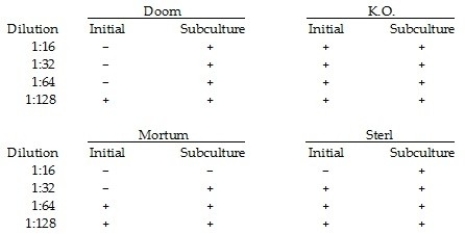 -In Table 7.3, which disinfectant was bactericidal?
 (Multiple Choice)
4.9/5 (71)
(71) An agent used to reduce the number of bacteria on a toilet would most accurately be called a(n)
(Multiple Choice)
4.8/5 (72)
(72) The pH of the medium has no effect on the activity of the disinfectant being applied.
(True/False)
4.9/5 (92)
(92) Which of the following could be used to sterilize plastic Petri plates in a plastic wrapper?
(Multiple Choice)
4.7/5 (83)
(83) The antimicrobial activity of chlorine is due to which of the following?
(Multiple Choice)
4.8/5 (84)
(84) Table 7.2
The fate of E. coli O157:H7 in apple cider held at 8°C for 2 weeks, with and without preservatives, is shown below: Bacteria/ml Cider only 2.2 Cider with potassium sorbate 2.0 Sodium benzoate 0 Potassium sorbate + sodium benzoate 0
-In Table 7.2, which preservative is most effective?
(Multiple Choice)
4.9/5 (88)
(88) Table 7.3
The following data were obtained by incubating gram- positive bacteria in nutrient medium + disinfectant for 24 hr, then transferring one loopful to nutrient medium (subculturing). (+ = growth; - = no growth)
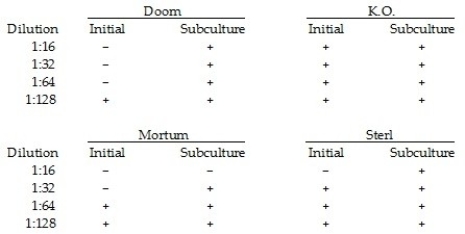 -In Table 7.3, which disinfectant was most effective against Salmonella?
 (Multiple Choice)
4.9/5 (82)
(82) The thermal death time is the time needed to kill all the bacteria in a particular culture at a certain temperature.
(True/False)
4.8/5 (88)
(88) All of the following substances are effective against nonenveloped viruses EXCEPT
(Multiple Choice)
4.9/5 (72)
(72) If you were preparing nutrient agar at home and did not have an autoclave, what could you use to sterilize the nutrient agar?
(Multiple Choice)
4.9/5 (87)
(87) Which one of the following is most resistant to chemical biocides?
(Multiple Choice)
4.8/5 (76)
(76) 
Filters
- Essay(0)
- Multiple Choice(0)
- Short Answer(0)
- True False(0)
- Matching(0)