



 Chat with AI
Exam 11: Fiscal Policy

Exam 1: Economics: the Core Issues152 Questions
Exam 2: The Useconomy: a Global View146 Questions
Exam 3: Supply and Demand164 Questions
Exam 4: The Role of Government153 Questions
Exam 5: National Income Accounting152 Questions
Exam 6: Unemployment147 Questions
Exam 7: Inflation152 Questions
Exam 8: The Business Cycle153 Questions
Exam 9: Aggregate Demand149 Questions
Exam 10: Self-Adjustment or Instability140 Questions
Exam 11: Fiscal Policy151 Questions
Exam 12: Deficits and Debt151 Questions
Exam 13: Money and Banks146 Questions
Exam 14: The Federal Reserve System146 Questions
Exam 15: Monetary Policy149 Questions
Exam 16: Supply-Side Policy: Short-Run Options147 Questions
Exam 17: Growth and Productivity: Long-Run Possibilities143 Questions
Exam 18: Theory Versus Reality146 Questions
Exam 19: Consumer Choice136 Questions
Exam 20: Elasticity141 Questions
Exam 21: The Costs of Production151 Questions
Exam 22: The Competitive Firm148 Questions
Exam 23: Competitive Markets150 Questions
Exam 24: Monopoly147 Questions
Exam 25: Oligopoly145 Questions
Exam 26: Monopolistic Competition144 Questions
Exam 27: Natural Monopolies: Deregulation144 Questions
Exam 28: Environmental Protection144 Questions
Exam 29: The Farm Problem132 Questions
Exam 30: The Labor Market137 Questions
Exam 31: Labor Unions144 Questions
Exam 32: Financial Markets146 Questions
Exam 33: Taxes: Equity Versus Efficiency146 Questions
Exam 34: Transfer Payments: Welfare and Social Security146 Questions
Exam 35: International Trade149 Questions
Exam 36: International Finance142 Questions
Exam 37: Global Poverty141 Questions
Select questions type


Ceteris paribus,if the AD shortfall equals $600 billion,then the federal government can close it by increasing
(Multiple Choice)
4.8/5  (84)
(84) What are the fiscal policy options to reduce an inflationary gap? Do these policies have the same impact?
(Essay)
4.8/5 (80)
(80) Time lags in the design,authorization,and implementation of fiscal policy reduce its effectiveness.
(True/False)
4.9/5 (78)
(78) The total change in aggregate spending generated by increased government spending depends on the
(Multiple Choice)
4.8/5 (75)
(75) 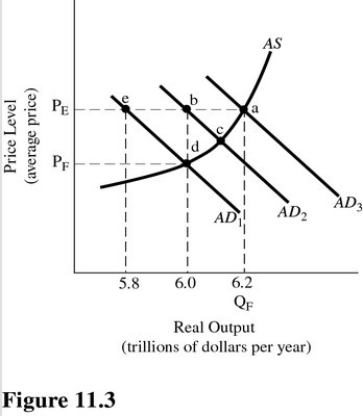 Refer to Figure 11.3.Assume aggregate demand is represented by AD3 and full-employment output is $5.8 trillion.To restore price stability,the AD curve must shift
 (Multiple Choice)
4.8/5 (72)
(72) What happens to aggregate demand when government spending and the taxes to pay for it both rise by the same amount?
(Multiple Choice)
4.8/5 (71)
(71) In formulating fiscal policy it is necessary to specify the amount of the desired AD shift.
(True/False)
4.9/5 (75)
(75) 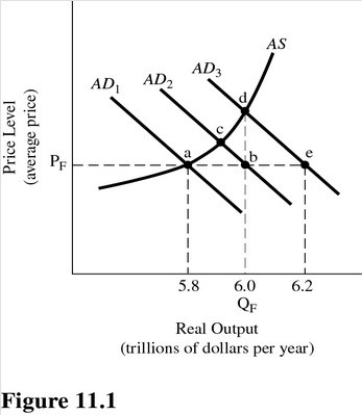 In Figure 11.1,assume that QF is full-employment output and the level of aggregate spending is represented by AD1.If AD1 increases to AD2,which of the following statements is correct?
 (Multiple Choice)
4.8/5 (82)
(82) Crowding out is the idea that an increase in government spending may cause a reduction in private sector spending.
(True/False)
4.7/5 (76)
(76) In a diagram of aggregate demand and supply curves,the GDP gap is measured as the
(Multiple Choice)
4.7/5 (87)
(87) What will happen in the economy if the government increases spending and increases taxes by equal amounts to pay for that additional government spending?
(Essay)
4.9/5 (70)
(70) The U.S.government was given the power to tax income in the
(Multiple Choice)
4.9/5 (76)
(76) Which of the following explains why the government should not increase spending by the entire amount of the AD shortfall to move the economy to full employment?
(Multiple Choice)
4.8/5 (84)
(84) Which of the following would cause both an increase in the price level and an increase in real output?
(Multiple Choice)
4.8/5 (84)
(84) 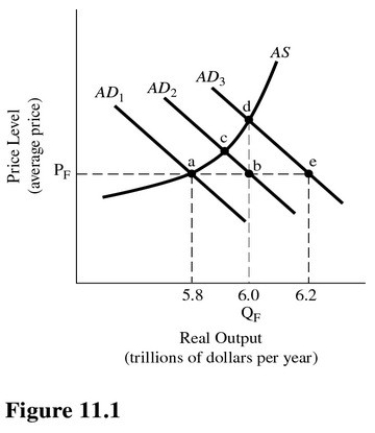 Refer to Figure 11.1.Assume aggregate demand is represented by AD1,full-employment output is $6.0 trillion,and the MPC is 0.75.The spending fiscal stimulus needed to reach full-employment equilibrium is
 (Multiple Choice)
4.9/5 (77)
(77) If the AS curve is upward-sloping,the government alone should raise its purchases by the amount of the AD shortfall in order to reach full-employment equilibrium.
(True/False)
5.0/5 (66)
(66) The general formula for calculating the desired fiscal stimulus is
(Multiple Choice)
4.9/5 (82)
(82) Which of the following will most likely provide fiscal stimulus to the economy?
(Multiple Choice)
4.7/5 (71)
(71) 
Filters
- Essay(0)
- Multiple Choice(0)
- Short Answer(0)
- True False(0)
- Matching(0)