



 Chat with AI
Exam 11: Fiscal Policy

Exam 1: Economics: the Core Issues152 Questions
Exam 2: The Useconomy: a Global View146 Questions
Exam 3: Supply and Demand164 Questions
Exam 4: The Role of Government153 Questions
Exam 5: National Income Accounting152 Questions
Exam 6: Unemployment147 Questions
Exam 7: Inflation152 Questions
Exam 8: The Business Cycle153 Questions
Exam 9: Aggregate Demand149 Questions
Exam 10: Self-Adjustment or Instability140 Questions
Exam 11: Fiscal Policy151 Questions
Exam 12: Deficits and Debt151 Questions
Exam 13: Money and Banks146 Questions
Exam 14: The Federal Reserve System146 Questions
Exam 15: Monetary Policy149 Questions
Exam 16: Supply-Side Policy: Short-Run Options147 Questions
Exam 17: Growth and Productivity: Long-Run Possibilities143 Questions
Exam 18: Theory Versus Reality146 Questions
Exam 19: Consumer Choice136 Questions
Exam 20: Elasticity141 Questions
Exam 21: The Costs of Production151 Questions
Exam 22: The Competitive Firm148 Questions
Exam 23: Competitive Markets150 Questions
Exam 24: Monopoly147 Questions
Exam 25: Oligopoly145 Questions
Exam 26: Monopolistic Competition144 Questions
Exam 27: Natural Monopolies: Deregulation144 Questions
Exam 28: Environmental Protection144 Questions
Exam 29: The Farm Problem132 Questions
Exam 30: The Labor Market137 Questions
Exam 31: Labor Unions144 Questions
Exam 32: Financial Markets146 Questions
Exam 33: Taxes: Equity Versus Efficiency146 Questions
Exam 34: Transfer Payments: Welfare and Social Security146 Questions
Exam 35: International Trade149 Questions
Exam 36: International Finance142 Questions
Exam 37: Global Poverty141 Questions
Select questions type


Given a $500 billion AD shortfall and an MPC of 0.75,the desired fiscal stimulus would be
(Multiple Choice)
4.9/5  (79)
(79) A tax increase of $250 will exactly offset a $250 increase in government purchases,leaving aggregate demand unaffected.
(True/False)
4.8/5 (81)
(81) Income transfers become part of aggregate demand as soon as they occur.
(True/False)
4.9/5 (72)
(72) 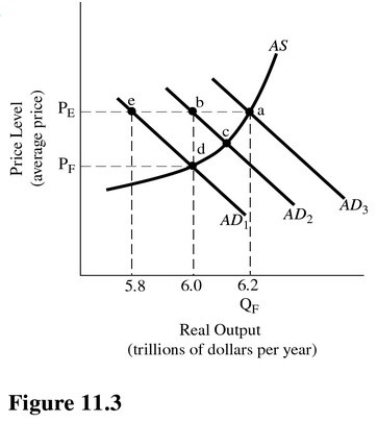 Refer to Figure 11.3.Assume aggregate demand is represented by AD3 and full-employment output is $5.6 trillion.The equilibrium level of income is
 (Multiple Choice)
4.9/5 (85)
(85) Assume the MPC is 0.75.To eliminate an AD shortfall of $200 billion,the government should
(Multiple Choice)
4.9/5 (97)
(97) If aggregate demand increases by the amount of the recessionary GDP gap and aggregate supply is upward-sloping,
(Multiple Choice)
4.8/5 (76)
(76) 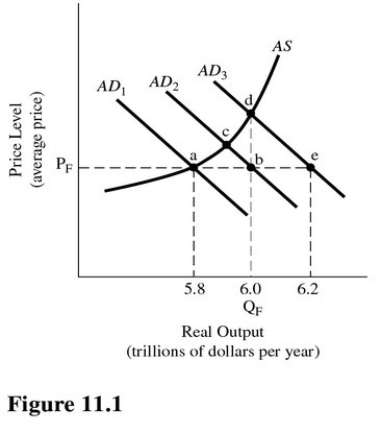 Refer to Figure 11.1.Assume aggregate demand is represented by AD1 and full employment output is $6.0 trillion.The equilibrium level of income is
 (Multiple Choice)
4.8/5 (90)
(90) How does the slope of the AS curve affect the closure of the GDP gap?
(Essay)
4.9/5 (83)
(83) Payments for unemployment benefits sent to unemployed people are considered government purchases.
(True/False)
4.9/5 (73)
(73) The use of government taxes and spending to alter macroeconomic outcomes is known as
(Multiple Choice)
4.9/5 (82)
(82) 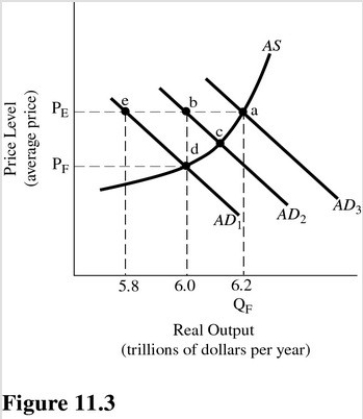 Refer to Figure 11.3.Assume aggregate demand is represented by AD3 and full-employment output is $5.6 trillion.The economy confronts an inflationary GDP gap of
 (Multiple Choice)
4.9/5 (92)
(92) Which of the following is a policy option to eliminate an AD shortfall?
(Multiple Choice)
4.8/5 (78)
(78) The ranking of the size of tax revenues received by the federal government (from highest to lowest)would be corporate taxes,income taxes,and Social Security payroll taxes.
(True/False)
4.7/5 (88)
(88) 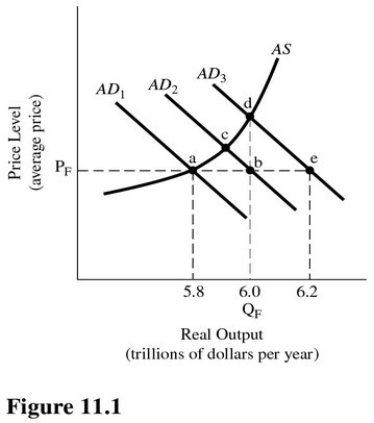 Using Figure 11.1,which fiscal policy action would increase aggregate demand from AD1 to AD3?
 (Multiple Choice)
4.9/5 (74)
(74) A tax cut has a smaller impact on aggregate demand than an increase in government purchases of the same size because
(Multiple Choice)
4.8/5 (83)
(83) Which of the following is generally considered a desirable outcome of fiscal policy?
(Multiple Choice)
4.8/5 (78)
(78) 
Filters
- Essay(0)
- Multiple Choice(0)
- Short Answer(0)
- True False(0)
- Matching(0)