



 Chat with AI
Exam 11: Fiscal Policy

Exam 1: Economics: the Core Issues152 Questions
Exam 2: The Useconomy: a Global View146 Questions
Exam 3: Supply and Demand164 Questions
Exam 4: The Role of Government153 Questions
Exam 5: National Income Accounting152 Questions
Exam 6: Unemployment147 Questions
Exam 7: Inflation152 Questions
Exam 8: The Business Cycle153 Questions
Exam 9: Aggregate Demand149 Questions
Exam 10: Self-Adjustment or Instability140 Questions
Exam 11: Fiscal Policy151 Questions
Exam 12: Deficits and Debt151 Questions
Exam 13: Money and Banks146 Questions
Exam 14: The Federal Reserve System146 Questions
Exam 15: Monetary Policy149 Questions
Exam 16: Supply-Side Policy: Short-Run Options147 Questions
Exam 17: Growth and Productivity: Long-Run Possibilities143 Questions
Exam 18: Theory Versus Reality146 Questions
Exam 19: Consumer Choice136 Questions
Exam 20: Elasticity141 Questions
Exam 21: The Costs of Production151 Questions
Exam 22: The Competitive Firm148 Questions
Exam 23: Competitive Markets150 Questions
Exam 24: Monopoly147 Questions
Exam 25: Oligopoly145 Questions
Exam 26: Monopolistic Competition144 Questions
Exam 27: Natural Monopolies: Deregulation144 Questions
Exam 28: Environmental Protection144 Questions
Exam 29: The Farm Problem132 Questions
Exam 30: The Labor Market137 Questions
Exam 31: Labor Unions144 Questions
Exam 32: Financial Markets146 Questions
Exam 33: Taxes: Equity Versus Efficiency146 Questions
Exam 34: Transfer Payments: Welfare and Social Security146 Questions
Exam 35: International Trade149 Questions
Exam 36: International Finance142 Questions
Exam 37: Global Poverty141 Questions
Select questions type


When government spending increases,consumption also increases via the multiplier process.
(True/False)
4.9/5  (86)
(86) Fiscal policy formation causes a delay in implementation even though a recession can usually be recognized within a few weeks after it begins.
(True/False)
4.8/5 (82)
(82) The recessionary GDP gap will differ from the AD shortfall when the
(Multiple Choice)
4.8/5 (74)
(74) 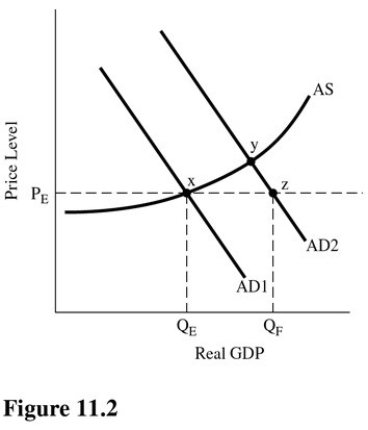 According to Figure 11.2,a shift from AD1 to AD2 will
If the recessionary GDP gap is $500,then the proper fiscal stimulus when faced with an upward-sloping AS curve is to
(Multiple Choice)
5.0/5 (72)
(72) If the multiplier equals 2 and the AD shortfall is $6 million,the desired fiscal stimulus is
(Multiple Choice)
4.8/5 (89)
(89) An income transfer contains less fiscal stimulus than an increase in government spending of the same size.
(True/False)
4.7/5 (76)
(76) The amount of additional aggregate demand needed to achieve full employment after allowing for price level changes is
(Multiple Choice)
4.9/5 (83)
(83) Which of the following would not be a policy option to eliminate an AD shortfall?
(Multiple Choice)
4.9/5 (75)
(75) Jack has an MPC of 0.82 and Jill has an MPC of 0.78.Ceteris paribus,if the government transfers income from people who behave like Jack to people who behave like Jill,
(Multiple Choice)
4.8/5 (76)
(76) If the economy is experiencing excess demand that is causing inflation,the inflationary pressures can be eliminated by reducing government spending by less than the amount of excess demand.
(True/False)
4.9/5 (66)
(66) 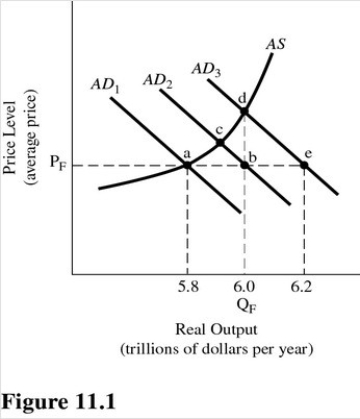 Refer to Figure 11.1.Assume aggregate demand is initially represented by AD1 and full-employment output is $6.0 trillion.If aggregate demand increases by the amount of the GDP gap,equilibrium will occur at
 (Multiple Choice)
4.8/5 (94)
(94) Fiscal policy involves changes in government spending and taxes,but not regulation of prices or production.
(True/False)
4.9/5 (88)
(88) 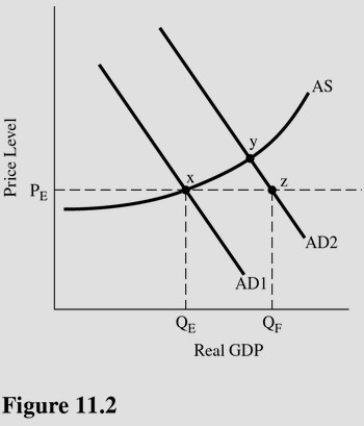 Assuming QF is the full employment equilibrium then a shift from AD1 to AD2 in Figure 11.2 will
 (Multiple Choice)
4.7/5 (88)
(88) Which of the following fiscal policies cause a decrease in aggregate expenditures?
(Multiple Choice)
4.9/5 (78)
(78) A $500 increase in government spending contains more fiscal stimulus than a $500 tax cut.
(True/False)
4.9/5 (76)
(76) 
Filters
- Essay(0)
- Multiple Choice(0)
- Short Answer(0)
- True False(0)
- Matching(0)