



 Chat with AI
Exam 15: Monetary Policy

Exam 1: Economics: the Core Issues152 Questions
Exam 2: The Useconomy: a Global View146 Questions
Exam 3: Supply and Demand164 Questions
Exam 4: The Role of Government153 Questions
Exam 5: National Income Accounting152 Questions
Exam 6: Unemployment147 Questions
Exam 7: Inflation152 Questions
Exam 8: The Business Cycle153 Questions
Exam 9: Aggregate Demand149 Questions
Exam 10: Self-Adjustment or Instability140 Questions
Exam 11: Fiscal Policy151 Questions
Exam 12: Deficits and Debt151 Questions
Exam 13: Money and Banks146 Questions
Exam 14: The Federal Reserve System146 Questions
Exam 15: Monetary Policy149 Questions
Exam 16: Supply-Side Policy: Short-Run Options147 Questions
Exam 17: Growth and Productivity: Long-Run Possibilities143 Questions
Exam 18: Theory Versus Reality146 Questions
Exam 19: Consumer Choice136 Questions
Exam 20: Elasticity141 Questions
Exam 21: The Costs of Production151 Questions
Exam 22: The Competitive Firm148 Questions
Exam 23: Competitive Markets150 Questions
Exam 24: Monopoly147 Questions
Exam 25: Oligopoly145 Questions
Exam 26: Monopolistic Competition144 Questions
Exam 27: Natural Monopolies: Deregulation144 Questions
Exam 28: Environmental Protection144 Questions
Exam 29: The Farm Problem132 Questions
Exam 30: The Labor Market137 Questions
Exam 31: Labor Unions144 Questions
Exam 32: Financial Markets146 Questions
Exam 33: Taxes: Equity Versus Efficiency146 Questions
Exam 34: Transfer Payments: Welfare and Social Security146 Questions
Exam 35: International Trade149 Questions
Exam 36: International Finance142 Questions
Exam 37: Global Poverty141 Questions
Select questions type


Which of the following is consistent with the monetarist view?
(Multiple Choice)
4.9/5  (90)
(90) All of the following are disproportionately affected by monetary policy except
(Multiple Choice)
4.8/5 (78)
(78) During periods of hyperinflation,money does not hold its value;therefore,people hold as little as possible for as short a time as possible.This description implies that the
(Multiple Choice)
4.8/5 (72)
(72) Which of the following shifts in the demand for money or the supply of money is most likely to occur as the result of a recession?
(Multiple Choice)
4.9/5 (80)
(80) The money supply curve is determined by all of the following except
(Multiple Choice)
4.8/5 (84)
(84) Which of the following is likely to cause monetary restraint to be effective?
(Multiple Choice)
5.0/5 (86)
(86) If the Federal Reserve raises the discount rate,we would expect the
(Multiple Choice)
4.8/5 (77)
(77) 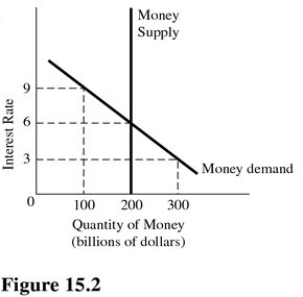 In Figure 15.2,the equilibrium rate of interest
The transactions demand for money is most closely associated with which of the following functions of money?
(Multiple Choice)
4.8/5 (65)
(65) In periods of restrictive monetary policy,which of the following industries are likely to feel a disproportionately large impact of the policy?
(Multiple Choice)
4.8/5 (78)
(78) Mark holds $100 in cash in his wallet to make purchases for gas and groceries.This represents the
(Multiple Choice)
4.8/5 (78)
(78) Use the equation of exchange to explain the impact of an increase in the money supply if velocity and output are stable.
(Essay)
4.8/5 (83)
(83) Which of the following is not true at the equilibrium rate of interest?
(Multiple Choice)
4.8/5 (77)
(77) Using the equation of exchange and assuming fixed price controls and a constant velocity of money,a decrease in the discount rate could temporarily result in
(Multiple Choice)
4.8/5 (80)
(80) 
Filters
- Essay(0)
- Multiple Choice(0)
- Short Answer(0)
- True False(0)
- Matching(0)