



 Chat with AI
Exam 15: Monetary Policy

Exam 1: Economics: the Core Issues152 Questions
Exam 2: The Useconomy: a Global View146 Questions
Exam 3: Supply and Demand164 Questions
Exam 4: The Role of Government153 Questions
Exam 5: National Income Accounting152 Questions
Exam 6: Unemployment147 Questions
Exam 7: Inflation152 Questions
Exam 8: The Business Cycle153 Questions
Exam 9: Aggregate Demand149 Questions
Exam 10: Self-Adjustment or Instability140 Questions
Exam 11: Fiscal Policy151 Questions
Exam 12: Deficits and Debt151 Questions
Exam 13: Money and Banks146 Questions
Exam 14: The Federal Reserve System146 Questions
Exam 15: Monetary Policy149 Questions
Exam 16: Supply-Side Policy: Short-Run Options147 Questions
Exam 17: Growth and Productivity: Long-Run Possibilities143 Questions
Exam 18: Theory Versus Reality146 Questions
Exam 19: Consumer Choice136 Questions
Exam 20: Elasticity141 Questions
Exam 21: The Costs of Production151 Questions
Exam 22: The Competitive Firm148 Questions
Exam 23: Competitive Markets150 Questions
Exam 24: Monopoly147 Questions
Exam 25: Oligopoly145 Questions
Exam 26: Monopolistic Competition144 Questions
Exam 27: Natural Monopolies: Deregulation144 Questions
Exam 28: Environmental Protection144 Questions
Exam 29: The Farm Problem132 Questions
Exam 30: The Labor Market137 Questions
Exam 31: Labor Unions144 Questions
Exam 32: Financial Markets146 Questions
Exam 33: Taxes: Equity Versus Efficiency146 Questions
Exam 34: Transfer Payments: Welfare and Social Security146 Questions
Exam 35: International Trade149 Questions
Exam 36: International Finance142 Questions
Exam 37: Global Poverty141 Questions
Select questions type


Effective expansionary monetary policy,according to Keynesian theorists,will do all of the following except
(Multiple Choice)
4.9/5  (83)
(83) The speculative demand for money is related to money functioning as a
(Multiple Choice)
4.8/5 (86)
(86) Assume the aggregate supply curve is horizontal and the economy is experiencing a recession.Which of the following is most likely to occur if the Fed pursues expansionary monetary policy?
(Multiple Choice)
4.7/5 (71)
(71) Which of the following causes the opportunity cost of holding money in the form of cash to decrease?
(Multiple Choice)
4.7/5 (97)
(97) 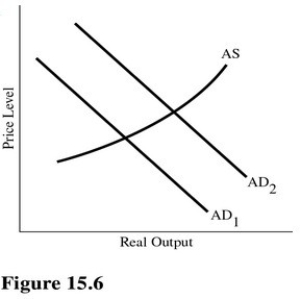 Refer to Figure 15.6.Which of the following Fed actions is most likely to decrease the aggregate demand curve from AD2 to AD1?
 (Multiple Choice)
4.7/5 (72)
(72) Why is expansionary monetary policy ineffective in the liquidity trap?
(Essay)
4.8/5 (79)
(79) How can the Fed increase the level of output for the economy through open market operations?
(Essay)
4.9/5 (92)
(92) Monetary policy is most likely to result in inflation when the aggregate supply curve is
(Multiple Choice)
4.9/5 (84)
(84) Monetary restraint is associated with all of the following except
(Multiple Choice)
4.8/5 (77)
(77) Currency held by the public,balances in transactions accounts,plus balances in most savings accounts and money market mutual funds are the
(Multiple Choice)
4.8/5 (84)
(84) Assume the price level is flexible both upward and downward but the Fed desires to keep the price level stable.If the level of aggregate supply decreases,the Fed must
(Multiple Choice)
4.8/5 (80)
(80) If the anticipated inflation rate is 5 percent and the nominal interest rate is 9 percent,the real interest rate will be
(Multiple Choice)
4.9/5 (75)
(75) Which of the following is a series of events that accurately describes the steps by which restrictive monetary policy is effective?
(Multiple Choice)
4.8/5 (78)
(78) U.S.multinational nonbank corporations can borrow money from all of the following except
(Multiple Choice)
4.9/5 (70)
(70) According to the equation of exchange,total spending will rise if the money supply decreases and velocity is stable.
(True/False)
5.0/5 (78)
(78) 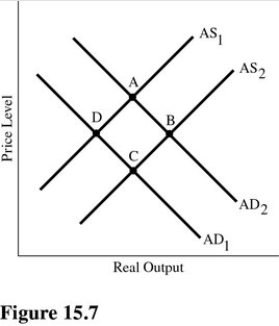 Refer to Figure 15.7.Suppose the Federal Reserve ________ bonds in the open market.The money supply will decrease and cause a shift from point ________.
 (Multiple Choice)
4.9/5 (82)
(82) 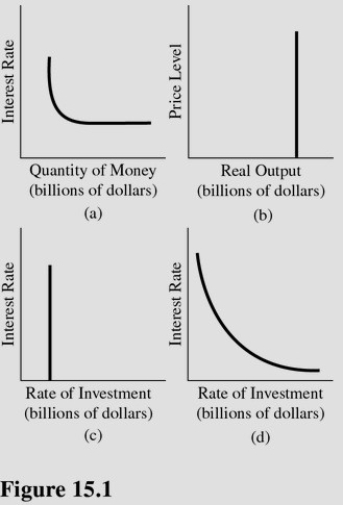 Which diagram in Figure 15.1 best represents a situation in which lower interest rates do not stimulate additional investment?
 (Multiple Choice)
4.8/5 (89)
(89) What should happen to the equilibrium interest rate and the corresponding rate of investment if the Fed decreases the discount rate?
(Multiple Choice)
4.9/5 (82)
(82) 
Filters
- Essay(0)
- Multiple Choice(0)
- Short Answer(0)
- True False(0)
- Matching(0)