



 Chat with AI
Exam 15: Monetary Policy

Exam 1: Economics: the Core Issues152 Questions
Exam 2: The Useconomy: a Global View146 Questions
Exam 3: Supply and Demand164 Questions
Exam 4: The Role of Government153 Questions
Exam 5: National Income Accounting152 Questions
Exam 6: Unemployment147 Questions
Exam 7: Inflation152 Questions
Exam 8: The Business Cycle153 Questions
Exam 9: Aggregate Demand149 Questions
Exam 10: Self-Adjustment or Instability140 Questions
Exam 11: Fiscal Policy151 Questions
Exam 12: Deficits and Debt151 Questions
Exam 13: Money and Banks146 Questions
Exam 14: The Federal Reserve System146 Questions
Exam 15: Monetary Policy149 Questions
Exam 16: Supply-Side Policy: Short-Run Options147 Questions
Exam 17: Growth and Productivity: Long-Run Possibilities143 Questions
Exam 18: Theory Versus Reality146 Questions
Exam 19: Consumer Choice136 Questions
Exam 20: Elasticity141 Questions
Exam 21: The Costs of Production151 Questions
Exam 22: The Competitive Firm148 Questions
Exam 23: Competitive Markets150 Questions
Exam 24: Monopoly147 Questions
Exam 25: Oligopoly145 Questions
Exam 26: Monopolistic Competition144 Questions
Exam 27: Natural Monopolies: Deregulation144 Questions
Exam 28: Environmental Protection144 Questions
Exam 29: The Farm Problem132 Questions
Exam 30: The Labor Market137 Questions
Exam 31: Labor Unions144 Questions
Exam 32: Financial Markets146 Questions
Exam 33: Taxes: Equity Versus Efficiency146 Questions
Exam 34: Transfer Payments: Welfare and Social Security146 Questions
Exam 35: International Trade149 Questions
Exam 36: International Finance142 Questions
Exam 37: Global Poverty141 Questions
Select questions type


Using the equation of exchange and assuming full employment and a constant velocity of money,a decrease in the required reserve ratio would result in a
(Multiple Choice)
4.9/5  (83)
(83) According to Bernanke's policy guide,a 1/4 point decrease in long-term interest rates results in a
(Multiple Choice)
4.8/5 (91)
(91) Assuming the aggregate supply curve is vertical,which of the following is most likely to occur if the Fed pursues expansionary monetary policy?
(Multiple Choice)
4.8/5 (86)
(86) 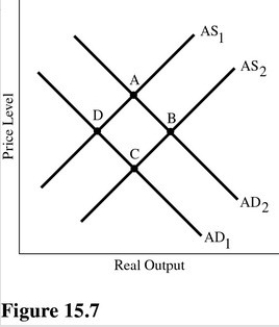 Refer to Figure 15.7.Suppose the money supply decreases.This will cause interest rates to ________ and cause a shift from point ________.
 (Multiple Choice)
5.0/5 (75)
(75) Keynes believed that monetary stimulus would be ineffective during a recession because of all of the following except
(Multiple Choice)
4.9/5 (62)
(62) Which of the following groups believes monetary policy to be effective for fighting inflation but not for changing real output?
(Multiple Choice)
4.9/5 (63)
(63) Which of the following is less sensitive to interest rate changes?
(Multiple Choice)
4.7/5 (92)
(92) The money supply curve as determined by current Federal Reserve policy is
(Multiple Choice)
4.9/5 (85)
(85) If the real rate of interest is negative,then,ceteris paribus,
(Multiple Choice)
4.8/5 (97)
(97) The liquidity trap exists because the lower portion of the money demand curve is horizontal.
(True/False)
4.7/5 (79)
(79) In which of the following situations is expansionary monetary policy most effective?
(Multiple Choice)
4.8/5 (69)
(69) Ceteris paribus,the quantities of money people are willing and able to hold
(Multiple Choice)
5.0/5 (86)
(86) Money held for making everyday market purchases represents the
(Multiple Choice)
4.8/5 (78)
(78) 
Filters
- Essay(0)
- Multiple Choice(0)
- Short Answer(0)
- True False(0)
- Matching(0)