



 Chat with AI
Exam 36: International Finance

Exam 1: Economics: the Core Issues152 Questions
Exam 2: The Useconomy: a Global View146 Questions
Exam 3: Supply and Demand164 Questions
Exam 4: The Role of Government153 Questions
Exam 5: National Income Accounting152 Questions
Exam 6: Unemployment147 Questions
Exam 7: Inflation152 Questions
Exam 8: The Business Cycle153 Questions
Exam 9: Aggregate Demand149 Questions
Exam 10: Self-Adjustment or Instability140 Questions
Exam 11: Fiscal Policy151 Questions
Exam 12: Deficits and Debt151 Questions
Exam 13: Money and Banks146 Questions
Exam 14: The Federal Reserve System146 Questions
Exam 15: Monetary Policy149 Questions
Exam 16: Supply-Side Policy: Short-Run Options147 Questions
Exam 17: Growth and Productivity: Long-Run Possibilities143 Questions
Exam 18: Theory Versus Reality146 Questions
Exam 19: Consumer Choice136 Questions
Exam 20: Elasticity141 Questions
Exam 21: The Costs of Production151 Questions
Exam 22: The Competitive Firm148 Questions
Exam 23: Competitive Markets150 Questions
Exam 24: Monopoly147 Questions
Exam 25: Oligopoly145 Questions
Exam 26: Monopolistic Competition144 Questions
Exam 27: Natural Monopolies: Deregulation144 Questions
Exam 28: Environmental Protection144 Questions
Exam 29: The Farm Problem132 Questions
Exam 30: The Labor Market137 Questions
Exam 31: Labor Unions144 Questions
Exam 32: Financial Markets146 Questions
Exam 33: Taxes: Equity Versus Efficiency146 Questions
Exam 34: Transfer Payments: Welfare and Social Security146 Questions
Exam 35: International Trade149 Questions
Exam 36: International Finance142 Questions
Exam 37: Global Poverty141 Questions
Select questions type


Under a fixed exchange rate regime,what will happen to the balance of payments for the United States and Mexico when the demand for Mexican goods rises? What is the only possible solution to this problem,given the fixed exchange rate?
(Essay)
4.9/5  (94)
(94) Ceteris paribus,if interest rates in the United States rise relative to those abroad,then the surplus in the U.S.capital account would
(Multiple Choice)
4.9/5 (77)
(77) When foreigners buy U.S.dollars because they are a more stable currency than the currencies in their countries,they are generating a
(Multiple Choice)
4.9/5 (97)
(97) Use a model of the dollar-euro foreign exchange market to illustrate how the value of the dollar is determined in terms of the euro.Identify two factors that would increase the value of the dollar in terms of the euro.
(Essay)
4.9/5 (80)
(80) A depreciation of the South Korean won against the U.S.dollar will
(Multiple Choice)
4.9/5 (82)
(82) When American companies buy office buildings in Australia,they are generating a
(Multiple Choice)
4.8/5 (87)
(87) Suppose that at the prevailing euro-dollar exchange rate there is an excess demand for dollars.To stabilize exchange rates,the United States might
(Multiple Choice)
4.9/5 (78)
(78) Ceteris paribus,if Americans decide they want to drive more German-made cars,this causes the ________ German currency to ________.
(Multiple Choice)
4.9/5 (82)
(82) 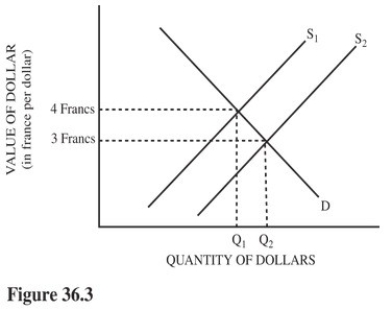 Suppose the supply of dollars decreased from S2 to S1 in Figure 36.3.As a result of this change,
 (Multiple Choice)
4.8/5 (81)
(81) Because of the United States' long-standing trade deficit with Japan,the supply of U.S.dollars in Japan has increased.Which of the following is true about this situation?
(Multiple Choice)
4.9/5 (82)
(82) Yesterday the exchange rate was €1 = $1.30,and today it is €1 = $1.35.In this case the dollar has appreciated.
(True/False)
4.9/5 (86)
(86) An increase in the price of the U.S.dollar in terms of euros will cause,ceteris paribus,
(Multiple Choice)
4.9/5 (88)
(88) A system in which governments intervene in foreign exchange markets to limit but not eliminate exchange rate fluctuations is referred to as
(Multiple Choice)
5.0/5 (84)
(84) 
Filters
- Essay(0)
- Multiple Choice(0)
- Short Answer(0)
- True False(0)
- Matching(0)