



 Chat with AI
Exam 36: International Finance

Exam 1: Economics: the Core Issues152 Questions
Exam 2: The Useconomy: a Global View146 Questions
Exam 3: Supply and Demand164 Questions
Exam 4: The Role of Government153 Questions
Exam 5: National Income Accounting152 Questions
Exam 6: Unemployment147 Questions
Exam 7: Inflation152 Questions
Exam 8: The Business Cycle153 Questions
Exam 9: Aggregate Demand149 Questions
Exam 10: Self-Adjustment or Instability140 Questions
Exam 11: Fiscal Policy151 Questions
Exam 12: Deficits and Debt151 Questions
Exam 13: Money and Banks146 Questions
Exam 14: The Federal Reserve System146 Questions
Exam 15: Monetary Policy149 Questions
Exam 16: Supply-Side Policy: Short-Run Options147 Questions
Exam 17: Growth and Productivity: Long-Run Possibilities143 Questions
Exam 18: Theory Versus Reality146 Questions
Exam 19: Consumer Choice136 Questions
Exam 20: Elasticity141 Questions
Exam 21: The Costs of Production151 Questions
Exam 22: The Competitive Firm148 Questions
Exam 23: Competitive Markets150 Questions
Exam 24: Monopoly147 Questions
Exam 25: Oligopoly145 Questions
Exam 26: Monopolistic Competition144 Questions
Exam 27: Natural Monopolies: Deregulation144 Questions
Exam 28: Environmental Protection144 Questions
Exam 29: The Farm Problem132 Questions
Exam 30: The Labor Market137 Questions
Exam 31: Labor Unions144 Questions
Exam 32: Financial Markets146 Questions
Exam 33: Taxes: Equity Versus Efficiency146 Questions
Exam 34: Transfer Payments: Welfare and Social Security146 Questions
Exam 35: International Trade149 Questions
Exam 36: International Finance142 Questions
Exam 37: Global Poverty141 Questions
Select questions type


All of the following are true regarding flexible exchange rates except
(Multiple Choice)
4.9/5  (82)
(82) An excess demand for domestic currency at current exchange rates is known as a
(Multiple Choice)
4.9/5 (86)
(86) Suppose a bottle of wine produced in France sells for 35 euros.If the exchange rate between euros and dollars is €1 = $1.30,how much will an American pay for the bottle of wine in America?
(Multiple Choice)
4.8/5 (86)
(86) In foreign exchange markets,the supply of U.S.dollars is determined by all of the following except
(Multiple Choice)
4.7/5 (78)
(78) In a floating exchange rate system,the capital account balance equals the negative of the current account balance.
(True/False)
5.0/5 (99)
(99) The fact that the United States has become a net debtor nation is an indication that
(Multiple Choice)
5.0/5 (82)
(82) If the exchange rate between the U.S.dollar and Japanese yen changes from $1 = 100 yen to $1 = 90 yen,then
(Multiple Choice)
4.7/5 (86)
(86) Explain what economists mean when they say that the United States is a net debtor nation.Identify a potential problem and a positive aspect associated with this status.
(Essay)
4.8/5 (83)
(83) The excess supply of dollars created by a balance-of-trade deficit must be offset by outflows of capital.
(True/False)
4.8/5 (74)
(74) Generally speaking,a country whose currency appreciates will experience,as a result,
(Multiple Choice)
4.9/5 (68)
(68) 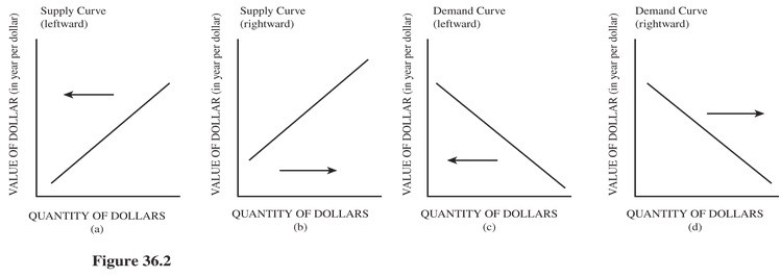 Choose the letter of the diagram in Figure 36.2 that represents the shift in the foreign exchange market for dollars given the following situation,ceteris paribus: The president of the United States decides to support the dollar by purchasing dollars with U.S.holdings of foreign currencies.
 (Multiple Choice)
4.8/5 (73)
(73) When Americans buy Mercedes-Benz automobiles made in Germany,they are generating a
(Multiple Choice)
4.9/5 (80)
(80) 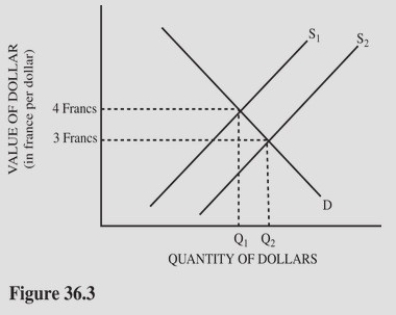 Suppose the supply of dollars increased from S1 to S2 in Figure 36.3.As a result of this change,
 (Multiple Choice)
4.9/5 (75)
(75) If income in the United States rises relative to income in Japan,the yen should appreciate against the dollar,ceteris paribus.
(True/False)
5.0/5 (82)
(82) 
Filters
- Essay(0)
- Multiple Choice(0)
- Short Answer(0)
- True False(0)
- Matching(0)