



 Chat with AI
Exam 36: International Finance

Exam 1: Economics: the Core Issues152 Questions
Exam 2: The Useconomy: a Global View146 Questions
Exam 3: Supply and Demand164 Questions
Exam 4: The Role of Government153 Questions
Exam 5: National Income Accounting152 Questions
Exam 6: Unemployment147 Questions
Exam 7: Inflation152 Questions
Exam 8: The Business Cycle153 Questions
Exam 9: Aggregate Demand149 Questions
Exam 10: Self-Adjustment or Instability140 Questions
Exam 11: Fiscal Policy151 Questions
Exam 12: Deficits and Debt151 Questions
Exam 13: Money and Banks146 Questions
Exam 14: The Federal Reserve System146 Questions
Exam 15: Monetary Policy149 Questions
Exam 16: Supply-Side Policy: Short-Run Options147 Questions
Exam 17: Growth and Productivity: Long-Run Possibilities143 Questions
Exam 18: Theory Versus Reality146 Questions
Exam 19: Consumer Choice136 Questions
Exam 20: Elasticity141 Questions
Exam 21: The Costs of Production151 Questions
Exam 22: The Competitive Firm148 Questions
Exam 23: Competitive Markets150 Questions
Exam 24: Monopoly147 Questions
Exam 25: Oligopoly145 Questions
Exam 26: Monopolistic Competition144 Questions
Exam 27: Natural Monopolies: Deregulation144 Questions
Exam 28: Environmental Protection144 Questions
Exam 29: The Farm Problem132 Questions
Exam 30: The Labor Market137 Questions
Exam 31: Labor Unions144 Questions
Exam 32: Financial Markets146 Questions
Exam 33: Taxes: Equity Versus Efficiency146 Questions
Exam 34: Transfer Payments: Welfare and Social Security146 Questions
Exam 35: International Trade149 Questions
Exam 36: International Finance142 Questions
Exam 37: Global Poverty141 Questions
Select questions type


The demand for U.S.dollars originates from all of the following except
(Multiple Choice)
4.8/5  (86)
(86) 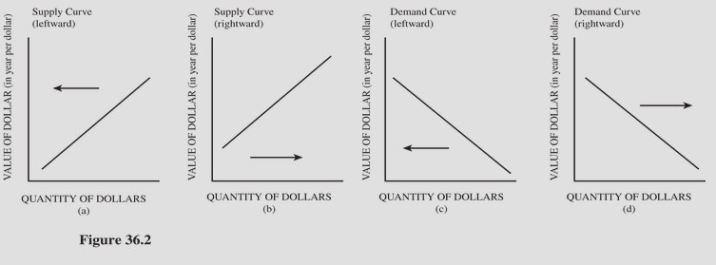 Choose the letter of the diagram in Figure 36.2 that represents the shift in the foreign exchange market for dollars given the following situation,ceteris paribus: A sudden,unexpected surge in inflation in the United States causes reduced purchases of U.S.goods by foreigners.
 (Multiple Choice)
4.7/5 (68)
(68) 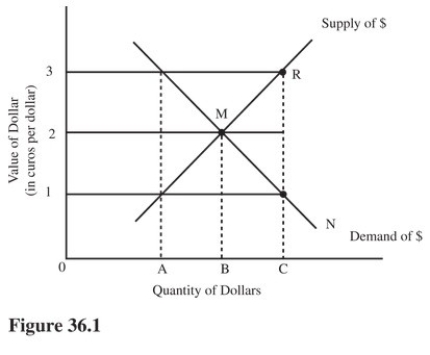 You have decided to purchase,directly from the French manufacturer,a helicopter that costs 800,000 euros.At the equilibrium exchange rate between dollars and euros in Figure 36.1,this purchase will cost you
 (Multiple Choice)
4.9/5 (73)
(73) When foreigners come to the United States as tourists,they are generating a
(Multiple Choice)
4.9/5 (70)
(70) The balance of payments is the domestic price of a foreign currency.
(True/False)
4.8/5 (80)
(80) Except for any statistical errors,any current account deficit
(Multiple Choice)
4.7/5 (77)
(77) The supply of U.S.dollars in the foreign exchange market originates from
(Multiple Choice)
4.8/5 (86)
(86) If speculators with Swiss francs believed the yen was going to depreciate against the dollar,they would most likely: =
(Multiple Choice)
4.8/5 (77)
(77) A good time for an American to hold German stocks,ceteris paribus,is when the
(Multiple Choice)
4.7/5 (81)
(81) Suppose a men's suit produced in Moldavia sells for 250 euros.If the exchange rate between euros and dollars is €1 = $1.38,how much will an American pay for the suit?
(Multiple Choice)
4.8/5 (88)
(88) A major problem with countries setting fixed exchange rates for their currencies is
(Multiple Choice)
4.9/5 (77)
(77) The article on China's $4 trillion of reserves indicates that the yuan's depreciation is due to
(Multiple Choice)
4.9/5 (74)
(74) The depreciation of a country's currency causes the price of imports to
(Multiple Choice)
5.0/5 (76)
(76) Which of the following generates demand for foreign currencies?
(Multiple Choice)
4.8/5 (89)
(89) The demand for U.S.dollars in the foreign exchange market is determined by all of the following except
(Multiple Choice)
4.8/5 (69)
(69) 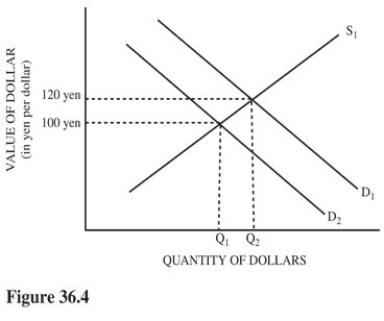 As a result of an increase in demand from D2 to D1 in Figure 36.4,ceteris paribus,the price of a $40,000 U.S.computer system,in terms of Japanese yen,would: =
 (Multiple Choice)
4.8/5 (86)
(86) 
Filters
- Essay(0)
- Multiple Choice(0)
- Short Answer(0)
- True False(0)
- Matching(0)