



 Chat with AI
Exam 16: B--The Digestive System

Exam 1: Introduction to Physiology and Homeostasis81 Questions
Exam 2: Cell Physiology135 Questions
Exam 3: The Plasma Membrane and Membrane Potential182 Questions
Exam 4: Principles of Neural and Hormonal Communication169 Questions
Exam 5: A--The Central Nervous System202 Questions
Exam 5: B--The Central Nervous System14 Questions
Exam 6: A--The Peripheral Nervous System: Afferent Division; Special Senses196 Questions
Exam 6: B--The Peripheral Nervous System: Afferent Division; Special Senses20 Questions
Exam 7: The Peripheral Nervous System: Efferent Division104 Questions
Exam 8: A--Muscle Physiology199 Questions
Exam 8: B--Muscle Physiology13 Questions
Exam 9: A--Cardiac Physiology159 Questions
Exam 9: B--Cardiac Physiology20 Questions
Exam 10: The Blood Vessels and Blood Pressure213 Questions
Exam 11: The Blood175 Questions
Exam 12: Body Defenses188 Questions
Exam 13: A--The Respiratory System198 Questions
Exam 13: B--The Respiratory System12 Questions
Exam 14: A--The Urinary System217 Questions
Exam 14: B--The Urinary System19 Questions
Exam 15: A--Fluid and Acid-Base Balance190 Questions
Exam 15: B--Fluid and Acid-Base Balance9 Questions
Exam 16: A--The Digestive System236 Questions
Exam 16: B--The Digestive System12 Questions
Exam 17: Energy Balance and Temperature Regulation139 Questions
Exam 18: A--Principles of Endocrinology: the Central Endocrine Glands204 Questions
Exam 18: B--Principles of Endocrinology: the Central Endocrine Glands6 Questions
Exam 19: A--The Peripheral Endocrine Glands196 Questions
Exam 19: B--The Peripheral Endocrine Glands6 Questions
Exam 20: A--The Reproductive System235 Questions
Exam 20: B--The Reproductive System5 Questions
Select questions type


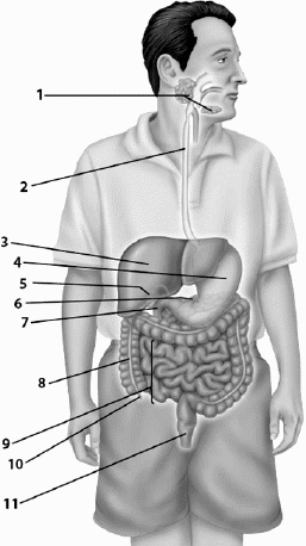
Use this figure to answer the corresponding questions.
The hormone called secretin has a stimulatory effect on the ____________________ (labeled # ____) and the ____________________ (labeled # ____), but it has an inhibitory effect on the ____________________ (labeled # ____).

Free
(Short Answer)
4.9/5  (85)
(85) Correct Answer: Verified
liver, 3, pancreas, 6, stomach, 4
Describe the defecation reflex. Include the following in your
Free
(Essay)
4.7/5 (78)
(78) Correct Answer:Verified
Verifiedrectum, external anal sphincter, mass movement, and internal anal sphincter.
Use this figure to answer the corresponding questions.
Match the following statements with all appropriate organ number(s). Some numbers may be used more than once.
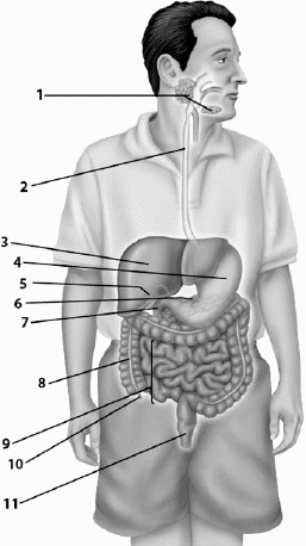 _________Secretes hormones that inhibit the stomach
_________Synthesizes bile
_________Contains parietal and chief cells
_________All organs that produce an enzyme that hydrolyzes starch
_________Experiencesmassmovement
_________Three structures attached to the cecum
_________Contains crypts of Lieberkühn
_________Stores a substance needed for fat emulsification
_________Stretchingthis iritiates the defecation reflex
_________Experiences segmentation
_________Stretchingthis initiates the gastroileal and gastrocolic reflexes
_________Experienceshaustral churning
_________Secretes hormones that inhibit the stomach
_________Synthesizes bile
_________Contains parietal and chief cells
_________All organs that produce an enzyme that hydrolyzes starch
_________Experiencesmassmovement
_________Three structures attached to the cecum
_________Contains crypts of Lieberkühn
_________Stores a substance needed for fat emulsification
_________Stretchingthis iritiates the defecation reflex
_________Experiences segmentation
_________Stretchingthis initiates the gastroileal and gastrocolic reflexes
_________Experienceshaustral churning
Free
(Short Answer)
4.9/5 (87)
(87) Correct Answer:Verified
Verified7, 3, 4, 1 and 6, 8, 8-9-10, 7 and 9, 5, 11, 7 and 9, 4, 8
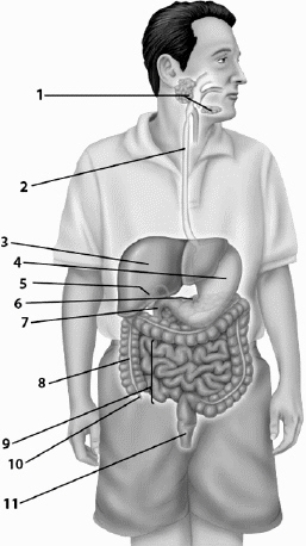
Use this figure to answer the corresponding questions.
Number ____ identifies the ____________________, which utilizes SGLT and GLUT-5 carriers.
(Short Answer)
4.8/5 (79)
(79) Describe factors within the stomach and duodenum, and those outside the digestive system that affect gastric motility and emptying.
(Essay)
4.8/5 (77)
(77) Describe the chemical digestion of proteins, including the sites where it occurs, specific enzymes involved and their actions, the sources of the enzymes, and how certain enzymes are activated.
(Essay)
4.8/5 (67)
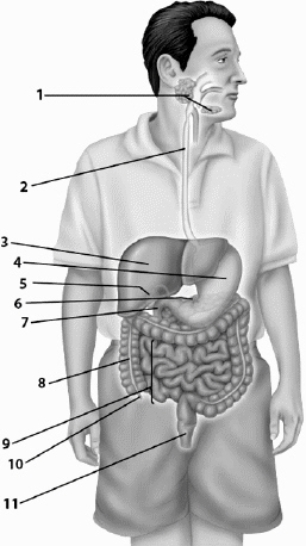
(67) Use this figure to answer the corresponding questions.
Number ____ identifies the ____________________, which secretes three proteolytic enzyme precursors. After activation, these precursors become three active enzymes including ____________________, ____________________, and ____________________.
(Essay)
4.7/5 (71)
(71) Describe how food in the stomach affects other structures in the digestive system. Include information about hormonal and neural reflexes.
(Essay)
4.7/5 (80)
(80) Indicate which item in the top column best describes the item in the bottom column by writing the appropriate letter in the blank.
enzyme for carbohydrate digestion that functions 1. Trypsin(ogen) primarily in the body of the stomach \_\_\_ 2. first to activate pepsinogen \_\_\_ 3. Secretin stimulates pancreatic acinar cells \_\_\_ enzyme for protein digestion secreted by 4. Pyloric gland area pancreas \_\_\_ 5. Lipase enzyme for fat digestion \_\_\_ 6. Gastrin stimulates parietal and chief cells \_\_\_ 7. Cholecystokinin secreted by chief cells \_\_\_ 8. Pancreatic acinar cell secretes gastrin \_\_\_ secreted by duodenal cells in response to the 9. Pepsin(ogen) presence of acid \_\_\_ 10. Aminopeptidase secretes pancreatic enzymes \_\_\_ 11. Salivary amylase functions inside brush border \_\_\_ 12. Pancreatic duct cell secretes \_\_\_
(Essay)
4.8/5 (71)
(71) Match digestive enzyme with correct characteristic.
Correct Answer:Verified
VerifiedPremises:
Responses:
(Matching)
4.7/5 (90)
(90) Match hormone with action.
Correct Answer:Verified
VerifiedPremises:
Responses:
(Matching)
4.9/5 (91)
(91) 
Filters
- Essay(0)
- Multiple Choice(0)
- Short Answer(0)
- True False(0)
- Matching(0)