



 Chat with AI
Exam 17: Energy Balance and Temperature Regulation

Exam 1: Introduction to Physiology and Homeostasis81 Questions
Exam 2: Cell Physiology135 Questions
Exam 3: The Plasma Membrane and Membrane Potential182 Questions
Exam 4: Principles of Neural and Hormonal Communication169 Questions
Exam 5: A--The Central Nervous System202 Questions
Exam 5: B--The Central Nervous System14 Questions
Exam 6: A--The Peripheral Nervous System: Afferent Division; Special Senses196 Questions
Exam 6: B--The Peripheral Nervous System: Afferent Division; Special Senses20 Questions
Exam 7: The Peripheral Nervous System: Efferent Division104 Questions
Exam 8: A--Muscle Physiology199 Questions
Exam 8: B--Muscle Physiology13 Questions
Exam 9: A--Cardiac Physiology159 Questions
Exam 9: B--Cardiac Physiology20 Questions
Exam 10: The Blood Vessels and Blood Pressure213 Questions
Exam 11: The Blood175 Questions
Exam 12: Body Defenses188 Questions
Exam 13: A--The Respiratory System198 Questions
Exam 13: B--The Respiratory System12 Questions
Exam 14: A--The Urinary System217 Questions
Exam 14: B--The Urinary System19 Questions
Exam 15: A--Fluid and Acid-Base Balance190 Questions
Exam 15: B--Fluid and Acid-Base Balance9 Questions
Exam 16: A--The Digestive System236 Questions
Exam 16: B--The Digestive System12 Questions
Exam 17: Energy Balance and Temperature Regulation139 Questions
Exam 18: A--Principles of Endocrinology: the Central Endocrine Glands204 Questions
Exam 18: B--Principles of Endocrinology: the Central Endocrine Glands6 Questions
Exam 19: A--The Peripheral Endocrine Glands196 Questions
Exam 19: B--The Peripheral Endocrine Glands6 Questions
Exam 20: A--The Reproductive System235 Questions
Exam 20: B--The Reproductive System5 Questions
Select questions type


An elevated body temperature is always indicative of an infection.
(True/False)
4.9/5  (78)
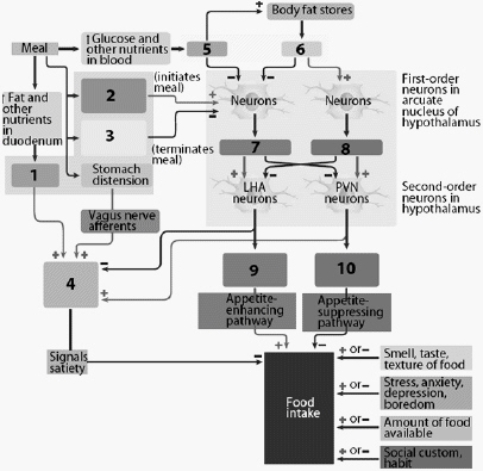
(78) Use this figure to answer the corresponding questions.
Based on the information provided in the figure, number 2 is ____________________, and it ultimately has a negative effect on the secretion of ____________________ (number 7).
(Short Answer)
4.9/5 (66)
(66) The most dominant factor influencing the BMR is the level of circulating, active thyroid hormone.
(True/False)
4.8/5 (69)
(69) The factor that increases the metabolic rate to the greatest extent is increased
(Multiple Choice)
4.8/5 (79)
(79) The body temperature is normally maintained at an elevated level during sustained exercise.
(True/False)
4.9/5 (75)
(75) Aspirin reduces a fever by inhibiting the synthesis of prostaglandins.
(True/False)
4.9/5 (78)
(78) The core temperature is maintained at a near constant level, but skin temperature is quite variable.
(True/False)
4.8/5 (87)
(87) An animal can be driven to overeat either by selective stimulation of the appetite centers or by destruction of the satiety centers.
(True/False)
4.7/5 (80)
(80) The presence of skin blood vessels diminishes the effectiveness of the skin as an insulator.
(True/False)
4.9/5 (91)
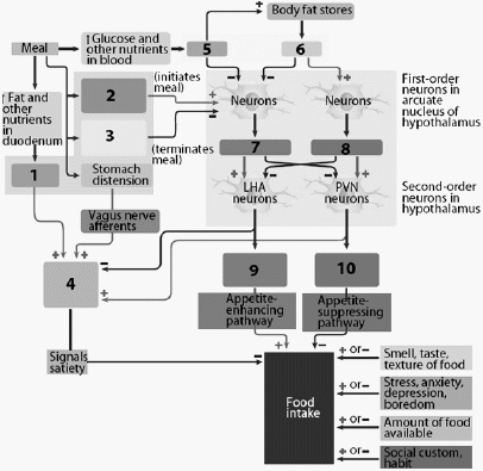
(91) Use this figure to answer the corresponding questions.
The substance labeled 3 is called ____________________, and it is released from the ____________________ during a meal.
(Essay)
4.8/5 (82)
(82) Complete each of the following statments.
A(n) ____________________ energy balance occurs when the amount of energy in food intake equals the amount of energy expended by the muscles performing external work.
(Short Answer)
4.8/5 (78)
(78) Which of the following does not characterize heat exhaustion?
(Multiple Choice)
5.0/5 (72)
(72) As the level of circulating, active thyroid hormone increases, the BMR increases correspondingly.
(True/False)
4.8/5 (67)
(67) 
Filters
- Essay(0)
- Multiple Choice(0)
- Short Answer(0)
- True False(0)
- Matching(0)