



 Chat with AI
Exam 7: The Peripheral Nervous System: Efferent Division

Exam 1: Introduction to Physiology and Homeostasis81 Questions
Exam 2: Cell Physiology135 Questions
Exam 3: The Plasma Membrane and Membrane Potential182 Questions
Exam 4: Principles of Neural and Hormonal Communication169 Questions
Exam 5: A--The Central Nervous System202 Questions
Exam 5: B--The Central Nervous System14 Questions
Exam 6: A--The Peripheral Nervous System: Afferent Division; Special Senses196 Questions
Exam 6: B--The Peripheral Nervous System: Afferent Division; Special Senses20 Questions
Exam 7: The Peripheral Nervous System: Efferent Division104 Questions
Exam 8: A--Muscle Physiology199 Questions
Exam 8: B--Muscle Physiology13 Questions
Exam 9: A--Cardiac Physiology159 Questions
Exam 9: B--Cardiac Physiology20 Questions
Exam 10: The Blood Vessels and Blood Pressure213 Questions
Exam 11: The Blood175 Questions
Exam 12: Body Defenses188 Questions
Exam 13: A--The Respiratory System198 Questions
Exam 13: B--The Respiratory System12 Questions
Exam 14: A--The Urinary System217 Questions
Exam 14: B--The Urinary System19 Questions
Exam 15: A--Fluid and Acid-Base Balance190 Questions
Exam 15: B--Fluid and Acid-Base Balance9 Questions
Exam 16: A--The Digestive System236 Questions
Exam 16: B--The Digestive System12 Questions
Exam 17: Energy Balance and Temperature Regulation139 Questions
Exam 18: A--Principles of Endocrinology: the Central Endocrine Glands204 Questions
Exam 18: B--Principles of Endocrinology: the Central Endocrine Glands6 Questions
Exam 19: A--The Peripheral Endocrine Glands196 Questions
Exam 19: B--The Peripheral Endocrine Glands6 Questions
Exam 20: A--The Reproductive System235 Questions
Exam 20: B--The Reproductive System5 Questions
Select questions type


Most innervated blood vessels receive only sympathetic nerve fibers.
(True/False)
4.9/5  (79)
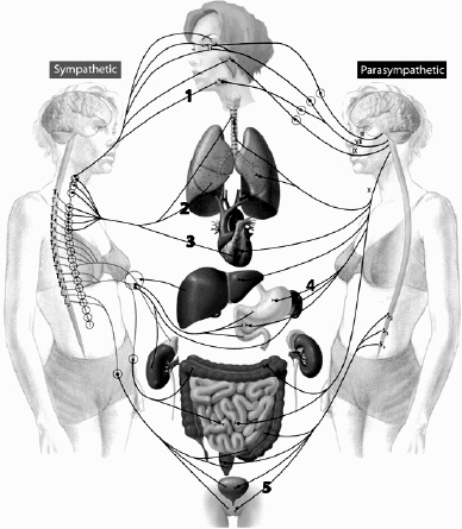
(79) Use this figure to answer the following questions.
Which neuron releases a neurotransmitter that binds to B2 receptors?
 a. 1 and 5 only
b. 3 and 4 only
c. 3 only
d. 5 only
e. 1, 3, and 5
a. 1 and 5 only
b. 3 and 4 only
c. 3 only
d. 5 only
e. 1, 3, and 5
(Short Answer)
4.8/5 (92)
(92) Which one of the following involves a response of a skeletal muscle through an efferent output?
(Multiple Choice)
4.8/5 (73)
(73) Sequencing
Indicate the proper sequence of events at the neuromuscular junction by filling in the blank with the appropriate number from 2 through 7. Numbers 1 and 8 are already identified.
\begin{array}{|l|l|}\hline &\text {AChis released from the axon terminal by exocytosis. } \\\hline &\text {AnEPP takes place, primarily as a result of \mathrm{Na} influx. } \\\hline 8 &\text {A cetylcholinesterase inactivates \( \mathrm{ACh} \), terminating activity at the neuromuscular junction } \\\hline 1&\text {An action potential is propagated to an axon terminal of a motor neuron } \\\hline &\text {Channels that permit passage of \( \mathrm{Na}^{+} \)and \( \mathrm{K} \) are opened in the motor end plate. } \\\hline &\text {\( \mathrm{Ca}^{2+} \) channels are opened in the axon terminal. } \\\hline &\text {Local current flow between the motor end plate and adjac ent mus de-cell membrane initiates an action potential that spreads } \\&\text { throughout the muscle fiber. }\\\hline &\text {ACh binds with receptor sites on the motor end plate. } \\\hline \end{array}
(Short Answer)
4.8/5 (87)
(87) Describe the events that occur at a skeletal neuromuscular junction. Include the following in your
(Essay)
4.9/5 (72)
(72) The salivary glands and the eye are sympathetically innervated by cranial nerves.
(True/False)
4.8/5 (87)
(87) The autonomic nervous system mainly controls smooth and cardiac muscles, but it can inhibit a few skeletal muscles.
(True/False)
4.9/5 (85)
(85) Action potentials are transmitted on a one-to-one basis at both a neuromuscular junction and a synapse.
(True/False)
4.9/5 (63)
(63) What are the various ways in which toxins can interfere with normal neuron functioning?
(Essay)
4.8/5 (86)
(86) Which of the following chemicals paralyzes skeletal muscle by binding to the acetylcholine receptor sites?
(Multiple Choice)
4.9/5 (76)
(76) The sympathetic postganglionic fibers that innervate the sweat glands secrete acetylcholine rather than norepinephrine.
(True/False)
4.8/5 (78)
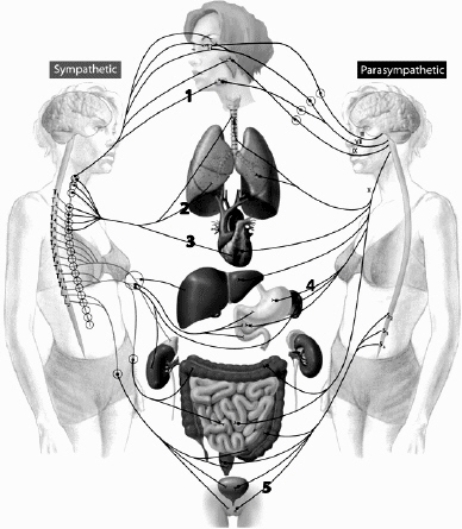
(78) Use this figure to answer the following questions.
The axons labeled 1 would release ____ and have a(n) ____ effect on the effector organ.
 a. ACh; inhibitory
b. ACh; excitatory
c. NE; inhibitory
d. NE; excitatory
e. NE; inhibitory and ACh; excitatory
a. ACh; inhibitory
b. ACh; excitatory
c. NE; inhibitory
d. NE; excitatory
e. NE; inhibitory and ACh; excitatory
(Short Answer)
5.0/5 (79)
(79) Most innervated blood vessels receive sympathetic and parasympathetic fibers.
(True/False)
4.9/5 (86)
(86) Complete each of the following statments.
Most sympathetic postganglionic fibers secrete the neurotransmitter ____________________, whereas all parasympathetic postganglionic fibers secrete the neurotransmitter ____________________.
(Essay)
4.7/5 (82)
(82) Muscarinic receptors are found on the effector cells innervated by the sympathetic division.
(True/False)
4.9/5 (76)
(76) What system would suppress the digestive organs during times of greater physical activity?
(Multiple Choice)
4.7/5 (69)
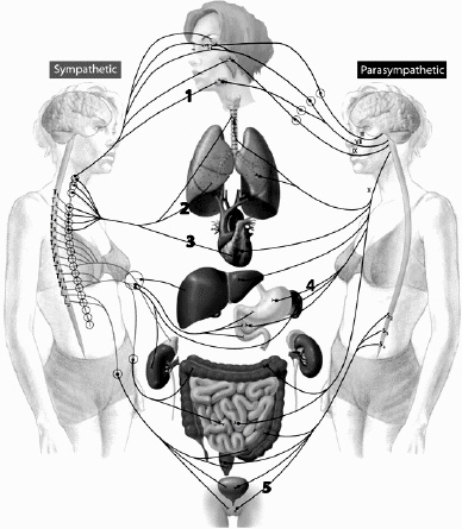
(69) Use this figure to answer the following questions.
Neuron 2
 a. uses adrenergic receptors to respond to stimulation by a preganglionic neuron
b. releases NE onto a very short postganglionic neuron
c. releases a chemical that binds to adrenergic receptors on a postganglionic neuron
d. all of these
e. none of these
a. uses adrenergic receptors to respond to stimulation by a preganglionic neuron
b. releases NE onto a very short postganglionic neuron
c. releases a chemical that binds to adrenergic receptors on a postganglionic neuron
d. all of these
e. none of these
(Short Answer)
5.0/5 (71)
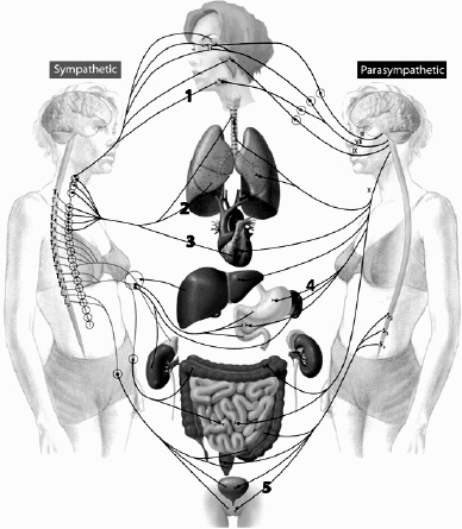
(71) Use this figure to answer the following questions.
Identify the correct statement(s):
 a. Neuron 5 causes contraction of its effector.
b. Neuron 6 is stimulated by ACh released from a preganglionic neuron.
c. Neuron 1 causes constriction of bronchioles
d. Neuron 2 releases a chemical that binds to nicotinic receptors on a postganglionic neuron.
e. Two of the above.
a. Neuron 5 causes contraction of its effector.
b. Neuron 6 is stimulated by ACh released from a preganglionic neuron.
c. Neuron 1 causes constriction of bronchioles
d. Neuron 2 releases a chemical that binds to nicotinic receptors on a postganglionic neuron.
e. Two of the above.
(Short Answer)
4.9/5 (87)
(87) 
Filters
- Essay(0)
- Multiple Choice(0)
- Short Answer(0)
- True False(0)
- Matching(0)