



 Chat with AI
Exam 9: B--Cardiac Physiology

Exam 1: Introduction to Physiology and Homeostasis81 Questions
Exam 2: Cell Physiology135 Questions
Exam 3: The Plasma Membrane and Membrane Potential182 Questions
Exam 4: Principles of Neural and Hormonal Communication169 Questions
Exam 5: A--The Central Nervous System202 Questions
Exam 5: B--The Central Nervous System14 Questions
Exam 6: A--The Peripheral Nervous System: Afferent Division; Special Senses196 Questions
Exam 6: B--The Peripheral Nervous System: Afferent Division; Special Senses20 Questions
Exam 7: The Peripheral Nervous System: Efferent Division104 Questions
Exam 8: A--Muscle Physiology199 Questions
Exam 8: B--Muscle Physiology13 Questions
Exam 9: A--Cardiac Physiology159 Questions
Exam 9: B--Cardiac Physiology20 Questions
Exam 10: The Blood Vessels and Blood Pressure213 Questions
Exam 11: The Blood175 Questions
Exam 12: Body Defenses188 Questions
Exam 13: A--The Respiratory System198 Questions
Exam 13: B--The Respiratory System12 Questions
Exam 14: A--The Urinary System217 Questions
Exam 14: B--The Urinary System19 Questions
Exam 15: A--Fluid and Acid-Base Balance190 Questions
Exam 15: B--Fluid and Acid-Base Balance9 Questions
Exam 16: A--The Digestive System236 Questions
Exam 16: B--The Digestive System12 Questions
Exam 17: Energy Balance and Temperature Regulation139 Questions
Exam 18: A--Principles of Endocrinology: the Central Endocrine Glands204 Questions
Exam 18: B--Principles of Endocrinology: the Central Endocrine Glands6 Questions
Exam 19: A--The Peripheral Endocrine Glands196 Questions
Exam 19: B--The Peripheral Endocrine Glands6 Questions
Exam 20: A--The Reproductive System235 Questions
Exam 20: B--The Reproductive System5 Questions
Select questions type


Use this figure to answer the corresponding questions.
Which structures are closed during ventricular ejection?
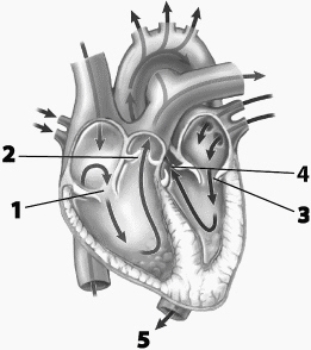 a. 1and 2
b. 1 and 3
c. 2 and 3
d. 1,2,3 and 4
e. only 3 and 4
a. 1and 2
b. 1 and 3
c. 2 and 3
d. 1,2,3 and 4
e. only 3 and 4
Free
(Short Answer)
4.8/5  (91)
(91) Correct Answer: Verified
B
List the following in the correct order of their occurrence within the ST segment on the ECG: ventricular ejection begins, lub sound, opening of semilunar valves, period of isovolumetric contraction, closing of AV valves, ventricular systole begins.
Free
(Essay)
4.7/5 (85)
(85) Correct Answer:Verified
Verified1. ventricular systole begins
2. closing of AV valves
3. lub sound
4. best time to measure EDV
5. opening of semilunar valves
6. ventricular ejection begins
Describe how contractile cells are able to contract rapidly but are not likely to experience tetanus. Include the following terms in your
Free
(Essay)
4.8/5 (62)
(62) Correct Answer:Verified
Verifiedrefractory period, calcium channels, contraction period, relaxation period, depolarization, and repolarization.
Use this figure to answer the corresponding questions.
Identify the location(s) where fast calcium channels are open.
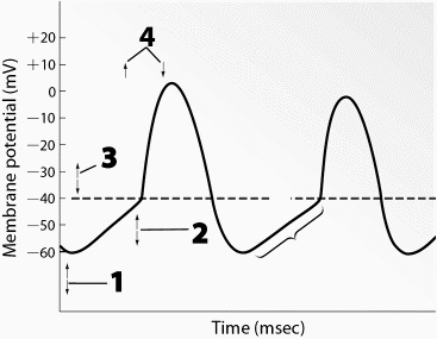 a. 1 and 2
b. 1 and 3
c. 2 and 3
d. 3 and 4
e. 4 only
a. 1 and 2
b. 1 and 3
c. 2 and 3
d. 3 and 4
e. 4 only
(Short Answer)
4.8/5 (76)
(76) Use this figure to answer the corresponding questions.
Which structures have oxygenated blood flowing through them?
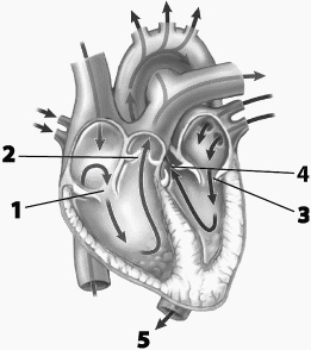 a. 1and 2
b. 4 and 3
c. 2 and 3
d. 2 and 4
e. 3,4 and 5
a. 1and 2
b. 4 and 3
c. 2 and 3
d. 2 and 4
e. 3,4 and 5 (Short Answer)
4.7/5 (83)
(83) Use this figure to answer the corresponding questions.
Which structures are open during isovolumetric relaxation?
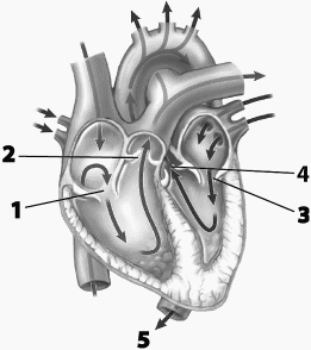 a. 1 and 2
b. 1 and 3
c. 2 and 4
d. 1,2,3, and 4
e. none of thess
a. 1 and 2
b. 1 and 3
c. 2 and 4
d. 1,2,3, and 4
e. none of thess (Short Answer)
4.8/5 (72)
(72) Use this figure to answer the corresponding questions.
The structure labeled B
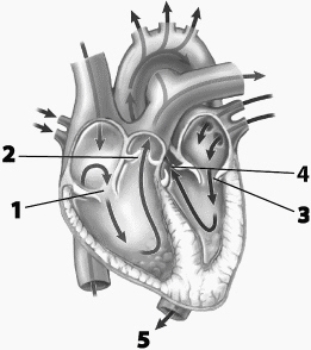 a. allows blood to pass into the ventricle
b. has de oxygenated blood flowing past it
c. is conne cted to chordae tendineae
d. all of these
e. none of these
a. allows blood to pass into the ventricle
b. has de oxygenated blood flowing past it
c. is conne cted to chordae tendineae
d. all of these
e. none of these (Short Answer)
4.8/5 (74)
(74) Match the characteristic with the appropriate term(s).
Correct Answer:Verified
VerifiedPremises:
Responses:
(Matching)
4.9/5 (74)
(74) Use this figure to answer the corresponding questions.
Identify the location(s) that indicates when fast calcium channels open within the cell.
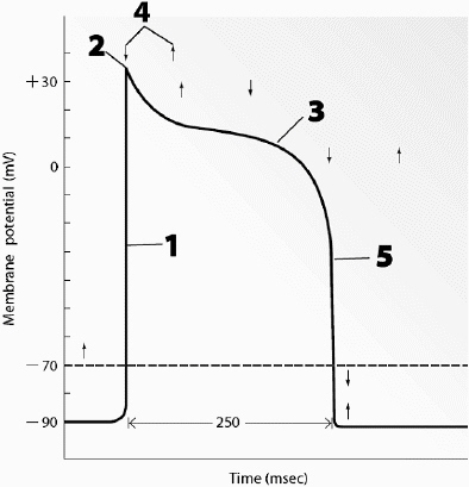 a. 1
b. 2 and 3
c. 2, 3, and 4
d. 1 and 4
e. There are no fast calcium channels in these cells.
a. 1
b. 2 and 3
c. 2, 3, and 4
d. 1 and 4
e. There are no fast calcium channels in these cells.
(Short Answer)
4.9/5 (91)
(91) Describe the mechanisms involved by which the parasympathetic and sympathetic nervous systems affect cardiac output. Include ACh, NE, regulated K+ channels, If channels and T-type Ca2+ channels, vagus nerve, cardiac nerves, contractility, stroke volume, and heart rate in your answer.
(Essay)
4.9/5 (87)
(87) Describe the generation of pacemaker action potentials and then track the resulting impulse through the cardiac conduction system. Include the names of specific types of channels in the first part of your answer.
(Essay)
4.9/5 (85)
(85) Match cardiovascular feature with correct characteristic.
Correct Answer:Verified
VerifiedPremises:
Responses:
(Matching)
4.9/5 (82)
(82) Use this figure to answer the corresponding questions.
This graph shows the electrical activity for one of the heart's
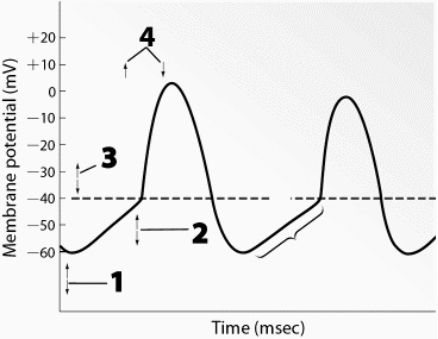 a. Purkinje fibers
b. pacemaker cells
c. contractile cells
d. ventricular cells
e. pacemaker and ventricular cells
a. Purkinje fibers
b. pacemaker cells
c. contractile cells
d. ventricular cells
e. pacemaker and ventricular cells
(Short Answer)
4.8/5 (80)
(80) Use this figure to answer the corresponding questions.
Identify the location(s) where voltage-gated potassium channels are open.
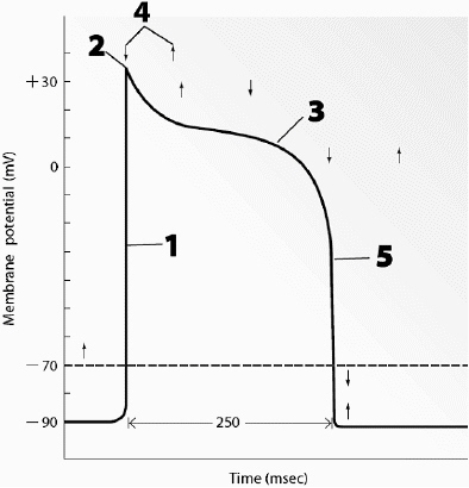 a. 1 only
b. only between 2 and 3
c. only between 3 and 4
d. 2, 3, and 4
e. only when the membrane potential is above threshold
a. 1 only
b. only between 2 and 3
c. only between 3 and 4
d. 2, 3, and 4
e. only when the membrane potential is above threshold
(Short Answer)
4.8/5 (82)
(82) Use this figure to answer the corresponding questions.
Identify the location(s) where fast calcium channels are open.
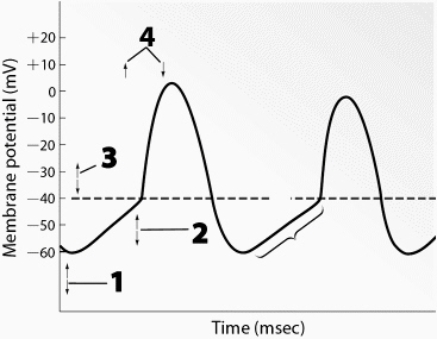 a. 1 and 2
b. 1 and 3
c. 2 and 3
d. 3 and 4
e. 4 only
a. 1 and 2
b. 1 and 3
c. 2 and 3
d. 3 and 4
e. 4 only (Short Answer)
4.8/5 (80)
(80) Use this figure to answer the corresponding questions.
This graph shows the electrical activity for one of the heart's
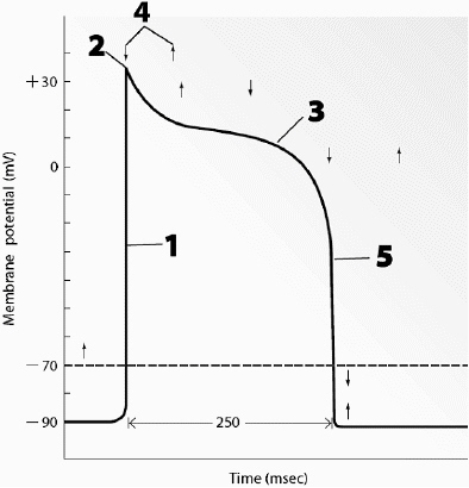 a. contractile cells
b. pacemaker cells
c. autorhythmic cells
d. contractile and autorhythmic cells
e. pacemaker and autorhythmic cells
a. contractile cells
b. pacemaker cells
c. autorhythmic cells
d. contractile and autorhythmic cells
e. pacemaker and autorhythmic cells
(Short Answer)
4.7/5 (84)
(84) Use this figure to answer the corresponding questions.
Identify the location(s) where the cell's permeability to Na+ is the greatest.
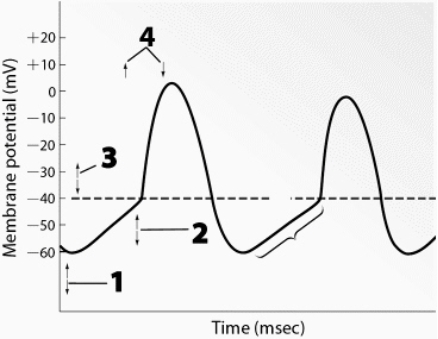 a. between 1 and 2 b. between 2 and 3 c. between 2 and 4 d. between 3 and 4 e. 4 only
 (Short Answer)
4.8/5 (72)
(72) Use this figure to answer the corresponding questions.
Identify the location(s) where slow calcium channels are open.
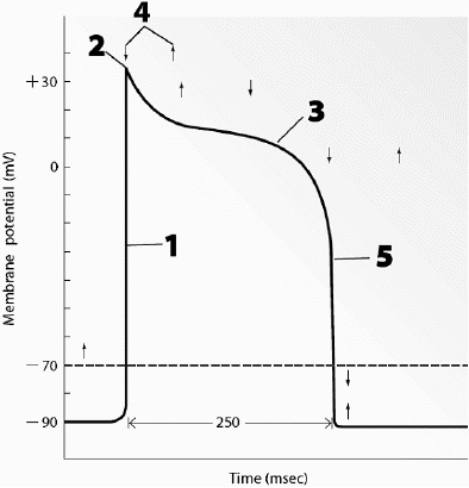 a. 1 only
b. 1 and 2
c. 3 only
d. 3 and 4
e. These cells do not have slow calcium channels.
a. 1 only
b. 1 and 2
c. 3 only
d. 3 and 4
e. These cells do not have slow calcium channels.
(Short Answer)
4.9/5 (71)
(71) Use the answer code below to complete the following statements.
1. Stroke volume can be increased by increasing \_\_\_\_ and \_\_\_\_ cardiac output \_\_\_\_ 2. The maximum volume of blood that the ventricle contains after filling is complete is stroke volume and heart the \_\_\_\_ rate \_\_\_\_ 3. The volume of blood ejected by each ventricle each minute is known as the \_\_\_\_ stroke volume \_\_\_\_ 4. The volume of blood ejected by each end-diastolic volume and ventricle each beat is known as the \_\_\_\_ end-systolic volume \_\_\_\_ 5. The number of times the heart contracts each minute is the \_\_\_\_ end-diastolic volume \_\_\_\_ 6. The two main determinants of cardiac output are \_\_\_\_ and \_\_\_\_ end-systolic volume \_\_\_\_ 7. The minimum volume of blood that the ventricle contains after emptying is complete end-diastolic volume and is the \_\_\_\_ sympathetic activity \_\_\_\_ 8. Heart rate can be increased by increasing \_\_\_\_ heart rate \_\_\_\_ 9. The stroke volume may be calculated by \_\_\_\_ minus \_\_\_\_ sympathetic activity \_\_\_\_
(Essay)
4.8/5 (66)
(66) Describe the way in which high blood pressure and a defective semilunar valve can make it more difficult for the heart to pump blood into the systemic circulation and how these factors can decrease cardiac output. Include the following in your
(Essay)
4.9/5 (84)
(84) 
Filters
- Essay(0)
- Multiple Choice(0)
- Short Answer(0)
- True False(0)
- Matching(0)