Multiple Choice
Passage
A group of students were given water from two reservoirs and asked to determine water hardness using flame atomic absorbance (AA) spectroscopy. Water hardness can be found by relating the concentration of calcium and magnesium ions to the concentration of carbonate species in the sample using Equation 1.[CO32-] = 2.5[Ca2+] + 4.1[Mg2+]Equation 1To correlate the concentration of the metal ions to absorbance, the students made standard solutions of MgO (MW = 40.31 g/mol) and CaO (MW = 56.08 g/mol) by diluting small portions of 0.01 M MgO and 0.01 M CaO stock solutions with 2% HNO3 into 100 mL volumetric flasks. The calibration curves generated from the standard solutions are shown in Figures 1 and 2.
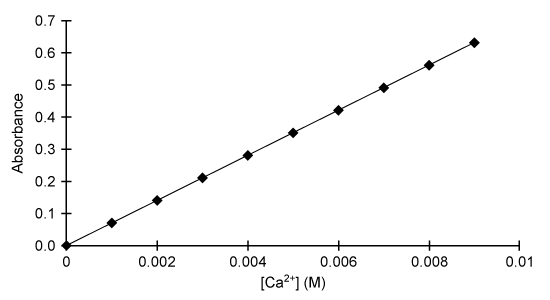 Figure 1 Calibration curve from the absorption of the Ca2+ solution standards
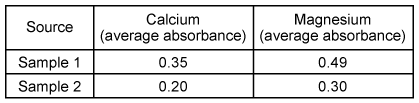
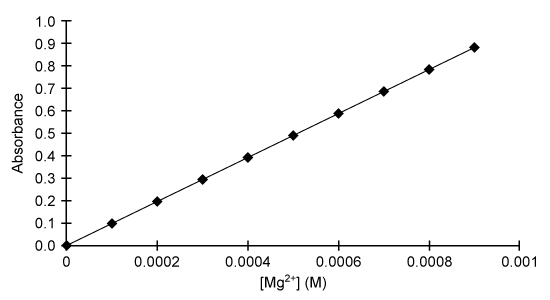 Figure 2 Calibration curve from the absorption of the Mg2+ solution standardsLanthanum(III) chloride (MM = 245.25) can be used to eliminate chemical interference in a sample by competitively binding to PO43−, releasing calcium to be atomized in the flame for detection.The students prepared unknown Samples 1 and 2 by mixing 25 mL reservoir water, 16 mL of 2% HNO3, and 9 mL of 0.1 M LaCl3 for a total sample volume of 50 mL each. The samples were each tested three times using flame AA spectroscopy, yielding the results reported in Table 1.Table 1 AA Spectroscopy Results for Reservoir Water Samples
-How many La3+ ions are present in each of the unknown samples?
A) 1.5 × 10⁻²⁷
B) 5.4 × 10²⁰
C) 9.0 × 10²⁰
D) 6.0 × 10²²
Correct Answer:

Verified
Correct Answer:
Verified
Q81: Passage<br>Living organisms that require oxygen to respire
Q82: Passage<br>Copper plays a vital role as a
Q83: Oxalate anions, C<sub>2</sub>O<sub>4</sub><sup>2−</sup>, added to a solution
Q84: Passage<br>The alkaline-earth metals are a highly reactive
Q85: The effective nuclear charge experienced by the
Q87: Passage<br>Umami is one of five basic tastes
Q88: Passage<br>Sulfur is the 10th most abundant element
Q89: Which of the following molecules has the
Q90: Passage<br>Dmitri Mendeleev is credited with grouping the
Q91: Passage<br>Magnetic resonance imaging (MRI) interprets the nuclear