Multiple Choice
Passage
Copper plays a vital role as a trace mineral for biological processes. The amount of dietary copper needed by an adult each day is about 30 μg/kg of body weight, and blood plasma normally has a copper concentration of 1 mg/L.Copper is an essential element, and toxic effects are not common. However, given sufficient exposure to high levels by inhalation, absorption, or ingestion from sources such as industrial hazards or contaminated groundwater, copper toxicity can occur.Salts that are more soluble tend to exhibit higher toxicity when ingested, but the solubilities of copper salts vary and are also temperature-dependent, as shown by selected examples in Figure 1.
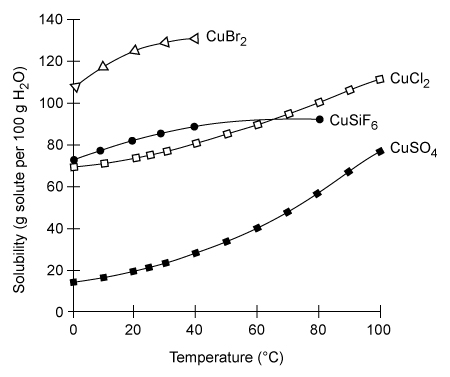 Figure 1 The solubility of selected copper salts in distilled water with increasing temperatureSome copper salts have solubilities much lower than those shown in Figure 1. For example, CuF2 has a solubility of only 0.075 g per 100 g of water (at 25 °C) . This indicates that CuF2 dissociates in water only to a small extent (Reaction 1) and that the equilibrium favors the undissociated salt, giving CuF2 a solubility product constant of Ksp = 1.6 × 10⁻⁶.
 Reaction 1Compound-specific properties can also impact solubility. In CuF2, the dissociated F− ion is mildly basic (pKb = 10.8) , causing the equilibrium to be influenced by the pH of the solution.Specific characteristics of copper can also play a role. For example, copper ions in solution express an affinity to form coordinate bonds with available lone-pair electrons of nitrogen atoms in amines (Reaction 2) .
 Reaction 2If excess amine ligands are present, coordinate bonds like that shown in Reaction 2 will continue to form until each Cu2+ ion in solution is coordinated with four nitrogen atoms. This acquisition of copper ions by ligands in solution can also impact the solubility equilibrium of copper salts by forming soluble coordination complexes.
-Based on the passage, which of the following procedures would assist in separating an aqueous mixture of CuCl2 and CuSO4 salts at 90 °C?Add Cu(NO3) 2 to the solution mixtureAdd Na2SO4 to the solution mixtureCool the solution mixture to 5°CLower the pH of the mixture
A) I and II only
B) I, II, and III only
C) II and III only
D) II, III, and IV only
Correct Answer:

Verified
Correct Answer:
Verified
Q77: Passage<br>Dmitri Mendeleev is credited with grouping the
Q78: Passage<br>The alkali metals are a highly reactive
Q79: 4 NH<sub>3</sub>(g) + 5 O<sub>2</sub>(g) → 4
Q80: A sodium atom in an excited state
Q81: Passage<br>Living organisms that require oxygen to respire
Q83: Oxalate anions, C<sub>2</sub>O<sub>4</sub><sup>2−</sup>, added to a solution
Q84: Passage<br>The alkaline-earth metals are a highly reactive
Q85: The effective nuclear charge experienced by the
Q86: Passage<br>A group of students were given water
Q87: Passage<br>Umami is one of five basic tastes