Multiple Choice
Passage
Dmitri Mendeleev is credited with grouping the elements by atomic mass and observing that similar properties emerge periodically. Henry Moseley then determined that a fundamental property, which Ernest Rutherford later called the atomic number, is more important than atomic mass for ordering the elements.As the periodic table took shape, scientists noted certain properties and trends. For example, Rayleigh and Ramsay observed that some elements are unreactive and gave them the name noble gases. But it was not until Niels Bohr described his model of the atom that scientists understood why noble gases are stable.Another important trend was discovered by Linus Pauling. He was the first to identify electronegativity as a way to describe bonds that are neither completely ionic nor completely covalent. Pauling assigned fluorine the highest electronegativity value of 4.0 because of its strong tendency to attract electrons when bonded to other atoms. All other atoms were assigned values relative to fluorine. This became known as the Pauling electronegativity scale.Scientists identified other trends based on x-ray crystallography and reactivity studies. Figure 1 shows the first ionization energy of the elements, and Figure 2 shows electron affinity.
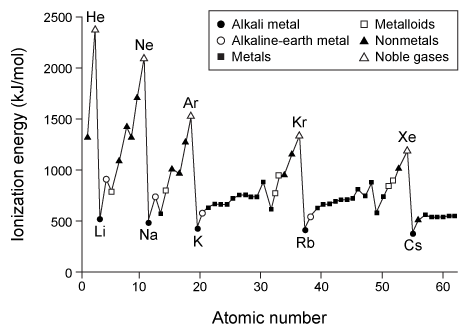 Figure 1 First ionization energy of elements
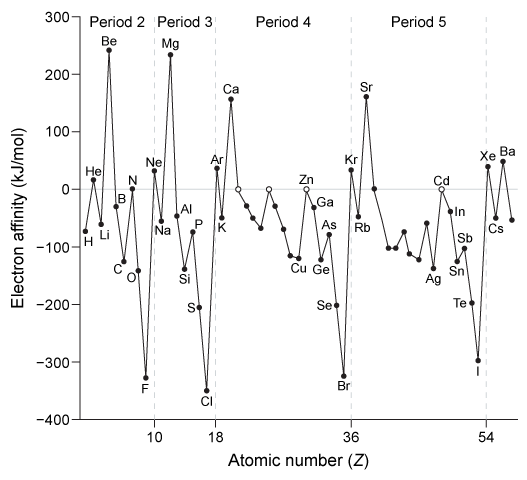 Figure 2 Electron affinity of several elements (larger negative values indicate greater electron affinity)
-Oxygen is the most electronegative element of Group 6A. However, it also has the lowest electron affinity in the group. What factor can be used to explain this discrepancy?
A) Oxygen is less stable than the other Group 6A elements.
B) Oxygen's valence electrons experience more electron-electron repulsion than other Group 6A elements.
C) Oxygen's valence electrons are more shielded from the positively charged nucleus than other Group 6A elements.
D) Oxygen does not have d orbitals available for additional electrons.
Correct Answer:

Verified
Correct Answer:
Verified
Q72: Passage<br>Heme is found in several proteins, including
Q73: Passage<br>Umami is one of five basic tastes
Q74: An element that exists in its standard
Q75: Passage<br>Nuclear medicine uses radiopharmaceuticals for disease treatment
Q76: Passage<br>Combustion occurs when an oxidation-reduction reaction takes
Q78: Passage<br>The alkali metals are a highly reactive
Q79: 4 NH<sub>3</sub>(g) + 5 O<sub>2</sub>(g) → 4
Q80: A sodium atom in an excited state
Q81: Passage<br>Living organisms that require oxygen to respire
Q82: Passage<br>Copper plays a vital role as a