Multiple Choice
Passage
Heme is found in several proteins, including hemoglobin in blood and myoglobin in muscle. It has a four-coordinate iron-bound porphyrin structure where ferrous iron (Fe2+) is bound to four nitrogen atoms through coordinate covalent bonds. The most common heme found in the body is heme b in hemoglobin (Figure 1) .
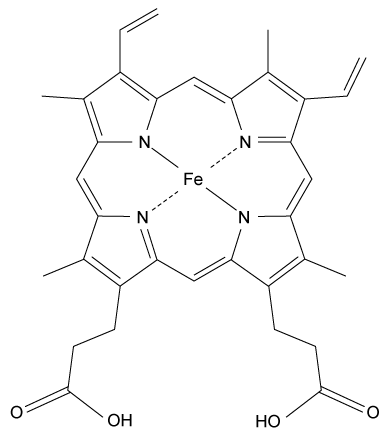 Figure 1 Structure of heme b found in hemoglobinAlong with the four nitrogen ligands in the porphyrin structure, His F8 also binds to Fe2+ in the axial position, leaving the other axial position available to bind oxygen. In this setting, iron's atomic d orbitals are no longer degenerate. The energetic difference between the d orbitals depends on the ligands.In deoxygenated heme, iron sits out of the plane formed by the nitrogen ligands in the porphyrin because its d orbitals make it slightly too large to fit in the porphyrin ring. However, when O2 binds to heme, iron's electrons re-arrange themselves. The d orbitals become smaller, and iron sits within the plane of the nitrogen atoms.When iron is scarce in the body, Zn2+ will coordinate to the ligands in the protoporphyrin structure through a nonenzymatic process, forming Zn-protoporphyrin IX (ZPP) . ZPP and protoporphyrin IX (PPIX) have distinct emission spectra when excited in the blue range whereas heme does not. Hematofluorometry can be used as a simple, inexpensive indicator for iron deficiency in whole blood by placing a blood sample in a fluorometer and measuring the amount of ZPP relative to the amount of heme. Figure 2 illustrates the fluorescence emission spectra for ZPP and protoporphyrin IX measured from a blood sample when ZPP is excited at 425 nm and PPIX is excited at 407 nm.
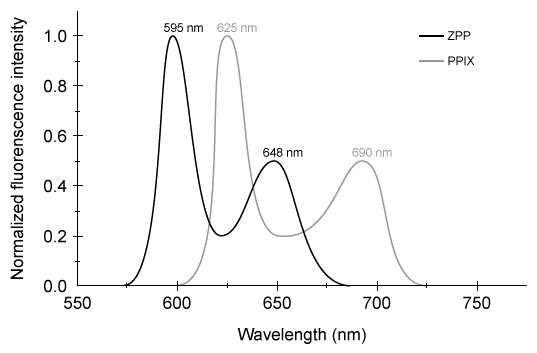 Figure 2 ZPP and PPIX fluorescence emission spectra
Adapted from Hennig G, Gruber C, Vogeser M, et al. Dual-wavelength excitation for fluorescence-based quantification of zinc protoporphyrin IX and protoporphyrin IX in whole blood. J Biophotonics. 2014;7(7) :514-24.
-Which of the following statements best explains why hemoglobin is red when it binds to O2?
A) O2 interacts with iron's d orbitals.
B) O2 is a nonpolar ligand.
C) O2 has lone pairs of electrons.
D) O2 changes the surrounding protein structure.
Correct Answer:

Verified
Correct Answer:
Verified
Q67: Passage<br>The alkaline-earth metals are a highly reactive
Q68: Passage<br>Gastric acid is one of many acids
Q69: Osmolarity, the number of moles of osmotically
Q70: Passage<br>An automated external defibrillator (AED) is a
Q71: A reaction was performed in which compounds
Q73: Passage<br>Umami is one of five basic tastes
Q74: An element that exists in its standard
Q75: Passage<br>Nuclear medicine uses radiopharmaceuticals for disease treatment
Q76: Passage<br>Combustion occurs when an oxidation-reduction reaction takes
Q77: Passage<br>Dmitri Mendeleev is credited with grouping the