Multiple Choice
Passage
An automated external defibrillator (AED) is a medical device used to send an electric shock to the heart after cardiac arrest. A key component of the AED is the power source, or battery. Batteries used in AEDs need to have a good charge-to-weight ratio; they must be safe and reliable as well as rechargeable.Two types of rechargeable batteries used in early models of AEDs are the lead storage (also called lead-acid) battery and the nickel-cadmium (NiCd) battery. These batteries consist of multiple electrochemical cells that are connected in series to deliver a potential between 9 V and 18 V. A capacitor allows the AED to accumulate charge so that it can deliver between 300 V and 1,000 V.Some AEDs use a sealed lead storage battery. Lead storage batteries are robust and hold a charge for a long time. However, they have a low energy-to-weight ratio. Each lead storage cell delivers approximately 2.0 V, and a battery of four cells weighing 1000 g can provide 30 W∙h of energy.
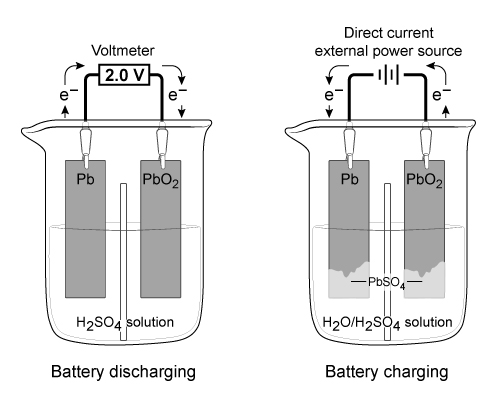 Figure 1 Electron flow in a lead storage battery when discharging and chargingThe half reactions for the anode and cathode of a lead storage battery in 4 M of sulfuric acid (H2SO4) are shown in Reactions 1 and 2:
 Reaction 1
 Reaction 2
NiCd batteries have a higher energy-to-weight ratio than lead storage batteries but cannot hold as much charge. Each NiCd cell delivers approximately 1.3 V, and a single-cell battery weighing 120 g can provide 7.2 W∙h of energy.The half reactions at the anode and cathode for a NiCd battery in KOH are shown in Reactions 3 and 4:
 Reaction 3
 Reaction 4
-Which statement correctly describes the Pb electrode when the lead storage battery is charging as shown in Figure 1?
A) It is the anode and PbSO4 is oxidized at its surface.
B) It is the anode and H2SO4 is reduced at its surface.
C) It is the cathode and PbSO4 is reduced at its surface.
D) It is the cathode and H2SO4 is oxidized at its surface.
Correct Answer:

Verified
Correct Answer:
Verified
Q65: Passage<br>The alkali metals are a highly reactive
Q66: Passage<br>Gastric acid is one of many acids
Q67: Passage<br>The alkaline-earth metals are a highly reactive
Q68: Passage<br>Gastric acid is one of many acids
Q69: Osmolarity, the number of moles of osmotically
Q71: A reaction was performed in which compounds
Q72: Passage<br>Heme is found in several proteins, including
Q73: Passage<br>Umami is one of five basic tastes
Q74: An element that exists in its standard
Q75: Passage<br>Nuclear medicine uses radiopharmaceuticals for disease treatment