Multiple Choice
Passage
Living organisms that require oxygen to respire can build up hydrogen peroxide (H2O2) as a byproduct of respiration. Because hydrogen peroxide can cause oxidative damage to cells, the amount of H2O2 in cells must be closely regulated. Although H2O2 decomposes spontaneously, a catalyst is needed for the reaction to occur at a sufficiently rapid rate suitable for biological purposes. In biological systems, an enzyme called a catalase accelerates the catalytic decomposition of H2O2 into water and oxygen (Reaction 1) .
 Reaction 1In a laboratory setting, several different inorganic compounds can also serve as catalysts for H2O2 decomposition, allowing researchers to compare how different catalysts affect the efficiency of the reaction. To compare Fe(NO3) 3 (a metal homogeneous catalyst) and NaI (a halogen homogeneous catalyst) , researchers measured the amount of heat evolved after placing each catalyst in a fresh solution of 3% hydrogen peroxide.To perform the measurements, the researchers placed 50 mL of 3% H2O2 in an insulated coffee cup to be used as a calorimeter, as shown in Figure 1. Before adding any catalyst, the initial, baseline temperature of the H2O2 solution was determined by recording the temperature every 30 seconds for 5 minutes. Then 10 mL of 0.10 M Fe(NO3) 3(aq) catalyst was added to the H2O2 solution. The temperature was recorded every 30 seconds for another 15 minutes. The experiment was then repeated using 10 mL of 0.50 M sodium iodide in 0.01 M NaOH as the catalyst. The results for each reaction are shown in Figure 2.
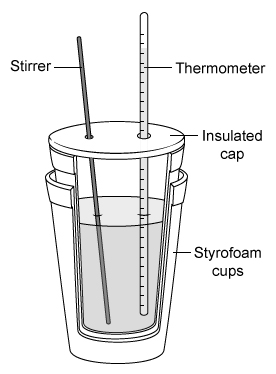 Figure 1 Coffee cup calorimeter
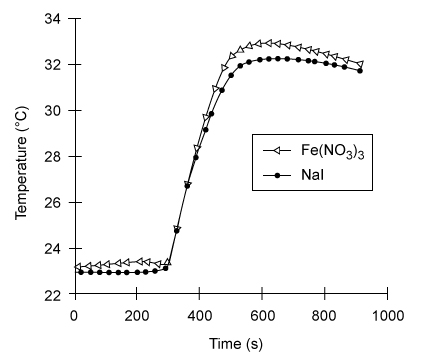 Figure 2 Temperature vs. time measurements for reactions catalyzed by Fe(NO3) 3 and NaI
Adapted from: C. Marzzacco, "The effect of a change in catalyst on the enthalpy of decomposition of hydrogen peroxide." Chem13 News Magazine. ©2008 University of Waterloo.
-Which of the following statements explains why the change in temperature of the H2O2 decomposition reaction using Fe(NO3) 3 is approximately the same value as the change in temperature using NaI?
A) Fe(NO3) 3 stabilizes the transition state more than NaI.
B) Fe(NO3) 3 results in a faster reaction rate than NaI.
C) Fe(NO3) 3 and NaI are both homogeneous catalysts.
D) Fe(NO3) 3 and NaI do not affect the heat of the reaction.
Correct Answer:

Verified
Correct Answer:
Verified
Q76: Passage<br>Combustion occurs when an oxidation-reduction reaction takes
Q77: Passage<br>Dmitri Mendeleev is credited with grouping the
Q78: Passage<br>The alkali metals are a highly reactive
Q79: 4 NH<sub>3</sub>(g) + 5 O<sub>2</sub>(g) → 4
Q80: A sodium atom in an excited state
Q82: Passage<br>Copper plays a vital role as a
Q83: Oxalate anions, C<sub>2</sub>O<sub>4</sub><sup>2−</sup>, added to a solution
Q84: Passage<br>The alkaline-earth metals are a highly reactive
Q85: The effective nuclear charge experienced by the
Q86: Passage<br>A group of students were given water