Multiple Choice
Passage
The alkaline-earth metals are a highly reactive family of metals occupying Group 2 (IIA) of the periodic table. In their elemental form, the alkaline-earth metals have a shiny, silvery-white to slightly yellowish appearance. The alkaline-earth metals exhibit some similarities to the chemistry of the alkali metals (Group 1) but are a little less reactive.Atoms of the alkaline-earth metals (M) have only two valence electrons and a low first and second ionization energy. Consequently, these metals readily lose both electrons to produce cations with a +2 charge (M+2) during reactions with nonmetals. As a result, the alkaline-earth metals do not exist in their elemental metallic form in nature. Instead, the Group 2 elements are found primarily as metal oxides, which form by reacting oxygen (Reaction 1) .

Similarly, elemental samples of alkaline-earth metals will react with elemental halogens (X2) to form metal halides (Reaction 2) , all of which are ionic except for BeCl2.

Except for beryllium, the alkaline-earth metals react with water to produce very basic metal hydroxide solutions and hydrogen gas (Reaction 3) .

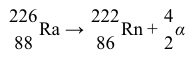
The most difficult alkaline-earth metal to study is radium, because it is a rare radioactive element that is produced from the nuclear decay of uranium. The most common natural isotope, radium-226, has a half-life of 1,600 years and decays by alpha emission into radon-222 (Reaction 4) .
-Based on the reaction in Figure 1 and the energy profile in Figure 2, which statement correctly describes both Compound 2 and Compound 3?
A) Compound 2 and Compound 3 are both the kinetic products of the reaction.
B) Compound 2 is the kinetic product, and Compound 3 is the thermodynamic product.
C) Compound 2 is the thermodynamic product, and Compound 3 is the kinetic product.
D) Compound 2 and Compound 3 are both the thermodynamic products of the reaction.
Correct Answer:

Verified
Correct Answer:
Verified
Q79: 4 NH<sub>3</sub>(g) + 5 O<sub>2</sub>(g) → 4
Q80: A sodium atom in an excited state
Q81: Passage<br>Living organisms that require oxygen to respire
Q82: Passage<br>Copper plays a vital role as a
Q83: Oxalate anions, C<sub>2</sub>O<sub>4</sub><sup>2−</sup>, added to a solution
Q85: The effective nuclear charge experienced by the
Q86: Passage<br>A group of students were given water
Q87: Passage<br>Umami is one of five basic tastes
Q88: Passage<br>Sulfur is the 10th most abundant element
Q89: Which of the following molecules has the