Multiple Choice
Passage
Sulfur is the 10th most abundant element on Earth and is an essential element in biological systems. Sulfur can form a variety of chemical compounds and will react with nearly every element except Au, Pt, Ir, Te, and the noble gases. A list of several common inorganic compounds of sulfur is given in Table 1.Table 1 Selected Common Inorganic Sulfur Compounds
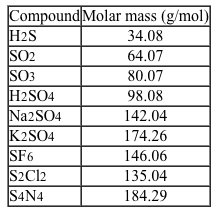 Reduction of elemental sulfur by bacteria during anaerobic digestion produces the toxic, foul-smelling gas H2S. Oxidation of elemental sulfur via combustion or volcanic processes yields gases of SO2 and SO3. When dissolved in water, both SO2 and SO3 produce acidic solutions, and SO3 reacts with water to form the acid H2SO4. Neutralization of H2SO4 can provide a variety of salts, including Na2SO4.Elemental sulfur can also react with halogen gases to form sulfur halides such as the industrially important insulator gas SF6 and the synthetic reagent S2Cl2. S2Cl2 facilitates the formation of other sulfur compounds. For example, reacting S2Cl2 with NH3 produces the sulfur pnictide S4N4.
-Which of the following compounds from Table 1 has a sulfur atom with a d2sp3 hybridization state?
A) SO2
B) SF6
C) SO3
D) S2Cl2
Correct Answer:

Verified
Correct Answer:
Verified
Q83: Oxalate anions, C<sub>2</sub>O<sub>4</sub><sup>2−</sup>, added to a solution
Q84: Passage<br>The alkaline-earth metals are a highly reactive
Q85: The effective nuclear charge experienced by the
Q86: Passage<br>A group of students were given water
Q87: Passage<br>Umami is one of five basic tastes
Q89: Which of the following molecules has the
Q90: Passage<br>Dmitri Mendeleev is credited with grouping the
Q91: Passage<br>Magnetic resonance imaging (MRI) interprets the nuclear
Q92: The Nernst equation states: <img src="https://d2lvgg3v3hfg70.cloudfront.net/MD0008/.jpg" alt="The
Q93: Passage<br>A group of students were given water