Multiple Choice
Passage
Magnetic resonance imaging (MRI) interprets the nuclear relaxation or relaxivity of hydrogen nuclei in resident water molecules. Hydrogen nuclei in water have two magnetic spin states: alpha and beta. In the presence of an applied magnetic field, these spins will align with the field in an "excited" state and then relax back to the "ground" state, producing a signal with intensity proportional to relaxivity. Frequently, an MRI contrast agent is used to increase the relaxation time in coordinated molecules, resulting in a more intense signal.Commonly used contrast agents include gadolinium-based agents. Depending on its environment, gadolinium (Gd) can have eight or nine sites in its coordination sphere, allowing Gd3+ to interact with eight water molecules as in Gd(H2O) 83+. The electronic configuration of gadolinium is shown in Figure 1.
 Figure 1 Electronic configuration of gadoliniumGd3+ alone is toxic to cells because its ionic radius is similar to that of Ca2+, allowing Gd3+ to displace Ca2+ in biologically important settings. Therefore, Gd3+ must be coordinated to an organic ligand such as 1,4,7,10-tetraazacyclododecane-1,4,7,10-tetraacetic acid (DOTA) to allow it to pass through the body safely. When chelated, DOTA displaces the water around gadolinium and leaves only one coordination site for a water molecule (Figure 2) .
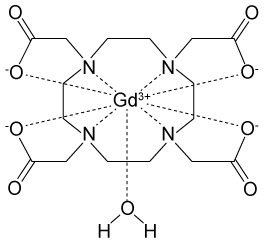 Figure 2 Gd-DOTA with a water coordinated to Gd3+Zinc ions (Zn2+) are required to store insulin and are co-released when insulin is secreted by the pancreas. To detect zinc ions in the body, researchers have designed a variation of Gd-DOTA called Gd-daa3 with two diaminoacetate (daa) arms that preferentially bind to Zn2+ ions (Figure 3) . When Zn2+ is absent, these arms coordinate to Gd3+ and create a nine-coordinate complex that prohibits water from binding to Gd3+. Binding of diaminoacetate arms to Zn2+ frees Gd3+ to coordinate with water molecules. This configuration results in increased signal intensity in the parts of the cell where Zn2+ is located.
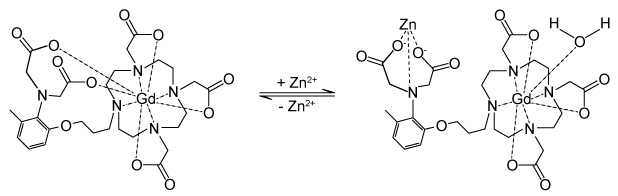 Figure 3 Gd-daa3 when Zn2+ is present
Adapted from Louie A. MRI biosensors: a short primer. J Magn Reson Imaging. 2013;38(3) :530-9.
-Two MRI images of the pancreas were taken at different times (Time A and Time B) in a mouse injected with Gd-daa3. Greater relaxivity was detected at Time B, suggesting all of the following EXCEPT:
A) Time B was soon after a meal.
B) fewer daa arms were bound to gadolinium ions at Time B than at Time A.
C) the relaxivity of water molecule nuclei was increased at Time B.
D) Gd3+ are bound to Zn2+ at Time B.
Correct Answer:

Verified
Correct Answer:
Verified
Q86: Passage<br>A group of students were given water
Q87: Passage<br>Umami is one of five basic tastes
Q88: Passage<br>Sulfur is the 10th most abundant element
Q89: Which of the following molecules has the
Q90: Passage<br>Dmitri Mendeleev is credited with grouping the
Q92: The Nernst equation states: <img src="https://d2lvgg3v3hfg70.cloudfront.net/MD0008/.jpg" alt="The
Q93: Passage<br>A group of students were given water
Q94: Considering the type of element represented by
Q95: Passage<br>The primary structure of a protein is
Q96: Passage<br>The alkali metals are a highly reactive