Multiple Choice
Passage
Dmitri Mendeleev is credited with grouping the elements by atomic mass and observing that similar properties emerge periodically. Henry Moseley then determined that a fundamental property, which Ernest Rutherford later called the atomic number, is more important than atomic mass for ordering the elements.As the periodic table took shape, scientists noted certain properties and trends. For example, Rayleigh and Ramsay observed that some elements are unreactive and gave them the name noble gases. But it was not until Niels Bohr described his model of the atom that scientists understood why noble gases are stable.Another important trend was discovered by Linus Pauling. He was the first to identify electronegativity as a way to describe bonds that are neither completely ionic nor completely covalent. Pauling assigned fluorine the highest electronegativity value of 4.0 because of its strong tendency to attract electrons when bonded to other atoms. All other atoms were assigned values relative to fluorine. This became known as the Pauling electronegativity scale.Scientists identified other trends based on x-ray crystallography and reactivity studies. Figure 1 shows the first ionization energy of the elements, and Figure 2 shows electron affinity.
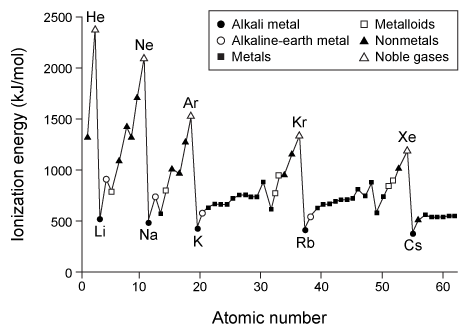 Figure 1 First ionization energy of elements
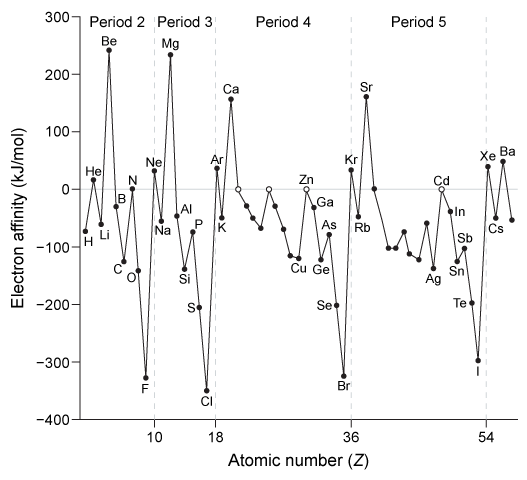 Figure 2 Electron affinity of several elements (larger negative values indicate greater electron affinity)
-Why are noble gases the least reactive group on the periodic table?
A) Noble gases are diamagnetic.
B) Noble gases have a full valence shell.
C) Noble gases tend to have the same number of protons and neutrons.
D) Noble gases tend to form diatomic molecules.
Correct Answer:

Verified
Correct Answer:
Verified
Q85: The effective nuclear charge experienced by the
Q86: Passage<br>A group of students were given water
Q87: Passage<br>Umami is one of five basic tastes
Q88: Passage<br>Sulfur is the 10th most abundant element
Q89: Which of the following molecules has the
Q91: Passage<br>Magnetic resonance imaging (MRI) interprets the nuclear
Q92: The Nernst equation states: <img src="https://d2lvgg3v3hfg70.cloudfront.net/MD0008/.jpg" alt="The
Q93: Passage<br>A group of students were given water
Q94: Considering the type of element represented by
Q95: Passage<br>The primary structure of a protein is