



 Chat with AI
Exam 14: Chemical Kinetics

Exam 1: Chemistry: the Central Science129 Questions
Exam 2: Atoms Molecules and Ions120 Questions
Exam 3: Stoichiometry Ratios of Combination131 Questions
Exam 4: Reactions in Aqueous Solutions144 Questions
Exam 5: Thermochemistry134 Questions
Exam 6: Quantum Theory and the Electronic Structure of Atoms107 Questions
Exam 7: Electron Configuration and the Periodic Table120 Questions
Exam 8: Chemical Bonding I Basic Concepts95 Questions
Exam 9: Chemical Bonding Ii Molecular Geometry and Bonding Theories137 Questions
Exam 10: Gases131 Questions
Exam 11: Intermolecular Forces and the Physical Properties of Liquids and Solids135 Questions
Exam 12: Modern Materials108 Questions
Exam 13: Physical Properties of Solutions147 Questions
Exam 14: Chemical Kinetics114 Questions
Exam 15: Chemical Equilibrium135 Questions
Exam 16: Acids and Bases133 Questions
Exam 17: Acid-Base Equilibria and Solubility Equilibria129 Questions
Exam 18: Entropy Free Energy and Equilibrium61 Questions
Exam 19: Electrochemistry122 Questions
Exam 20: Nuclear Chemistry125 Questions
Exam 21: Environmental Chemistry131 Questions
Exam 22: Coordination Chemistry128 Questions
Exam 23: Metallurgy and the Chemistry of Metals115 Questions
Exam 24: Nonmetallic Elements and Their Compounds119 Questions
Exam 25: Organic Chemistry148 Questions
Select questions type


What is the name given to the equation that relates the rate of reaction to the concentrations of reactants?
(Short Answer)
4.7/5  (93)
(93) The units of the rate constant depend on the order of the reaction.
(True/False)
5.0/5 (68)
(68) The rate of a reaction is determined by the rate of the fastest step in the mechanism.
(True/False)
4.7/5 (78)
(78) For a zeroth-order reaction,if the concentration of reactant A is plotted vs.time,which corresponds to the slope of this plot?
(Multiple Choice)
4.8/5 (87)
(87) A transition state is a species (or state)corresponding to an energy maximum on a reaction energy diagram.
(True/False)
4.9/5 (67)
(67) What rate constant can be determined from only the half-life of a reaction?
(Multiple Choice)
5.0/5 (66)
(66) According to the collision theory of reaction rates,what are the three requirements which must be met before an elementary reaction between two molecules can occur?
(Essay)
4.8/5 (79)
(79) Butadiene,C4H6 (used to make synthetic rubber and latex paints).dimerizes to C8H12 with a rate law of rate = 0.014 L/mol• s [C4H6]2.What will be the concentration of C4H6 after 3.0 hours if the initial concentration is 0.025 M?
(Multiple Choice)
4.9/5 (86)
(86) The rate law predicted by the following two-step mechanism is Rate = k[A][B].
A → C + B (slow)
A + B → C + E (fast)
(True/False)
4.9/5 (82)
(82) A certain first-order reaction A → B is 25% complete in 42 min at 25°C.What is the half-life of the reaction?
(Multiple Choice)
4.9/5 (79)
(79) Consider the following potential energy profile for the A → B reaction.The overall reaction is________. 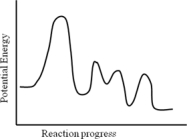
(Multiple Choice)
4.9/5 (80)
(80) Consider the following potential energy profile for the A → B reaction.How many intermediates are formed? 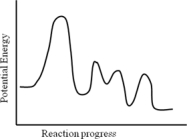
(Multiple Choice)
4.9/5 (83)
(83) The reaction 2NO2(g)→ 2NO(g)+ O2(g)is suspected to be second order in NO2.Which of the following kinetic plots would be the most useful to confirm whether or not the reaction is second order?
(Multiple Choice)
4.9/5 (73)
(73) The rate law for the reaction 3A → 2B is rate = k[A] with a rate constant of 0.0447 h-1.What is the half-life of the reaction?
(Multiple Choice)
4.7/5 (78)
(78) Is a bimolecular reaction necessarily second-order? Is a second order reaction necessarily bimolecular? Answer,with explanations and clarifications.
(Essay)
4.9/5 (78)
(78) Carbon-14 is a radioactive isotope which decays with a half-life of 5730 years.What is the first-order rate constant for its decay?
(Multiple Choice)
4.8/5 (73)
(73) According to the ___________ ________ of chemical kinetics,the reaction rate is directly proportional to the number of molecular collisions per second.
(Short Answer)
4.8/5 (78)
(78) 
Filters
- Essay(0)
- Multiple Choice(0)
- Short Answer(0)
- True False(0)
- Matching(0)