



 Chat with AI
Exam 14: Chemical Kinetics

Exam 1: Chemistry: the Central Science129 Questions
Exam 2: Atoms Molecules and Ions120 Questions
Exam 3: Stoichiometry Ratios of Combination131 Questions
Exam 4: Reactions in Aqueous Solutions144 Questions
Exam 5: Thermochemistry134 Questions
Exam 6: Quantum Theory and the Electronic Structure of Atoms107 Questions
Exam 7: Electron Configuration and the Periodic Table120 Questions
Exam 8: Chemical Bonding I Basic Concepts95 Questions
Exam 9: Chemical Bonding Ii Molecular Geometry and Bonding Theories137 Questions
Exam 10: Gases131 Questions
Exam 11: Intermolecular Forces and the Physical Properties of Liquids and Solids135 Questions
Exam 12: Modern Materials108 Questions
Exam 13: Physical Properties of Solutions147 Questions
Exam 14: Chemical Kinetics114 Questions
Exam 15: Chemical Equilibrium135 Questions
Exam 16: Acids and Bases133 Questions
Exam 17: Acid-Base Equilibria and Solubility Equilibria129 Questions
Exam 18: Entropy Free Energy and Equilibrium61 Questions
Exam 19: Electrochemistry122 Questions
Exam 20: Nuclear Chemistry125 Questions
Exam 21: Environmental Chemistry131 Questions
Exam 22: Coordination Chemistry128 Questions
Exam 23: Metallurgy and the Chemistry of Metals115 Questions
Exam 24: Nonmetallic Elements and Their Compounds119 Questions
Exam 25: Organic Chemistry148 Questions
Select questions type


The following is an Arrhenius plot of a first-order reaction.The rate constant is measured in units of s-1. 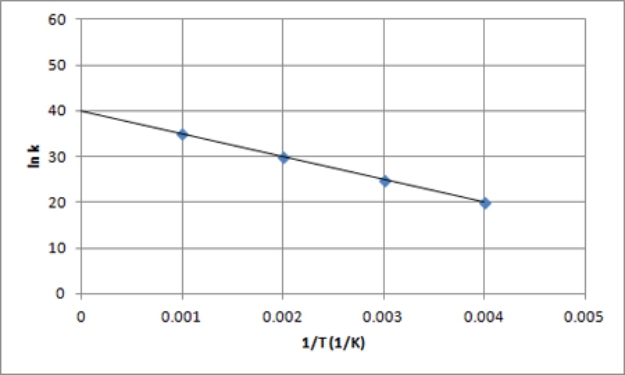 If a catalyst is added to the reaction,which could correspond to an Arrhenius plot of the catalyzed reaction?
 (Multiple Choice)
4.7/5  (81)
(81) A first-order reaction has a rate constant of 7.5 × 10⁻³ s-1.The time required for the reaction to be 60% complete is?
(Multiple Choice)
4.8/5 (71)
(71) Consider the reaction 2NH3(g)→ N2(g)+ 3 H2 (g)
If the rate Δ[H2]/Δt is 0.030 mol L-1 • s-1,what is Δ[N H3]/Δt?
(Multiple Choice)
4.7/5 (73)
(73) ______________ describes the reaction rate as being directly proportional to the number of molecular collisions per second.
(Short Answer)
4.8/5 (67)
(67) A catalyst increases the rate of the reaction and is recovered completely at the end of the reaction.
(True/False)
5.0/5 (92)
(92) What statement below best describes the graph representing the integrated second-order rate law?
(Multiple Choice)
4.8/5 (67)
(67) The intermediate in a reaction appears in the mechanism of the reaction and in the overall balanced equation.
(True/False)
4.9/5 (77)
(77) Consider the following potential energy profile for the A → B reaction.How many elementary steps are there? 
(Multiple Choice)
4.7/5 (76)
(76) A certain first-order reaction A → B is 25% complete in 42 min at 25°C.What is its rate constant?
(Multiple Choice)
4.8/5 (84)
(84) The reaction A + 2B → products was found to have the rate law,rate = k[A][B]2.Predict by what factor the rate of reaction will increase when the concentration of A is doubled and the concentration of B is also doubled.
(Multiple Choice)
4.9/5 (76)
(76) The reaction A + 2B → products has the rate law,rate = k[A][B]3.If the concentration of B is doubled while that of A is unchanged,by what factor will the rate of reaction increase?
(Multiple Choice)
4.8/5 (73)
(73) For the overall chemical reaction shown below,which one of the following statements can be rightly assumed? 2 H2S(g)+ O2(g)→ 2S(s)+ 2H2O(l)
(Multiple Choice)
4.9/5 (74)
(74) The rate constant for a reaction is 4.65 L • mol-1 • s-1.What is the overall order of the reaction?
(Multiple Choice)
4.7/5 (76)
(76) The following diagram represents the second-order decomposition of A to form X according to the following balanced chemical equation: A → X.Each sphere represents 1.0 mmol of atoms,and the volume of the box is 1.0 L. 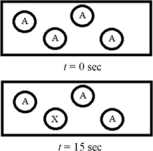 What is the half-life of the reaction?
 (Multiple Choice)
4.9/5 (84)
(84) The rate law for the reaction H2O2 + 2H+ + 2I- → I2 + 2H2O is rate = k[H2O2][I-].The following mechanism has been suggested. H2O2 + I- → HOI + OH- (slow)
OH- + H+ → H2O (fast)
HOI + H+ + I- → I2 + H2O (fast)
Identify all intermediates included in this mechanism.
(Multiple Choice)
4.8/5 (71)
(71) A rate constant obeys the Arrhenius equation,the factor A being 2.2 × 10¹³ s-1 and the activation energy being 150.kJ mol-1.What is the value of the rate constant at 227°C? (R = 8.314 J/mol• K)
(Multiple Choice)
4.9/5 (89)
(89) A _________-__________________ is a reaction whose rate depends on the concentration of one of the reactants raised to the first power.
(Short Answer)
5.0/5 (76)
(76) A(n)_______________ increases the reaction rate without being consumed.
(Short Answer)
4.8/5 (79)
(79) The _______________ is the rate for a specific instant in time.
(Short Answer)
4.8/5 (84)
(84) 
Filters
- Essay(0)
- Multiple Choice(0)
- Short Answer(0)
- True False(0)
- Matching(0)