



 Chat with AI
Exam 10: Gases

Exam 1: Chemistry: the Central Science129 Questions
Exam 2: Atoms Molecules and Ions120 Questions
Exam 3: Stoichiometry Ratios of Combination131 Questions
Exam 4: Reactions in Aqueous Solutions144 Questions
Exam 5: Thermochemistry134 Questions
Exam 6: Quantum Theory and the Electronic Structure of Atoms107 Questions
Exam 7: Electron Configuration and the Periodic Table120 Questions
Exam 8: Chemical Bonding I Basic Concepts95 Questions
Exam 9: Chemical Bonding Ii Molecular Geometry and Bonding Theories137 Questions
Exam 10: Gases131 Questions
Exam 11: Intermolecular Forces and the Physical Properties of Liquids and Solids135 Questions
Exam 12: Modern Materials108 Questions
Exam 13: Physical Properties of Solutions147 Questions
Exam 14: Chemical Kinetics114 Questions
Exam 15: Chemical Equilibrium135 Questions
Exam 16: Acids and Bases133 Questions
Exam 17: Acid-Base Equilibria and Solubility Equilibria129 Questions
Exam 18: Entropy Free Energy and Equilibrium61 Questions
Exam 19: Electrochemistry122 Questions
Exam 20: Nuclear Chemistry125 Questions
Exam 21: Environmental Chemistry131 Questions
Exam 22: Coordination Chemistry128 Questions
Exam 23: Metallurgy and the Chemistry of Metals115 Questions
Exam 24: Nonmetallic Elements and Their Compounds119 Questions
Exam 25: Organic Chemistry148 Questions
Select questions type


What is the pressure in atmospheres exerted by a column of mercury that is 100.m high? (density of mercury = 13.5951 g/cm3,gravitational constant = 9.80665 m/s2,1 atm = 101,325 Pa
= 760 torr = 760 mmHg)
(Multiple Choice)
4.8/5  (82)
(82) 1.000 atm of oxygen gas,placed in a container having a pinhole opening in its side,leaks from the container 2.14 times faster than does 1.000 atm of an unknown gas placed in this same apparatus.Which of the following species could be the unknown gas?
(Multiple Choice)
4.9/5 (81)
(81) A sample of hydrogen gas exerts a pressure of 466 torr in a container.What is this pressure in atmospheres? (1 atm = 1.01325 ×10⁵ Pa = 760 torr)
(Multiple Choice)
4.9/5 (73)
(73) Consider the following reaction. H2(g)+ I2(s)→ 2 HI(g)
If the cylinder with a movable piston below contains 1 mol H2(g)and 1 mol I2(s),which represents the cylinder after the reaction is complete? 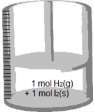
(Multiple Choice)
5.0/5 (85)
(85) A flask with a volume of 3.16 L contains 9.33 g of an unknown gas at 32.0°C and 1.00 atm. What is the molar mass of the gas?
(R = 0.08206 L • atm/K • mol)
(Multiple Choice)
4.8/5 (73)
(73) At -3°C,2.5 moles of a gas in a 0.50-L container exert a pressure of 135 atm.Under these conditions,is the gas behaving like an ideal gas?
(Essay)
4.8/5 (75)
(75) What are the units of the constant b in the van der Waals equation?
(Multiple Choice)
4.8/5 (84)
(84) Assuming ideal behavior,what is the density of argon gas at STP? (R = 0.08206 L • atm/K • mol)
(Multiple Choice)
4.7/5 (89)
(89) Gases form heterogeneous mixtures or solutions with one another.
(True/False)
4.8/5 (79)
(79) When active metals such as magnesium are immersed in acid solution,hydrogen gas is evolved. Calculate the volume of H2(g)at 30.1°C and 0.85 atm that can be formed when 275 mL of 0.725
M HCl solution reacts with excess Mg to give hydrogen gas and aqueous magnesium chloride.
Mg(s)+ 2HCl(aq)→ MgCl2(aq)+ H2(g)
(R = 0.08206 L • atm/K • mol)
(Multiple Choice)
4.8/5 (64)
(64) The pressure of hydrogen sulfide gas in a container is 3.565 ×10⁴ Pa.What is this pressure in torr? (1 atm = 101,325 Pa = 760 torr)?
(Multiple Choice)
4.8/5 (76)
(76) What is the volume occupied by 35.2 g of methane gas (CH4)at 25°C and 1.0 atm? (R = 0.08206 L • atm/K • mol)
(Multiple Choice)
4.7/5 (92)
(92) ___________ is the formula to determine the molar mass of a compound using the ideal gas law.
(Short Answer)
4.8/5 (74)
(74) The rate of diffusion of a gas is inversely proportional to its molar mass.
(True/False)
4.7/5 (76)
(76) A gaseous compound is 30.4% nitrogen and 69.6% oxygen by mass.A 5.25-g sample of the gas occupies a volume of 1.00 L and exerts a pressure of 1.26 atm at -4.0°C.What is its molecular formula? (R = 0.08206 L • atm/K • mol)
(Multiple Choice)
4.9/5 (78)
(78) ___________ is the formula to determine the amount of a reactant or product in units of moles using the ideal gas law.
(Short Answer)
4.8/5 (75)
(75) What is the final temperature of a gas that expands from a volume of 22.4 L at 278 K to a volume of 38.3 L?
(Multiple Choice)
4.7/5 (86)
(86) What mass of KClO3 must be decomposed to produce 126 L of oxygen gas at 133°C and 0.880 atm? (The other reaction product is solid KCl.) (R = 0.08206 L • atm/K • mol)
(Multiple Choice)
4.9/5 (91)
(91) What volume of CO2 gas at 645 torr and 800.K could be produced by the decomposition of 45.0 g of CaCO3?
CaCO3(s)→ CaO(s)+ CO2(g)
(R = 0.08206 L • atm/K • mol)
(Multiple Choice)
4.9/5 (87)
(87) 
Filters
- Essay(0)
- Multiple Choice(0)
- Short Answer(0)
- True False(0)
- Matching(0)