



 Chat with AI
Exam 11: Reactions of Alcohols

Exam 1: Introduction and Review127 Questions
Exam 2: Structure and Properties of Organic Molecules129 Questions
Exam 3: Structure and Stereochemistry of Alkanes129 Questions
Exam 4: The Study of Chemical Reactions128 Questions
Exam 5: Stereochemistry128 Questions
Exam 6: Alkyl Halides: Nucleophilic Substitution and Elimination132 Questions
Exam 7: Structure and Synthesis of Alkenes128 Questions
Exam 8: Reactions of Alkenes132 Questions
Exam 9: Alkynes124 Questions
Exam 10: Structure and Synthesis of Alcohols132 Questions
Exam 11: Reactions of Alcohols124 Questions
Exam 12: Infrared Spectroscopy and Mass Spectrometry120 Questions
Exam 13: Nuclear Magnetic Resonance Spectroscopy130 Questions
Exam 14: Ethers, Epoxides, and Thioethers127 Questions
Exam 15: Conjugated Systems, Orbital Symmetry, and Ultraviolet Spectroscopy130 Questions
Exam 16: Aromatic Compounds128 Questions
Exam 17: Reactions of Aromatic Compounds129 Questions
Exam 18: Ketones and Aldehydes132 Questions
Exam 19: Amines129 Questions
Exam 20: Carboxylic Acids125 Questions
Exam 21: Carboxylic Acid Derivatives128 Questions
Exam 22: Condensations and Alpha Substitutions of Carboxyl Compounds125 Questions
Exam 23: Carbohydrates and Nucleic Acids125 Questions
Exam 24: Amino Acids, Peptides, and Proteins127 Questions
Exam 25: Lipids127 Questions
Exam 26: Synthetic Polymers128 Questions
Select questions type


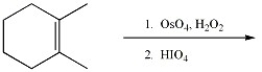
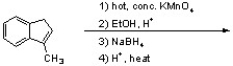


Why are alcohols unreactive toward nucleophilic substitution reactions?
(Essay)
4.8/5  (91)
(91) When an alcohol is heated in concentrated H2SO4, dehydration to produce both alkenes and ethers is possible. Which process is more favored by higher reaction temperatures and why?
(Essay)
4.9/5 (70)
(70) Provide the structure of the major organic product in the reaction below. 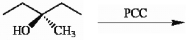
(Essay)
5.0/5 (80)
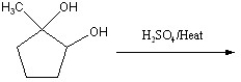
(80) 
Draw the structure of dimethyl sulfate, and provide a mechanism for the reaction of this compound with sodium benzoate (PhCO2Na).
(Essay)
4.8/5 (75)
(75) Provide the structure of the major organic product in the reaction below.
PhCH2CH2OH 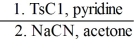 →
→ (Short Answer)
4.7/5 (77)
(77) Provide the name of the major organic product that results when cyclopentanol is subjected to the following sequence of reactions: 1. NaH; 2. CH3CH2Br.
(Short Answer)
5.0/5 (85)
(85) What series of synthetic steps could be used to prepare hexan-3-ol from propan-1-ol?
(Essay)
4.9/5 (86)
(86) Chromic acid oxidations are believed to proceed through a chromate ester intermediate. In the oxidation of propran-1-ol, provide the structure of this ester and give the mechanism for its conversion to the intermediate aldehyde.
(Essay)
4.8/5 (56)
(56) Provide the structure of the major organic product in the reaction below. 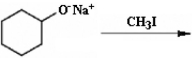
(Essay)
4.7/5 (76)
(76) Provide the structure of the major organic product in the reaction below.
(CH3)2CHCH2OH 
(Essay)
5.0/5 (85)
(85) Provide the name of the major organic product that results when trans-4-methylcyclohexanol is treated with Lucas reagent.
(Essay)
4.9/5 (80)
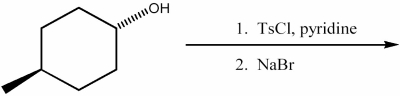
(80) 
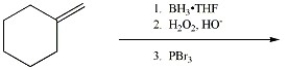
Which of the following reagents can be used to convert cyclopentanol to cyclopentane?
(Multiple Choice)
5.0/5 (86)
(86) What series of synthetic steps could be used to carry out the transformation shown below? 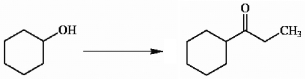
(Essay)
4.8/5 (72)
(72) 
Filters
- Essay(0)
- Multiple Choice(0)
- Short Answer(0)
- True False(0)
- Matching(0)