



 Chat with AI
Exam 17: Reactions of Aromatic Compounds

Exam 1: Introduction and Review127 Questions
Exam 2: Structure and Properties of Organic Molecules129 Questions
Exam 3: Structure and Stereochemistry of Alkanes129 Questions
Exam 4: The Study of Chemical Reactions128 Questions
Exam 5: Stereochemistry128 Questions
Exam 6: Alkyl Halides: Nucleophilic Substitution and Elimination132 Questions
Exam 7: Structure and Synthesis of Alkenes128 Questions
Exam 8: Reactions of Alkenes132 Questions
Exam 9: Alkynes124 Questions
Exam 10: Structure and Synthesis of Alcohols132 Questions
Exam 11: Reactions of Alcohols124 Questions
Exam 12: Infrared Spectroscopy and Mass Spectrometry120 Questions
Exam 13: Nuclear Magnetic Resonance Spectroscopy130 Questions
Exam 14: Ethers, Epoxides, and Thioethers127 Questions
Exam 15: Conjugated Systems, Orbital Symmetry, and Ultraviolet Spectroscopy130 Questions
Exam 16: Aromatic Compounds128 Questions
Exam 17: Reactions of Aromatic Compounds129 Questions
Exam 18: Ketones and Aldehydes132 Questions
Exam 19: Amines129 Questions
Exam 20: Carboxylic Acids125 Questions
Exam 21: Carboxylic Acid Derivatives128 Questions
Exam 22: Condensations and Alpha Substitutions of Carboxyl Compounds125 Questions
Exam 23: Carbohydrates and Nucleic Acids125 Questions
Exam 24: Amino Acids, Peptides, and Proteins127 Questions
Exam 25: Lipids127 Questions
Exam 26: Synthetic Polymers128 Questions
Select questions type


Which of the following is the strongest activating group in electrophilic aromatic substitution reactions?
(Multiple Choice)
5.0/5  (85)
(85) 
Provide a series of synthetic steps by which 4-t-butylbenzoic acid can be prepared from toluene.
(Essay)
4.7/5 (72)
(72) Provide the structure of the major organic product(s) in the following reaction. 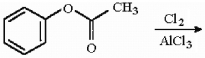
(Essay)
4.9/5 (83)
(83) Draw the two major resonance structures of the acylium ion which results when butanoyl chloride  is treated with AlCl3.
 (Essay)
4.8/5 (76)
(76) What intermediate is thought to occur in the elimination-addition nucleophilic aromatic substitution mechanism?
(Multiple Choice)
4.9/5 (74)
(74) List two of the three limitations usually associated with the Friedel-Crafts alkylation reaction.
(Essay)
4.8/5 (88)
(88) Provide the structure of the major organic product in the following reaction. 
(Essay)
4.8/5 (84)
(84) Which of the following compounds is least reactive in the nucleophilic aromatic substitution reaction with NaOH?
(Multiple Choice)
4.9/5 (71)
(71) 
In electrophilic aromatic substitution reactions the nitro group is:
(Multiple Choice)
4.8/5 (86)
(86) Provide the structure of the major mononitration product of the compound below. 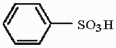
(Essay)
4.9/5 (81)
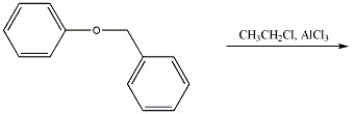
(81) Provide the structures of the major organic products in the following reaction. 
(Essay)
4.8/5 (65)
(65) Provide the structure of the major mononitration product of the compound below. 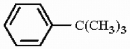
(Essay)
4.7/5 (79)
(79) 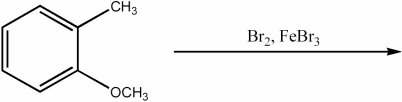
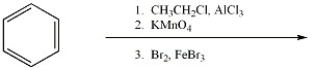
Provide a series of synthetic steps by which 2-bromo-4-nitrobenzoic acid can be prepared from toluene.
(Essay)
4.9/5 (84)
(84) Electrophilic iodination of benzene requires which reagent in addition to I2?
(Short Answer)
4.9/5 (65)
(65) Which of the following compounds will react most rapidly when treated with CH3CH2Cl and AlCl3?
(Multiple Choice)
4.8/5 (89)
(89) 
Filters
- Essay(0)
- Multiple Choice(0)
- Short Answer(0)
- True False(0)
- Matching(0)